Accession No
1838
Brief Description
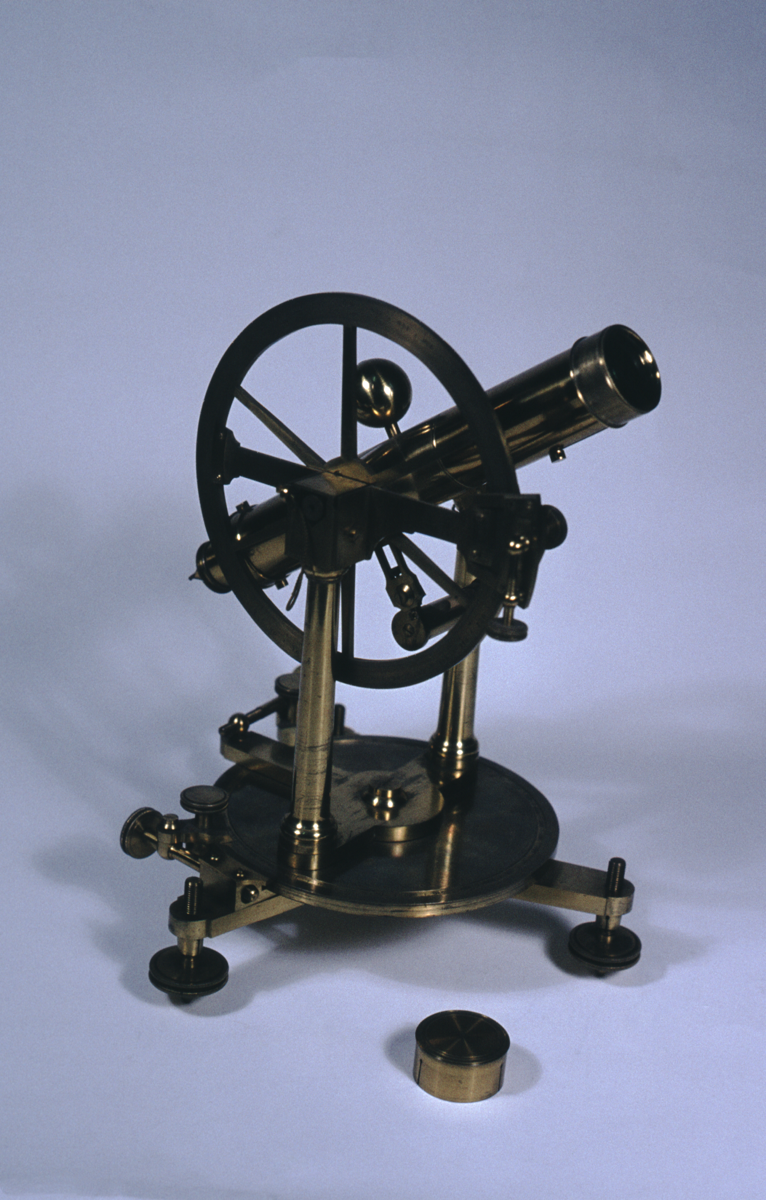
altazimuth instrument, by Dollond, English, 1790 (c)
Origin
England; London
Maker
Dollond
Class
astronomy
Earliest Date
1790
Latest Date
1790
Inscription Date
Material
metal (brass); glass; wood (mahogany)
Dimensions
height 280mm; length 200mm; breadth 195mm box height 360mm; breadth 230mm; depth 207mm
Special Collection
Heywood collection
Provenance
Purchased from the Professor Harold Heywood collection under estate duty exemption benefit with the assistance of a Science Museum grant-in-aid.
Inscription
‘Dollond London’
Description Notes
Telescope with achromatic object glass in threaded brass mount, push-fit cover, cross-hairs, 2-lens eyepiece with diagonal attachment. Transverse bubble level slung below telescope and screw-in spherical counterweight above. Vertical circle divided on brass 0 - 180˚ - 0, subdivided to 1˚ and to 30´; 2 verniers (centre zeros), clamp and tangent screws. Brass Ys with hinged covers with pins for holding covers closed. Double pillar stand, with clamp and tangent screws for setting to horizontal circle. Circle moved independently and has clamp ad tangent screws and type-B vernier on brass. Flat tribrach base with 3 levelling scews. Central securing screw with screw-fit cover. Eyepiece with long shade. Steel pin; small brass bar.
Fitted mahogany box with brass handle and key.
References
Events
Description
An altazimuth instrument is a telescope set on a mounting that can be moved both horizontally and vertically. It needs to be adjusted in both directions of movement at the same time in order to follow a star across the sky. It allows you to measure the position of a celestial object in altitude (height in the sky) and azimuth (degrees horizontally from north).
Altazimuth mounts are the earliest type of telescope mount. They have the disadvantage that you need to constantly adjust the position of the two axes in order to follow a celestial object across the sky as the earth rotates. However, since altazimuth mounts are easy to construct compared to equatorial mounts (which rotate parallel to the earth’s rotation), they are used in modern very large telescopes (where an equatorial mount would be far too heavy) and also for inexpensive commercial telescopes.
02/05/2008
Created by: Dr. Jenny Downes on 02/05/2008
FM:43761
Images (Click to view full size):