Accession No
4130
Brief Description
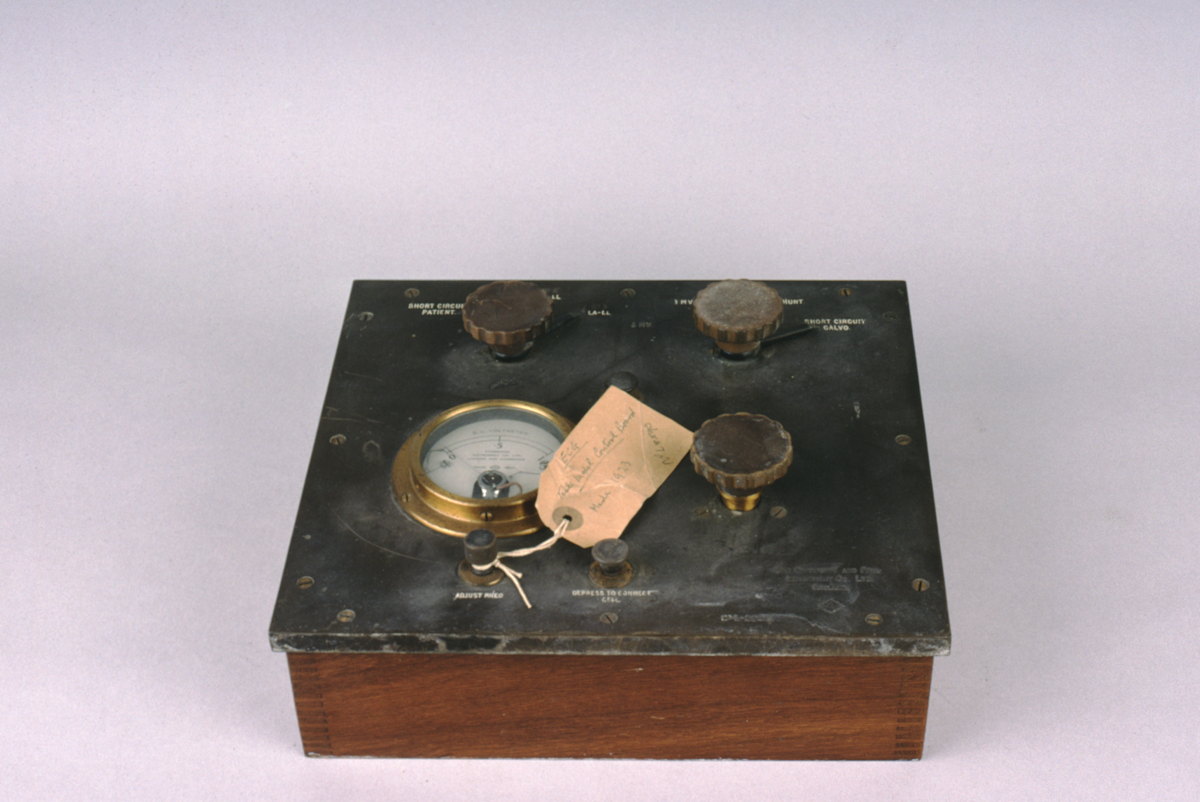
control panel for table electrocardiograph (ECG), by Cambridge and Paul Instrument Company Ltd. and Cambridge Instrument Company Ltd., English, voltmeter made 1923
Origin
England; London
Maker
Cambridge and Paul Instrument Company Ltd. Cambridge Instrument Company Ltd.
Class
medical
Earliest Date
1923
Latest Date
1923
Inscription Date
Material
metal (brass, 2 types of white metal); glass; plastic (bakelite, at least 2 others); card; wood
Dimensions
breadth 330mm; height 301mm; depth 140mm
Special Collection
Cambridge Instrument Company Collection
Provenance
Donated by the Cambridge Instrument Company.
Inscription
‘The Cambridge and Paul
Instrument Co. Ltd.,
England.’
‘CAMBRIDGE
INSTRUMENT CO. LTD.,
LONDON AND CAMBRIDGE’ (voltmeter)
Description Notes
Rectangular wooden casing (back missing, so revealing electrical connections). Bakelite front plate. Glazed voltmeter set in brass, scale divided 0 - 1, numbered by 0.5; dial for selecting the electrodes; dial for setting voltage; unmarked dial; push-button marked ‘depress to insert 4000 ohms’; push-button marked ‘depress to connect cell’; further dial marked adjust rheostat.
Condition fair; incomplete (backboard missing).
References
Events
Description
An electrocardiograph is a medical instrument that records the electrical activity of the heart. Physiologists discovered the electrical wave that accompanies the human heart beat at the end of the 19th Century and Dr Willem Einthoven designed an electrocardiograph using a string galvanometer to practically and precisely record it in 1903. It would eventually revolutionise the study of the heart and massively improve the treatment of heart disease. However, the original design was large and awkward - filling a room, weighing over 650lbs, and requiring patients to immerse their limbs in saltwater baths to transmit the heart's electrical current.
Dr Einthoven approached Cambridge Scientific Instrument Company to manufacture a marketable electrocardiograph and the Company proceeded with the redesign of the instrument. It completed its first full electrocardiograph in 1908. The Company continued to improve the electrocardiograph and make it smaller, but its design remained fundamentally unchanged for decades.
This is a control panel for a large table electrocardiograph, which was large and immobile and inconveniently, required patients to be brought to the machine.
20/03/2020
Created by: Morgan Bell on 20/03/2020
Description
An Electrocardiograph is a medical instrument that detects, displays, and records the electrical activity of the heart over a period of time, normally using electrodes attached to the surface of the skin. Its main use is to measure the rhythm of heart contractions and the relative strength of different parts of the heart muscle.
This is a control panel for a large table electrocardiograph.
FM:44097
Images (Click to view full size):