Accession No
3381
Brief Description
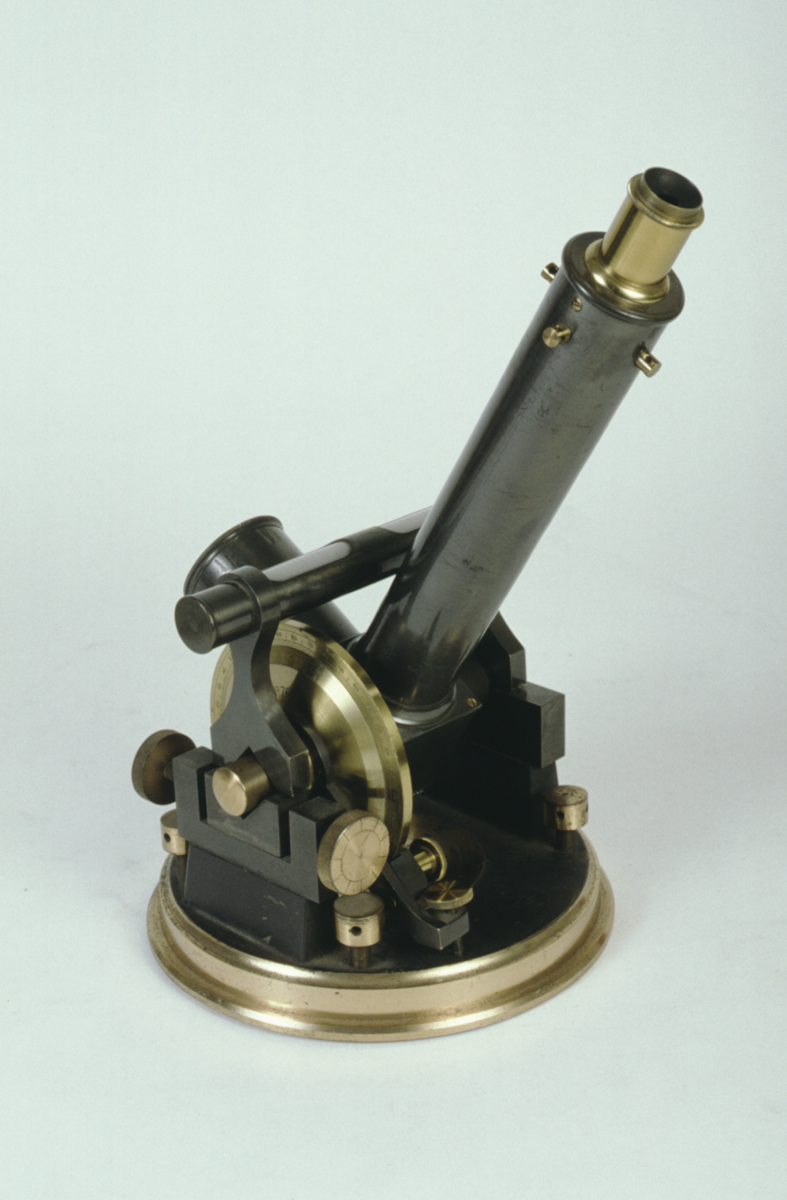
window-sill transit, Latimer Clark's patent, by A. J. Frost, English, 1884
Origin
England; London; 6 Westminster Chambers
Maker
Frost, A. J.
Class
astronomy
Earliest Date
1884
Latest Date
1884
Inscription Date
1884
Material
metal (brass, oxidised brass); glass; wood
Dimensions
box length 343mm; breadth 190mm; height 154mm
Special Collection
Provenance
Purchased, 1986.
Inscription
‘LATIMER CLARK’S
PATENT
A.J. FROST FECIT.
1884. No 768
6, WESTMINSTER CHAMBERS. LONDON’ (centre of base)
Description Notes
Brass base with adjustable screw feet, the cardinal points marked in the centre, and supports for the instrument, one of which can be adjusted using two horizontal screws. Main instrument is made of oxidised brass; objective tube at right angles to eyepiece tube; mounted on trunions; degree scale with screw clamp on one side. Oxidised brass spirit level can be placed across the trunions. Contained in a fitted wooden case.
Condition: good (glass on level cracked); complete.
References
Events
Description
In the nineteenth century accurate watches were available, but it was difficult to check that your watch was showing the right time. Instrument makers made transit instruments that helped people to do this by observing the sky. They were cheap, and easy for someone without much knowledge of astronomy to use.
The transit instrument is a telescope that can only move in one plane and has cross-wires in its eyepiece. This one was made in London in 1884, and is designed to be set up on a window-sill. If you set it up facing South, you can observe the exact point at which the sun, or a star, crosses the observer’s meridian (a line imagined to run north to south across the sky directly above the observer’s head).
Before the nineteenth century, most people used local time (so noon in Plymouth, for example, would be a few minutes later than noon in London). Standardised and precise timekeeping became more important as the railways and telegraph systems ran to exact schedules all across the country. Railway stations and telegraph offices had clocks set to Greenwich Mean Time, but if you lived in the country you still had to use the sun or stars to regulate your watch. If you used the transit instrument to measure local noon precisely, you could then add the difference between noon at your location and noon in Greenwich to set your watch to the exact time as used all over Britain.
02/05/2008
Created by: Dr. Jenny Downes on 02/05/2008
FM:44122
Images (Click to view full size):