Accession No
1364
Brief Description
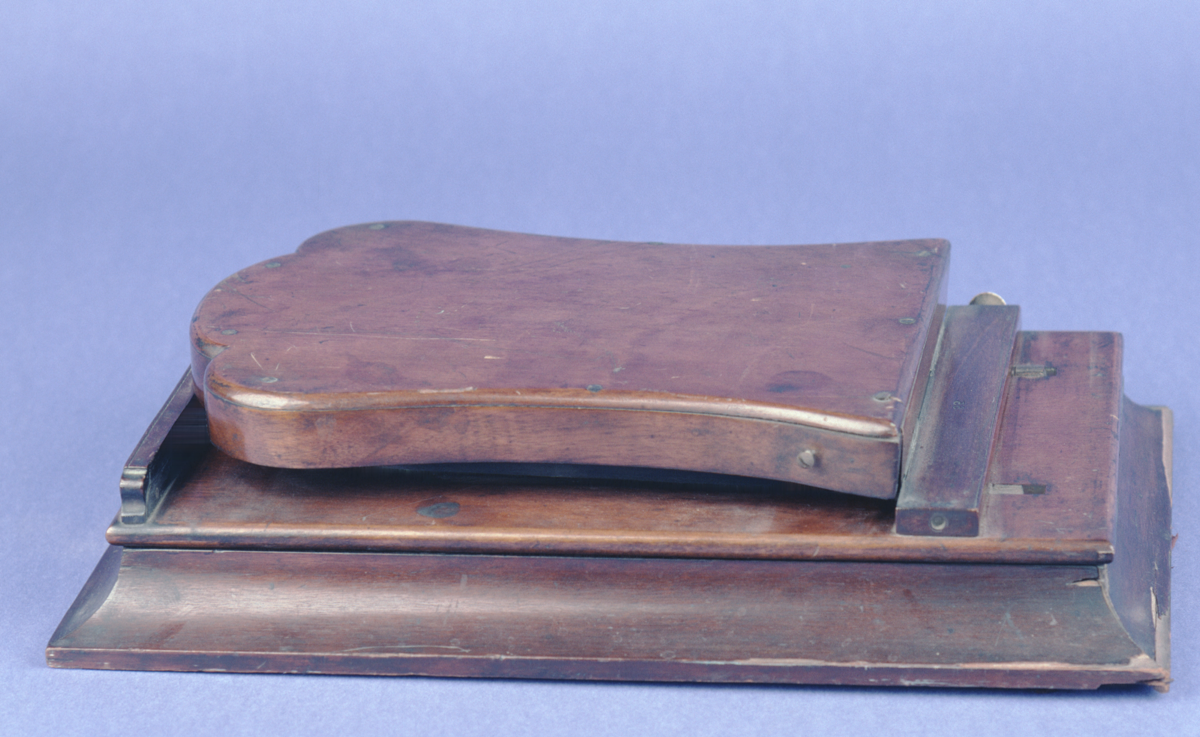
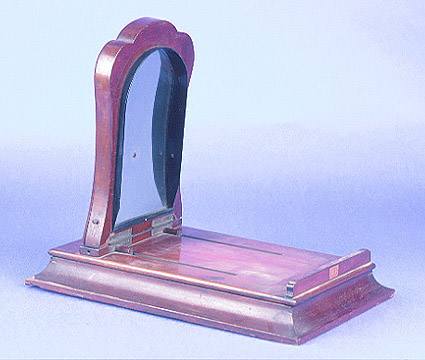
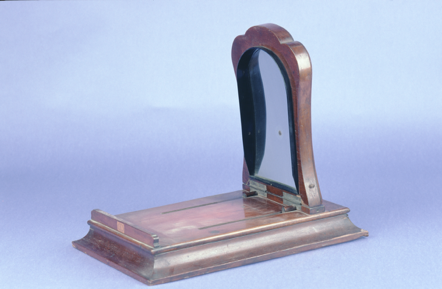
graphoscope, by Philip Carpenter, English, 1826-1833
Origin
England; London
Maker
Carpenter, Philip
Class
optical
Earliest Date
1826
Latest Date
1833
Inscription Date
Material
wood (mahogany); metal (brass); glass
Dimensions
length 400mm; breadth 248mm; height 87mm
Special Collection
Provenance
Inscription
‘BY HER MAJESTYS ROYAL LETTERS PATENT
LONDON’
Description Notes
Mahogany base and frame. Hollow base with hinged top. Fretwork hinged support fits into brass ‘ladder’ supporting top at variety of angles. 2 slots in top for hinged shaped frame for concave mirror.
References
Events
Description
Stereoscope
Sir Charles Wheatstone, 1838 (popularised by Oliver Wendell Holmes, 1881)
The graphoscope resembled the common magnifying glasses in many ways. It was usually composed of a single lens that served to magnify whatever small picture was placed on the easel. Later versions, called stereographoscopes, had two or three lenses and allowed people to see stereographic views. These optical toy’s names were derived from the Greek 'scope' for viewing.
Stereoscopes were one of the most popular forms of entertainment in the late 1800s and early 1900s. Wheatstone had experimented with simple stereoscopic drawings in 1832, several years before photography was invented. Later, the two principles were combined to form the stereoscope.
A stereoscope is composed of two pictures mounted next to each other, and a set of lenses to view the pictures through. Each picture is taken from a slightly different viewpoint that corresponds closely to the spacing of the eyes. The left picture represents what the left eye would see, and likewise for the right picture. Early stereo photographs were taken with a camera mounted on a tripod with a sliding bar. Once the first picture was taken and a new photographic plate was inserted, the camera was moved about 7 cm along the bar (approximately adult eye spacing). Then, the second picture was taken. When observing the pictures through a special viewer, the pair of two-dimensional pictures merge together into a single three-dimensional photograph. This phenomenon had been known for quite some time, ever since the ancient Greek mathematician Euclid discovered the principles of binocular vision.
FM:44193
Images (Click to view full size):