Accession No
4095
Brief Description
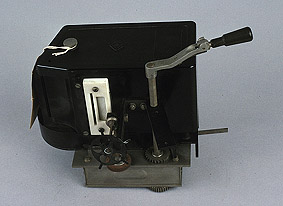
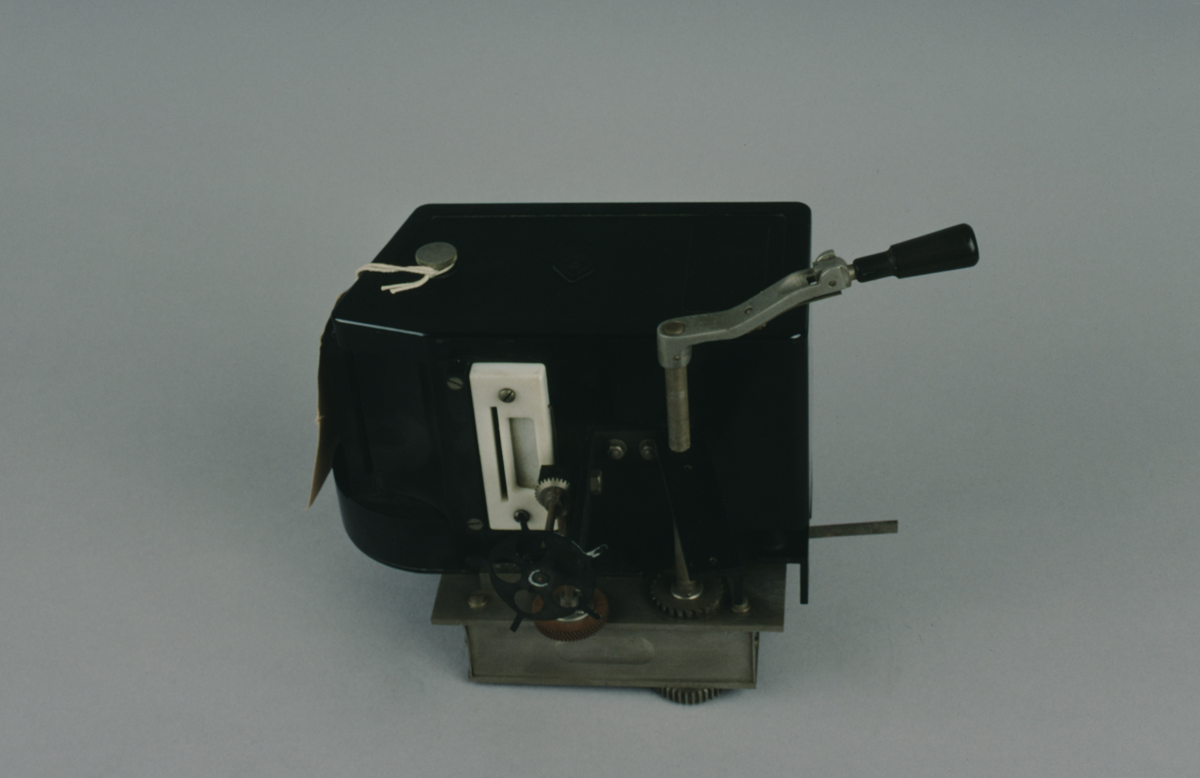
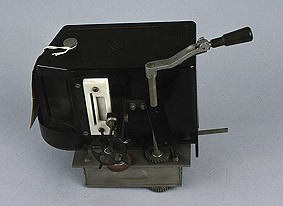
camera and clockwork for a suitcase Portable electrocardiograph (ECG), by Cambridge Instrument Company Ltd., England, mid-20th Century
Origin
England
Maker
Cambridge Instrument Company Ltd.
Class
medical
Earliest Date
1936
Latest Date
1952
Inscription Date
Material
metal (at least 4 types); glass; plastic (at least 3 types)
Dimensions
length 225mm; breadth 250mm; height 170mm
Special Collection
Cambridge Instrument Company Collection
Provenance
Donated by the Cambridge Instrument Company.
Inscription
Description Notes
Black plastic camera box with white metal clockwork mechanism set on one side of it. The clockwork is wound by a white metal crank with plastic handle. Mirror set into front plate of camera, and in front of this a wheel with five circular apertures, each linked to a protruding spike. This wheel is operated by the clockwork and acts to provide a time marker on the print-out. Door in one end of the camera to allow the amount of film remaining to be checked; marked ‘feet unused’ with the numbers 0, 10, 20, 30, 40 and 50.
Condition fair
References
Events
Description
By the early 1920s, the Cambridge Standard Electrocardiograph had become an established clinicial tool; however, demands on the use of the machine forced designers to modify the instrument. There were three problems in particular: the instrument was sensitive to vibrations (though this was later disproven), considerable skill and training was required for the successful operation of the machine, and lastly, the instrument was extremely heavy. In order create a more mobile apparatus for use in hospital wards, a trolley-mounted version of the Standard was developed. The instrument’s success as a diagnostic tool eventually led to the re-design of electrocardiograph as a portable instrument that could be carried by a medical practitioner.
08/07/2014
Created by: Allison Ksiazkiewicz on 08/07/2014
FM:44355
Images (Click to view full size):