Accession No
2223
Brief Description
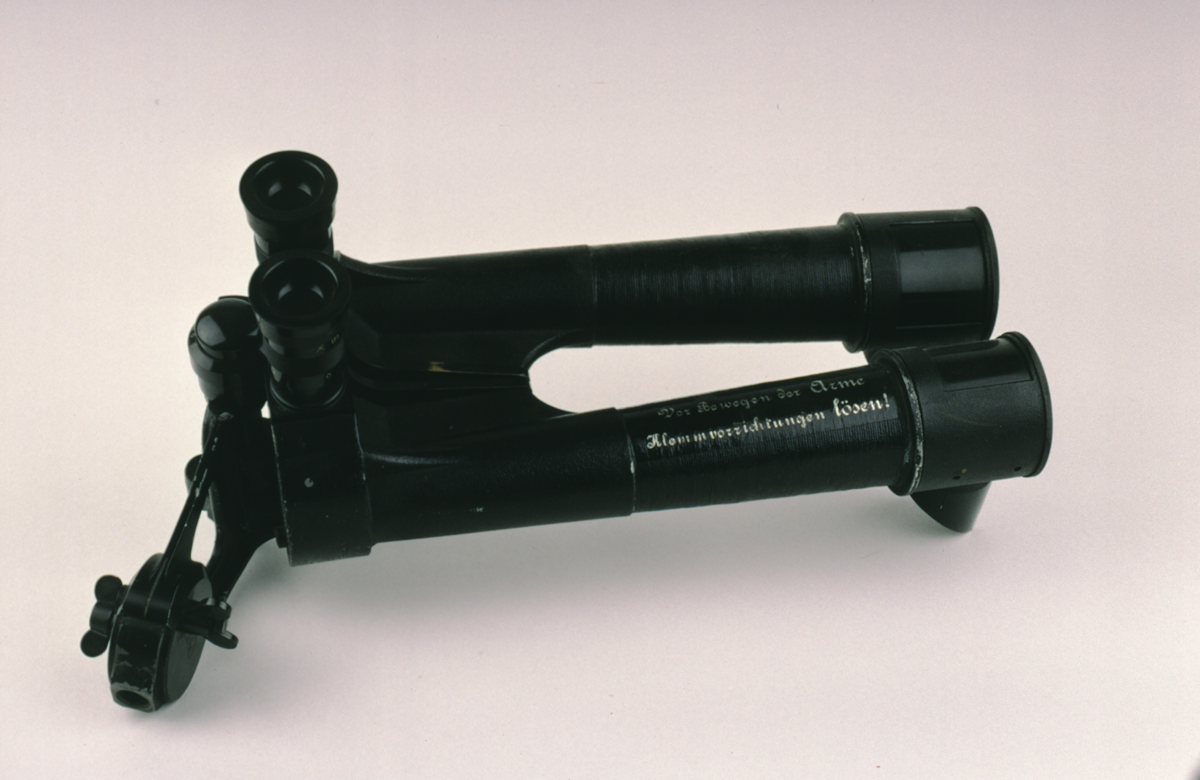
binocular periscope, by Carl Zeiss, German, 1915 (c)
Origin
Germany; Jena
Maker
Carl Zeiss
Class
optical; military
Earliest Date
1915
Latest Date
1915
Inscription Date
Material
metal (alloy)
Dimensions
height 540mm; depth 230mm; breadth 190mm
Special Collection
Provenance
Transferred from Department of Geography, University of Cambridge, Cambridge, England, 05/1969.
Inscription
‘CARL ZEISS JENA
Vor Bewegen der Arme
Klemmvorrichlungen losen!’
Description Notes
Metal alloy. Black finish. Hooded objectives, adjustable eyepieces. Clamp round axis for attachment to support.
References
Events
Description
The first ‘pair of binoculars’ were two telescopes fixed together by a metal bridge. Whilst the telescope was invented in the 17th century binoculars were only developed from the early 19th century onwards.
The earliest commercially successful binoculars were opera glasses produced by Voigtlander in 1823. Opera glasses
combined two telescopes to give limited magnification. To see with greater magnification would have required telescopes inconveniently long. Rather than use the long telescope optical ‘folding’ was employed within the tube, making it shorter and broader.
Optical ‘folding’ was first carried out using mirrors. Light rays travelling through the telescope tube are made to fold back twice (see diagram) on contact with the mirror. However, some light is lost when reflected from the surface of a mirror. To overcome this problem Ignazio Porro (1801-1875) developed the prismatic binocular. Here optical ‘folding’ is achieved by the arrangement of glass prisms (A prism is a block of clear glass usually in a triangular shape). The more powerful prismatic binoculars were first produced by the manufacturer
Zeiss in 1894. The prismatic binocular ‘field glasses’ became a conventional military item from the end of the 19th century onwards.
Binoculars, whether ‘opera glasses’ or ‘field glasses’ (for marine and racing use) continue to be popular today.
01/03/2001
Created by: Chris Lewis on 01/03/2001
FM:44634
Images (Click to view full size):