Accession No
2085
Brief Description
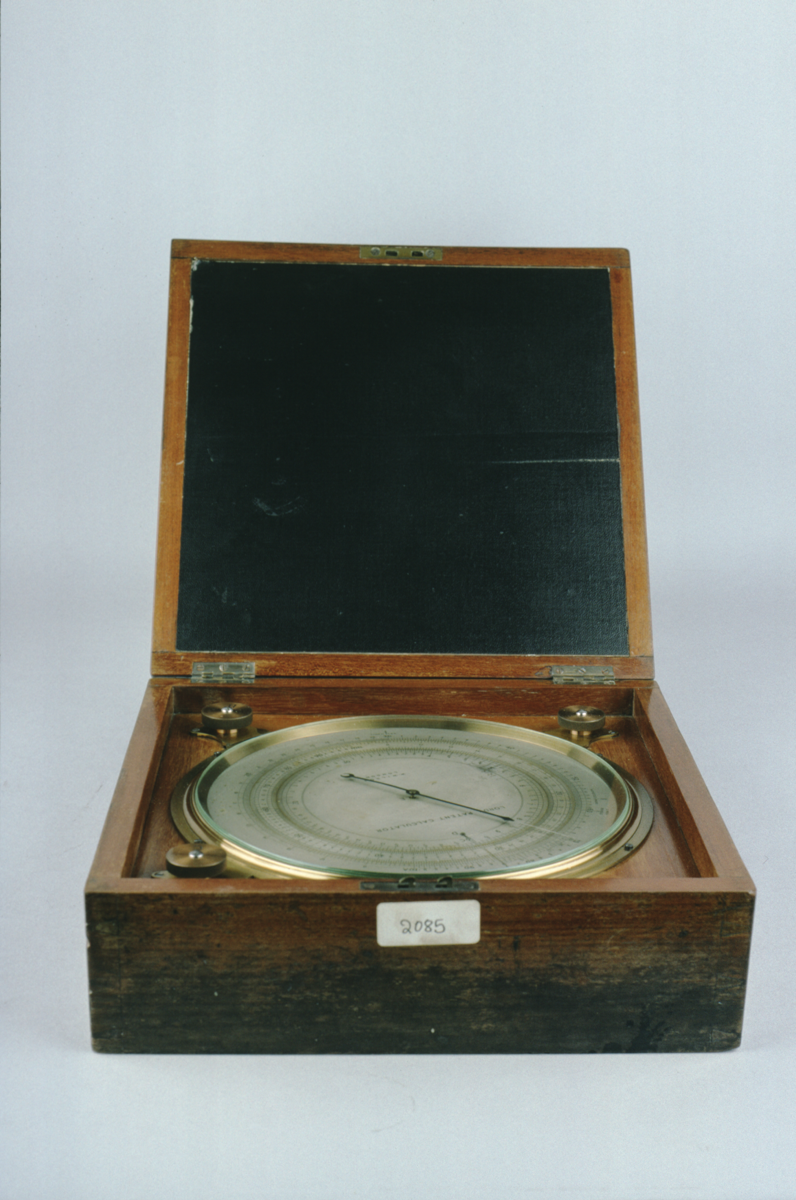
circular slide rule, by W. Wilson, English, c. 1892
Origin
England; London
Maker
Wilson, William
Class
calculating
Earliest Date
1892
Latest Date
1892
Inscription Date
Material
wood (mahogany); metal (brass, 2 types of white metal); glass; paper
Dimensions
box length 325mm; breadth 325mm; height 124mm
Special Collection
Provenance
Purchased from P. Delehar, London, England, 16/7/1975.
Inscription
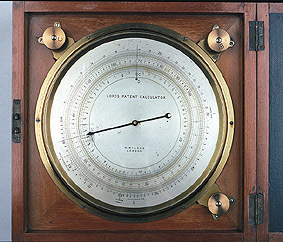
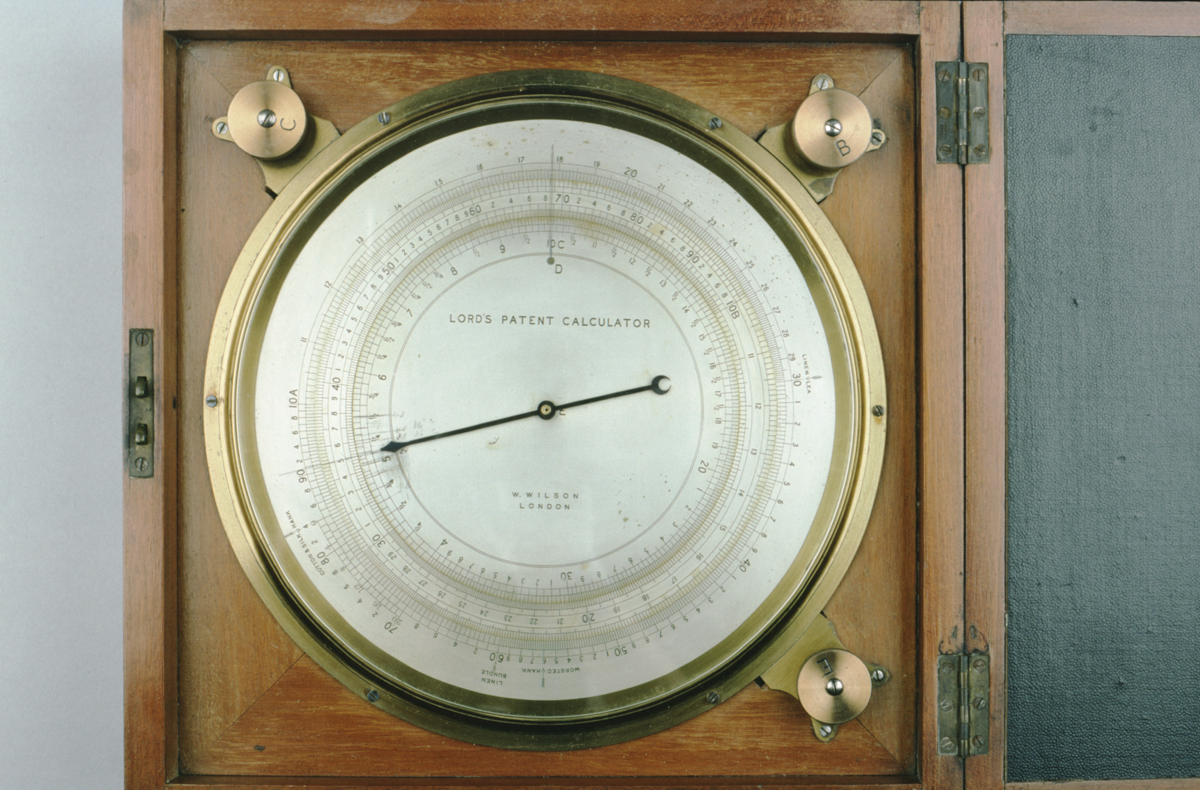
‘LORD’S PATENT CALCULATOR
W.WILSON
LONDON’ (centre of dial)
Description Notes
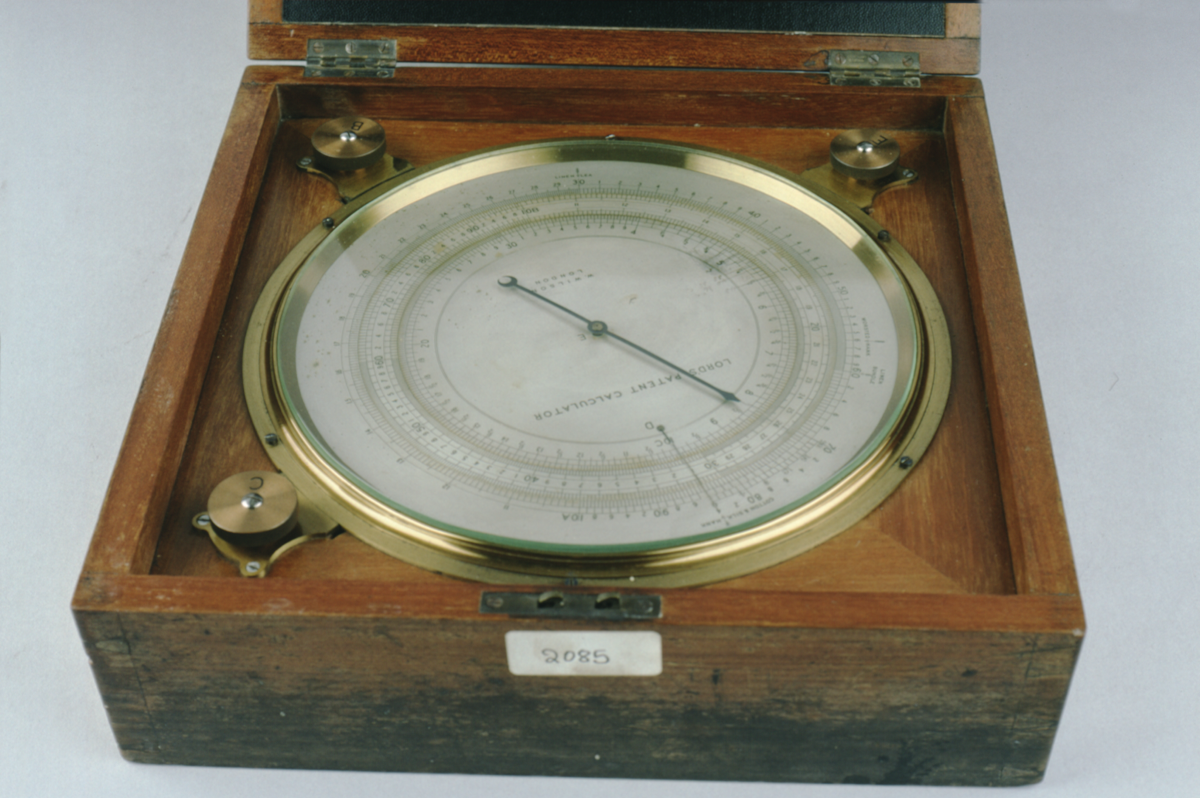
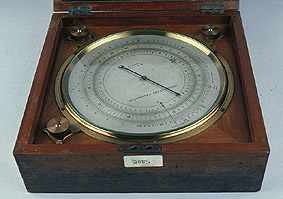
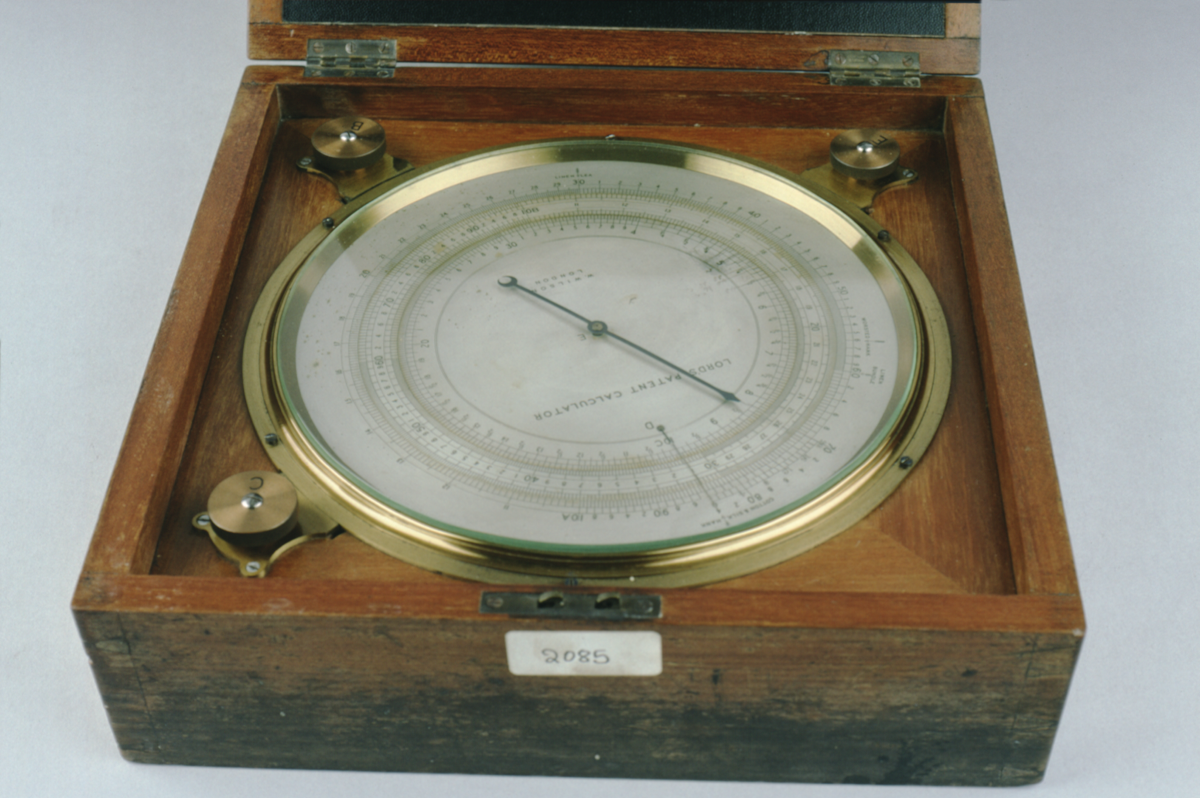
Mahogany box with hinged lid cut on the slant, so that the whole forms a single angled plane when open, akin to portable writing bureau; brass hinges and lock (no key). Inside of lid is covered with black paper in simulated leather form to act as a writing surface. Set into the main part of the box is a glazed circular white metal slide rule in brass mount. Fixed outer circle is marked ‘A’ and has a logarithmic scale divided 10 - [100], numbered 10, 11...60, 62...98; between 70 and 84 there is a reversed scale divided 0 - 20, numbered by 4, subdivided to 1; arrows indicate ‘worsted hank’ ‘linen bundle’, ‘cotton & silk hank’ and ‘linen lea’. Within ‘A’ is a ring marked ‘B’, which can be rotated by means of a brass knob set outside the rule; the scale is divided as before (without the reversed scale or the arrows). The central disc is also rotatable and is marked ‘C’; it has a logarithmic scale divided 4 - [40]. A pointer marked ‘D’ is attached to the central circle at 10 on the C scale, and extends over all three scales. A larger rotatable pointer marked ‘E’ is pivoted at the central point of the rule.
Condition good; complete.
References
Events
Description
This instrument is a circular slide rule, a variation on the most common type, also shown in this drawer, and described below.
Developed during the seventeenth century, the modern slide rule is based upon the design by William Oughtred (circa 1630). It is one of many calculation devices that is based on the logarithmic scale, a calculation method invented in 1614 by John Napier.
Before the rise of the pocket electronic calculator in the 1970s, the slide rule was the most common tool for calculation used in science and engineering. It was used for multiplication and division, and in some cases also for ‘scientific’ functions like trigonometry, roots and logs, but not usually for addition and subtraction.
A logarithm transforms the operations of multiplication and division to addition and subtraction according to the rules log(xy) = log(x) + log(y) and log(x/y) = log(x) - log(y). The slide rule places movable logarithmic scales side by side so that the logarithms of two numbers can be easily added or subtracted from one another. This much simplifies the alternative process of looking up logs in a table, thus greatly simplifying otherwise challenging multiplications and divisions. To multiply, for example, you place the start of the second scale at the log of the first number you are multiplying, then find the log of the second number you are multiplying on the second scale, and see what number it is next to on the first scale.
Circular slide rules allow the longest dimension to be reduced by a factor of about 3 (i.e. π).
FM:44648
Images (Click to view full size):