Accession No
2399
Brief Description
calculating machine by the Marchant Calculating Machine Company, 1947.
Origin
Oakland; California; USA
Maker
Marchant Calculating Machine Company
Class
calculating
Earliest Date
1947
Latest Date
1947
Inscription Date
Material
metal (at least 3 types); rubber; plastic (at least one type); cloth
Dimensions
length 360mm; breadth 321mm; height 215mm
Special Collection
Provenance
Transferred from Dept of Geology, University of Cambridge, Cambridge, England, 06/12/1978. Bought by P. Allen of the Geology Department in 1947
Inscription
‘MARCHANT CALCULATING MACHINE COMPANY, Inc.
OAKLAND, CALIFORNIA, U.S.A.’ (label on underside of instrument)
Description Notes
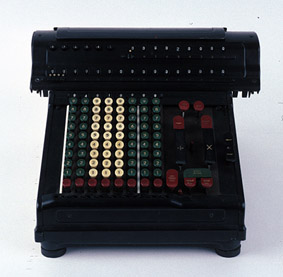
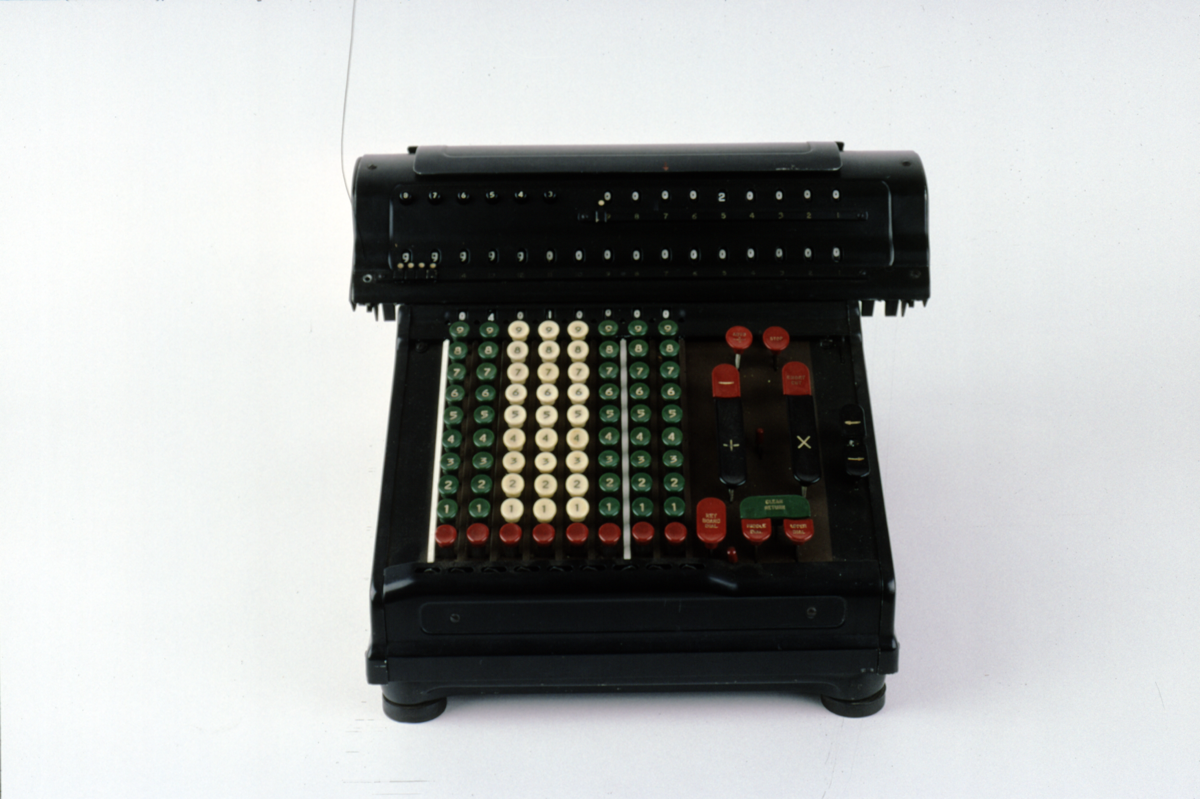
Black-painted metal casing. Main front of machine carries array of eight columns of keys running from 0 (not marked) to 9. To the right of this array are keys for addition, subtraction, multiplication and ‘auto division’, also ‘stop’, ‘short cut’, ‘clear/return’, ‘middle dial’, ‘upper dial’ and ‘keyboard dial’. Numbers entered on the main array are registered in a the dial set immediately above them. A carriage is set above the main machine and carries two further displays or ‘dials’. The middle dial registers the end result,and the upper dial registers numbers used during the operation. A set of six carriage setting buttons are situated on the left hand side of the carriage, and these govern the point to which the carriage returns. Decimal points are marked by sliding indices below the dials.
Cloth dust cover in poor condition.
Condition good; complete.
References
Events
Description
Calculating machine
A calculating machine could be any machine that adds, subtracts, multiplies or divides. Before about 1820, they were solely produced as marvels and were not sufficiently developed to be of practical use. Direct multiplication was only possible in 1895, and had immediate time-saving application, particularly in the work of insurers and astronomers.
Numbers were represented digitally, with various different methods of entry. Earlier examples usually used rotating wheels with pins protruding. The pins were linked to a weight which fell and registered the number. Later examples were key driven.
18/10/2002
Created by: Saffron Clackson on 18/10/2002
FM:44699
Images (Click to view full size):