Accession No
2837
Brief Description
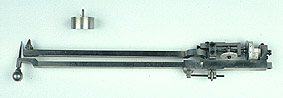
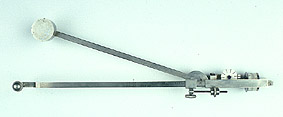
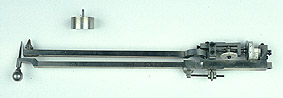
planimeter, by Stanley, English, 1900 (c)
Origin
England; London; Great Turnstile
Maker
Stanley
Class
calculating; drawing
Earliest Date
1900
Latest Date
1900
Inscription Date
Material
metal (steel); plastic; wood; hide (leather); cloth (velvet)
Dimensions
box length 285mm; breadth 55mm; height 33mm
Special Collection
Provenance
Purchased from Christie’s, South Kensington, London, England; lot 203, 29/04/1982.
Inscription
Description Notes
Leather-covered fitted wooden box lined with blue velvet.
Steel planimeter with fixed arm and mobile arm, each with point at the end away from the hinge. Knurled screws for adjustment of the moveable arm, one with drumhead scale andtype-B vernier. Tracing arm engraved 1 dcm/0.1 f/2000 m 1:500/10 in/ 0.5 dcm/ 1000 m 1:500. Values for conversion between metric and imperial units and between scaled maps and actual measurements given on arms of instrument.
Separate drumhead weight sits on mobile arm.
Condition
References
Events
Description
Planimeters are mechanical instruments designed to solve the common problem of computing the area of an irregular closed shape. The first instrument designed to do this was made by J.M. Hermann, a Bavarian engineer, in 1814. Tito Gonella of Florence independently invented a similar instrument in 1824 using a wheel and cone arrangement.
FM:44707
Images (Click to view full size):