Accession No
2943
Brief Description
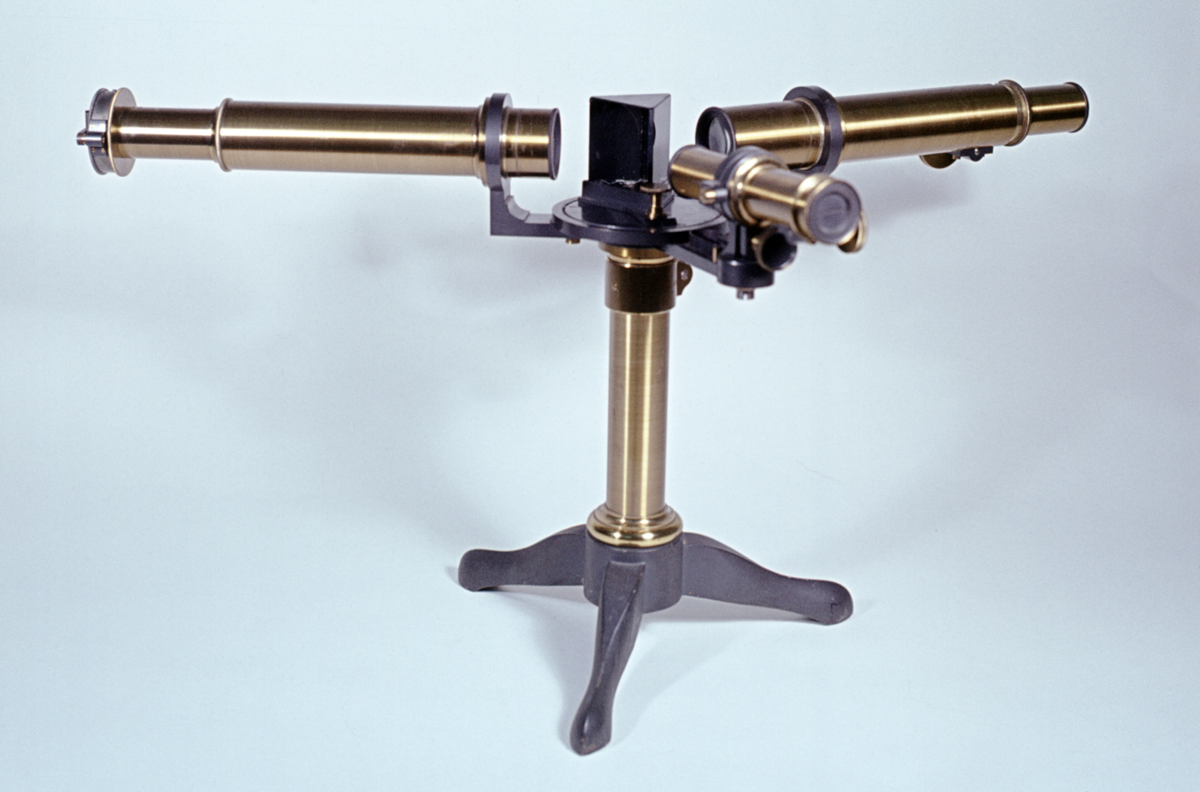
spectroscope, by Laurent, French, 1875-1900 (c)
Origin
France; Paris; Rue de l’Odeon
Maker
Laurent
Class
optical
Earliest Date
1875
Latest Date
1900
Inscription Date
Material
metal (brass, steel, oxidised brass); glass; lacquer
Dimensions
length 614mm; breadth 270mm; height 340mm
Special Collection
Provenance
Purchased from Historical Technology Inc., Masssachustts, USA; Catalogue 124, Fall 1982, No 217, 25/02/1983.
Inscription
‘Laurent
Rue de l’Odeon
Paris’
Description Notes
Brass table stand spectroscope. Push-fit steel cover to slit with central aperture with reflecting prism on pivoted arm. Slit with steel jaws in oxidised brass mount, width adjustable by knurled screw, on push fit draw tube. Collimator. Stage with prism on oxidised mount secured to stage by knurled screw. Telescope pivots around stage, with clamp, rack and pinion focus moved by knurled knob, with linear scale divided 0-6 to 0.1, screw-fit eyepiece. Second collimator for reference spectrum, rotatable slit, rack and pinion focus with linear scale divided 0-8 to 0.1, tube adjustable laterally and about horizontal axis, by knurled screws moving against springs. All 3 optical tubes screw into brackets mounted with stage. Column, with clamp, tripod stand with cabriolet feet. Optic tubes and column lacquered, the rest oxidised.
References
Events
Description
In 1814 Joseph von Fraunhofer noticed that the sun’s spectrum, when dispersed by a glass prism, is crossed by hundreds of fine dark lines. These lines could be used to determine the chemical composition of the sun, stars and many other substances by spectral analysis. The first photograph of the spectrum of a star (Vega) was made by Henry Draper using a spectroscope in 1872.
There are various different forms of spectroscope, but all use a slit and collimator to make a parallel beam of light, a prism for dispersing different wavelengths and a telescope to observe the dispersed spectrum.
This is the most unusual form of late nineteenth century spectroscope. The collimator on the right passes the light via a slit to the prism, which disperses the light and this is observed by the telescope on the left. The second collimator is used to project a standard spectrum into the telescope simultaneously for comparision with the spectrum being analysed.
18/10/2002
Created by: Saffron Clackson on 18/10/2002
FM:44743
Images (Click to view full size):