Accession No
3060
Brief Description
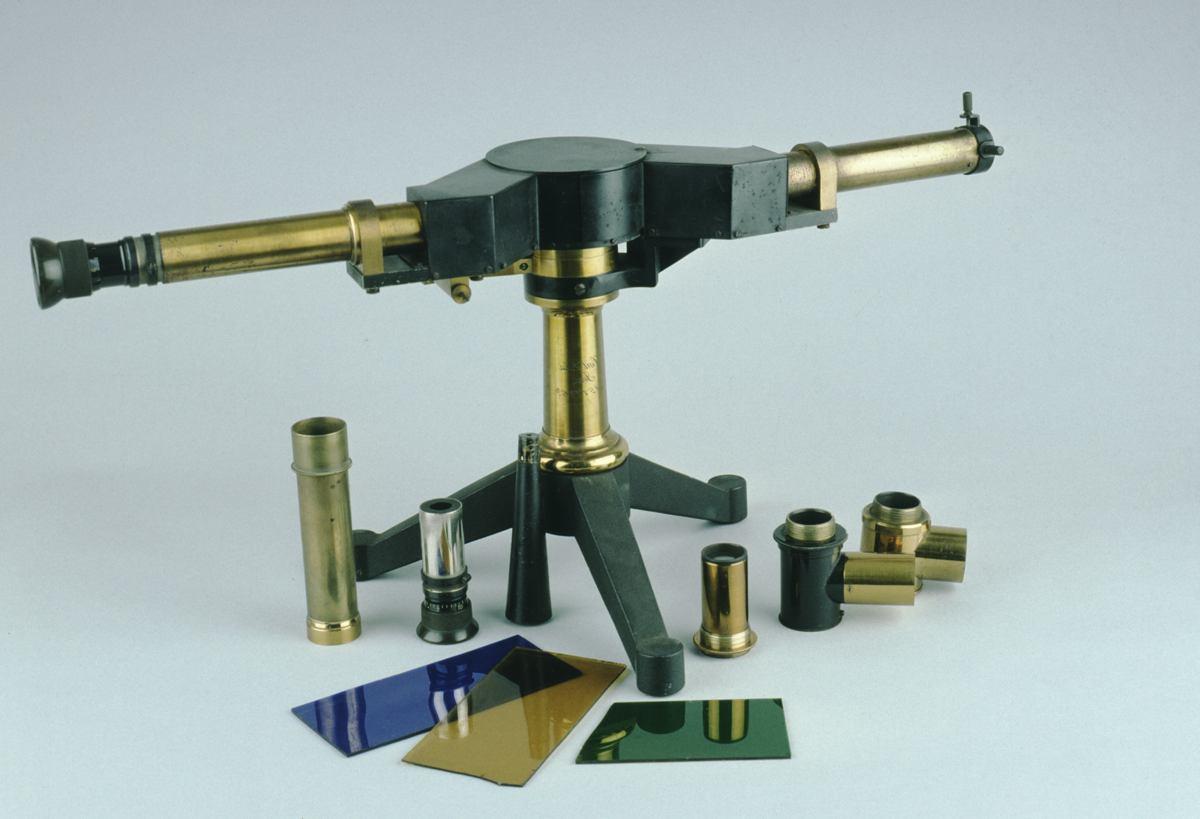
spectroscope, by Carl Zeiss, German, 1902
Origin
Germany; Jena
Maker
Carl Zeiss
Class
optical
Earliest Date
1902
Latest Date
1902
Inscription Date
Material
glass; metal (brass, other); wood (pine)
Dimensions
box breadth 360mm; height 390mm; depth 365mm
Special Collection
Steward collection
Provenance
Collection purchased from member of the Steward family, 1974.
Inscription
‘Carl Zeiss.
Jena.
No 1776’ (on pillar)
‘Carl Zeiss, Jena. Orthoshop Ocular F 5mm’ (on one eyepiece)
Description Notes
Glazed slit adjustable by 3 screws. Brass collimator. Metal cased prism system. Brass telescope, rotating about central pivot, with clamp and tangent screws and pointer moving across 8 positions marked: “A a B C D E F G”, sliding focus and screw focus eyepiece, graduated. Mounted on brass pillar with cast tripod stand. Accessories include 3 eyepieces, 2 brass connecting tubes and 2 right angle reflecting pieces one with plane (unsilvered) glass. Pine box.
Maker’s invoice showing date of instrument (now in file).
References
Events
Description
Spectroscope
In 1814 Joseph von Fraunhofer noticed that the sun’s spectrum, when dispersed by a glass prism, is crossed by hundreds of fine dark lines. These lines could be used to determine the chemical composition of the sun, stars and many other substances by spectral analysis. The first photograph of the spectrum of a star (Vega) was made by Henry Draper using a spectroscope in 1872.
There are various different forms of spectroscope, but all use a slit and collimator to make a parallel beam of light, a prism for dispersing different wavelengths and a telescope to observe the dispersed spectrum.
18/10/2002
Created by: Saffron Clackson on 18/10/2002
FM:44871
Images (Click to view full size):