Accession No
2050
Brief Description
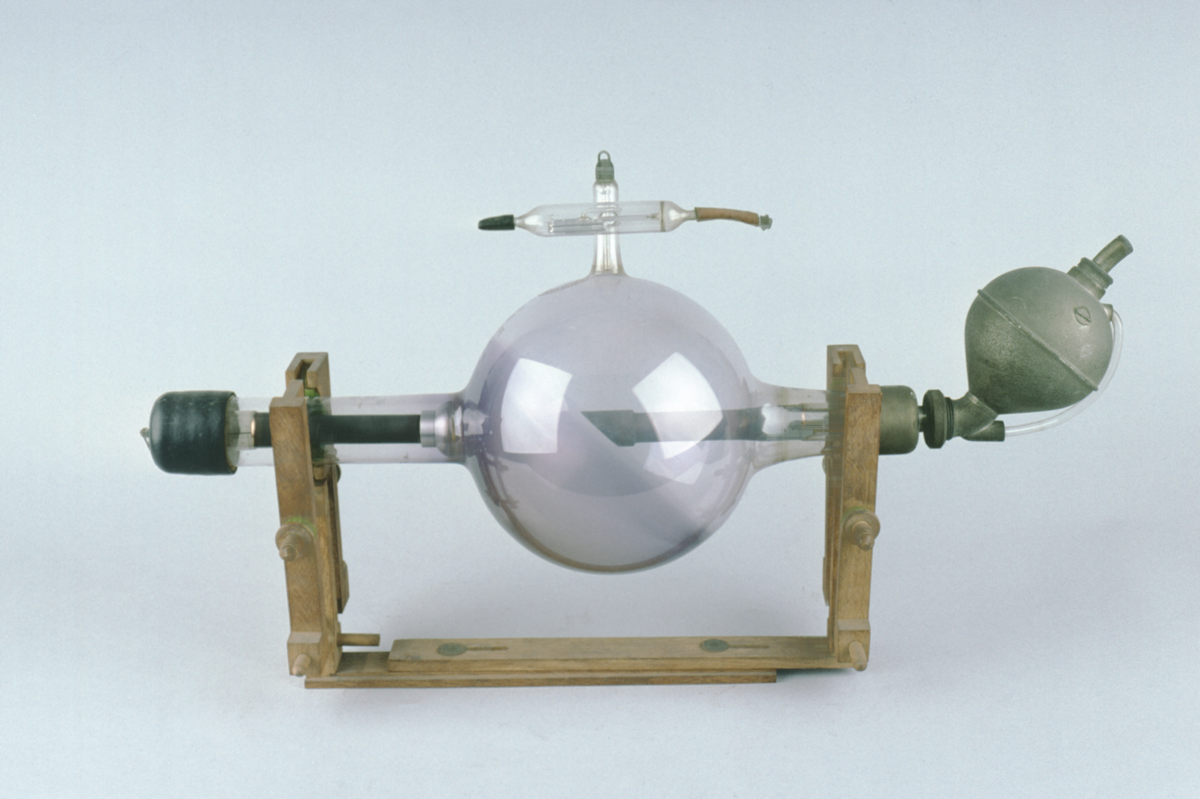
Series 12 Müller type X-ray tube, by Müller Röntgenröhre, sold by Cuthbert Andrews, German, early 20th Century
Origin
Germany
Maker
Müller Röntgenröhre Cuthbert Andrews [seller]
Class
physics
Earliest Date
1900
Latest Date
1940
Inscription Date
Material
glass; metal (brass, white metal, 3 others); wood; cloth (felt)
Dimensions
length 670mm; breadth 210mm; height 365mm
Special Collection
Cavendish collection
Provenance
Transferred from Cavendish Laboratory, University of Cambridge, 09/1974.
Inscription
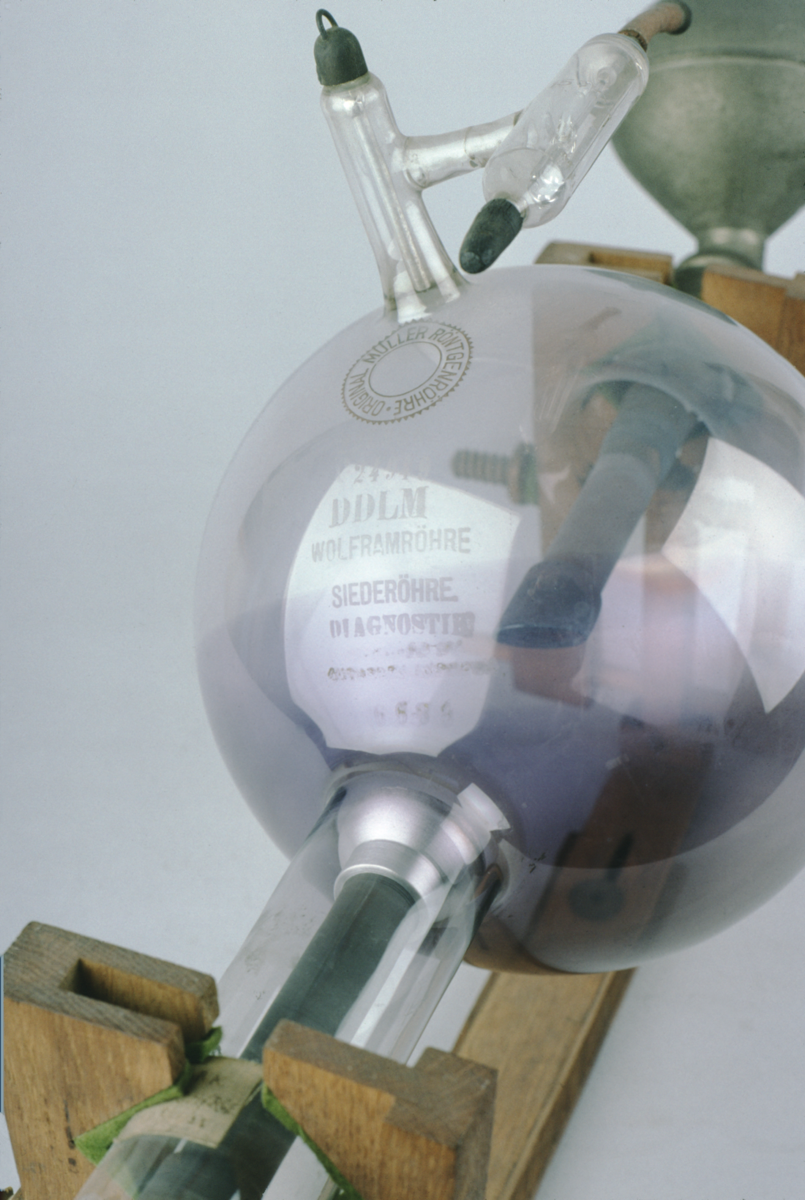
‘ORIGINAL MÜLLER RÖNTGENRÖHRE’ (on glass sphere)
‘227986
C24949
DDLM
WOLFRAMRÖHRE
SIEDERÖHRE
DIAGNOSTI[C?]
[ONLY SOLD BY
CUTHBERT ANDREWS]
6688’ (on glass sphere)
Description Notes
Glass sphere with 2 side-arms. One arm contains cathode, wih spherical inner end. End of side-arm has metal cap. Other side arm with inclined target. End of side-arm has brass cap and also a brass sphere with external glass tubing, used to water-cool the instrument. Top of glass sphere carries short arm with regulator (?). On contemporary wooden stand, partially lined with green felt.
Condition fair; complete
References
Events
Description
Used at Cambridge's Cavendish Laboratory of Experimental Physics in the early 20th century, this commercially-manufactured X-ray tube reveals the ways in which new discoveries could become profitable businesses.
Hamburg-based glass-blower C.H.F. Müller began with fine art glass, but his eye for a commercial opportunity led him into scientific glassware. He produced some of Europe's first Edison light-bulbs, and then, in 1896, rapidly perfected a design for an X-ray tube just weeks after Wilhelm Röntgen announced their discovery. Working closely with physicians, he was able to corner the market.
By 1909, Müller was the pre-eminent X-ray manufacturer in Europe, and eyeing up an expansion into England. He appointed Londoner Cuthbert Andrews to manage his first UK factory, staffed by glassblowers relocated from Hamburg. While Andrews was not a glass-maker himself, he had helped run an early X-ray service for London hospitals, taking equipment where it was needed by horse-drawn carriage, and sold Müller's German-made products. Müller (London) was seized at the start of World War 1, and Andrews purchased the business.
10/07/2025
Created by: Hannah Price on 10/07/2025
Description
This X-ray tube was originally used by physicists at the Cavendish Laboratory of Experimental Physics in the early 20th century.
In November 1895, Wilhelm Röntgen was experimenting with a Crookes' tube in his laboratory in Würzburg. He observed that the radiation he was producing could pass through some substances but not others. But why wasn't clear. He named the new rays X-rays.
By January 1896, Röntgen's X-ray photographs arrived in Cambridge. A public meeting was held at the Cavendish Laboratory, in which Cavendish Professor J.J. Thomson used an X-ray tube made by his assistant, Ebenezer Everett, to demonstrate the effects of the new rays.
Thomson was already studying cathode rays, and he began research on X-rays immediately with the support of his research student Ernest Rutherford. On 25 January, Rutherford wrote home, "The Professor has been very busy lately over the new method of photography discovered by Professor Röntgen. ... [He] is trying to find out the real cause and nature of the waves, and the great object is to find the theory of the matter before anyone else, for nearly every Professor in Europe is now on the warpath..."
26/02/2025
Created by: Hannah Price on 26/02/2025
FM:44876
Images (Click to view full size):