Accession No
2072
Brief Description
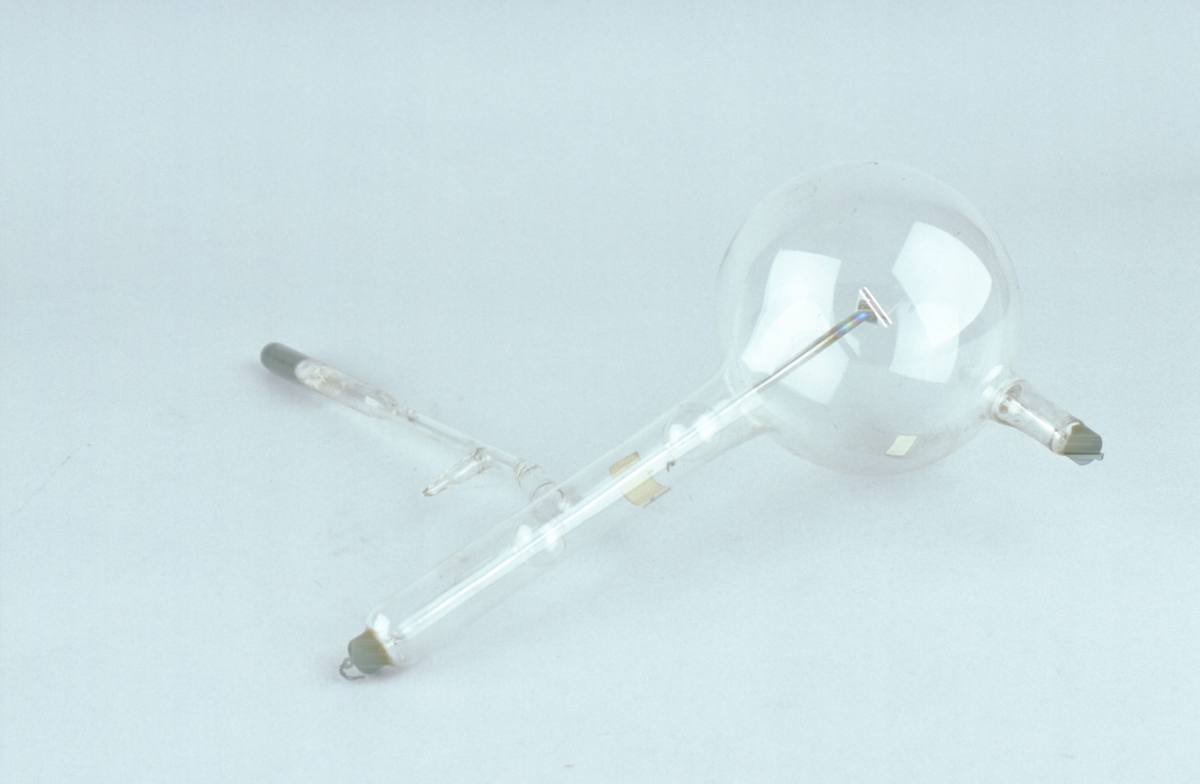
vacuum tube, helium, by Cavendish Laboratory technician Ebenezer Everett, English, 1908
Origin
England; Cambridge
Maker
Everett, Ebeneezer
Class
physics
Earliest Date
1908
Latest Date
1908
Inscription Date
1908
Material
glass; metal (white metal, brass); inorganic (charcoal); cloth (cotton wool); paper
Dimensions
length 335mm; breadth 400mm; depth 125mm
Special Collection
Cavendish collection
Provenance
Transferred from Cavendish Laboratory, University of Cambridge, 1974.
Inscription
Helium EE Feb [190?]8
Description Notes
Experimental/demonstration vacuum tube, helium, by Cavendish Laboratory technician Ebeneezer Everett, 1908.
Glass chamber with long arm carrying white metal rod topped by target consisting of two parallel triangular plates. Side arm with second electrode ending in white metal disc. Target arm has side arm for evacuation tube with carbon chip regulator. Brass caps on electrode arms to aid electrical connection. Paper label with MS note ‘Helium EE Feb [190?]8’.
Condition good; complete.
Orange paper label caution note, found in box with this object, 2005, 2055 and 2980. Unclear which object it belongs to.
References
Events
Description
This delicate glass vacuum tube is labelled "E.E. Feb 8". E.E. is Ebenezer Everett, virtuoso glass-blower and personal assistant to Cavendish Professor J.J. Thomson, and he created this in-house at the Cavendish Laboratory.
Ebenezer Everett (1865-1933) was born in Chesterton, just outside Cambridge. In 1886 he was poached by a desperate J.J. Thomson from the Chemistry Laboratory. Thomson was no glassblower himself, and needed an expert assistant for his research. (He once confessed in frustration that he believed all of the glass in the Laboratory was bewitched.)
The partnership between J.J. and E.E. lasted 41 years. He is estimated to have made over 5,000 pieces of apparatus, and taught numerous students. His contribution to science was recognised by an M.A. by the University – (unfortunately, still) a very unusual honour for a technician.
***
Glass has been prized for centuries for its transparency and moldability. It’s these qualities that make it one of the most important materials in the history of physics. The Whipple cares for a large collection of glassware from the University of Cambridge’s Cavendish Laboratory of Experimental Physics.
Most of it dates from the 1880s to the 1930s, when Cavendish Professor J.J. Thomson and his students were studying the mysterious glows and rays that can be seen through the glass when electricity is run through a gas in a partial vacuum. These studies led to Thomson’s discovery that cathode rays were made up of sub-atomic negatively charged particles in 1897. He named them corpuscles: we know them as electrons.
Everett and the other members of the Cavendish Laboratory’s technical team created and repaired the intricate vessels to order: whatever the researcher needed for his or her experiments. Removing the air from a vessel like this one might take Everett half a day using a hand-pump before he was able to fill it with a gas (in this case, helium).
Many of the technicians joined the Laboratory as young boys and remained there throughout their careers. This meant there was an unbroken continuity of craft and technical knowledge across the Laboratory’s first six decades.
“Only those who have tried it know how exasperating glass-blowing can be, and how often when the apparatus is finished it breaks and the work has to be begun again.”
J.J. Thomson, Cavendish Professor, 1936
10/07/2025
Created by: Hannah Price on 10/07/2025
FM:44884
Images (Click to view full size):