Accession No
1952.1
Brief Description
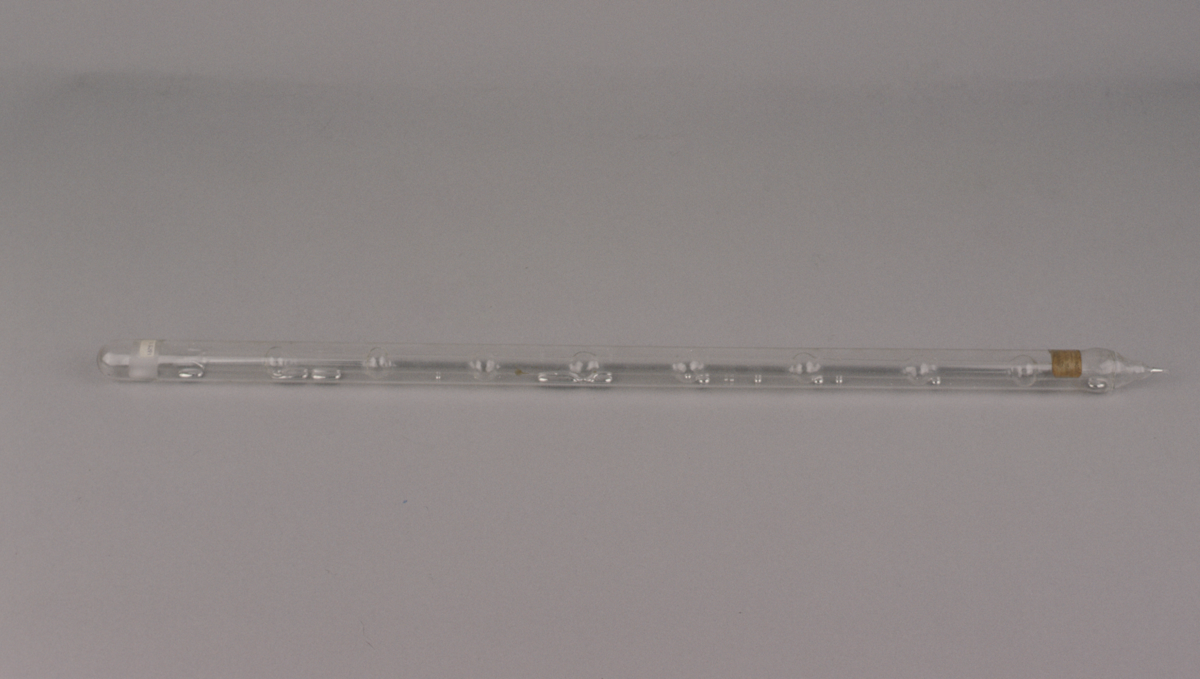
neon flash tube, by G. A. Crowe, English, 1925
Origin
England
Maker
Crowe, G. A.
Class
physics
Earliest Date
1925
Latest Date
1925
Inscription Date
10/1925
Material
glass; metal (mercury); paper
Dimensions
length 695mm; maximum diameter 21mm
Special Collection
Cavendish collection
Provenance
Transferred from the Cavendish Laboratory, University of Cambridge, in 1974.
Inscription
‘Neon Flash Tube
Made Oct 1925
G.A.Crowe’ (paper label)
Description Notes
Glass casing containing tube with eight spherical chambers. Mercury between outer and inner tubes (acts as excitor).
Condition good; complete.
References
Events
Description
Glass has been prized for centuries for its transparency and moldability. It’s these qualities that make it one of the most important materials in the history of physics. The Whipple cares for a large collection of glassware from the University of Cambridge’s Cavendish Laboratory of Experimental Physics.
The Cavendish Laboratory’s technical team included gifted glassblowers. They created and repaired the intricate vessels to order: whatever the researcher needed for his or her experiments.
Many of the technicians joined the Laboratory as young boys and remained there throughout their careers. This meant there was an unbroken continuity of craft and technical knowledge across the Laboratory’s first six decades.
Scientific glassblowers work with prefabricated tubes of set diameters and thicknesses. They use a flame and their own breath to expand and bend them into the shapes needed for each experiment.
The son of a Cambridge boat-builder, George Crowe (1893-1966) joined the Cavendish as a boy in 1907. In 1919, he became Ernest Rutherford’s personal assistant. Calm, skillful, and ready to try anything, he was the perfect foil to the creative and tempestuous Rutherford. He retired as Principal Assistant in 1959.
Rutherford’s research into radioactivity relied on delicate glass vessels, emptied with a vacuum pump and usually filled with the unstable gases given off by radioactive substances. Crowe needed skin grafts as a result of dealing with X-rays and radium.
This flash tube, labelled with George Crowe’s signature, gives a very bright burst of red light. Neon signs, which were first installed in public spaces in the 1910s, work in a similar way.
The tube contains an inner tube, filled with neon, and an outer, with mercury. It goes without saying that creating and handling glassware like this needs “good hands”–for which many researchers relied on their technicians. Crowe recalled Rutherford’s exclamation “Don’t shake the bloody bench, Crowe!” when struggling with a fiddly task.
10/07/2025
Created by: Hannah Price on 10/07/2025
FM:44978
Images (Click to view full size):