Accession No
1965
Brief Description
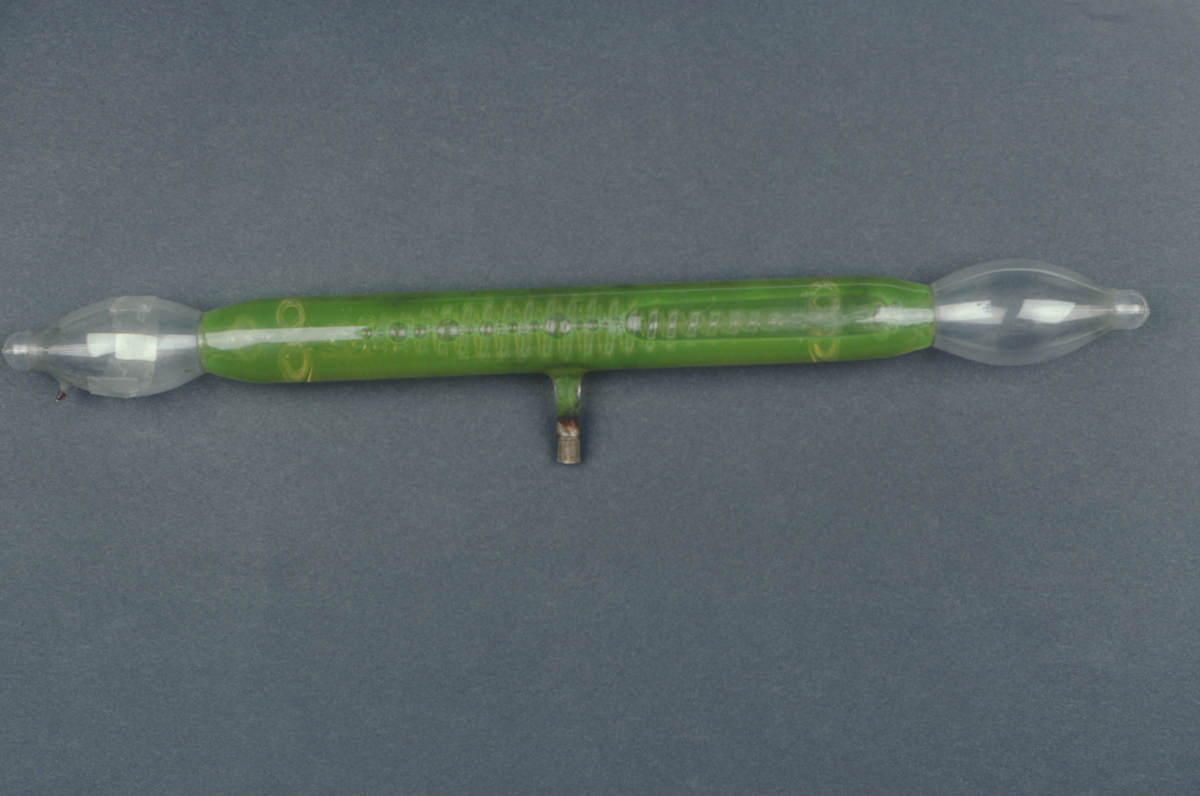
glass vacuum tube, 1875–1925
Origin
Maker
Class
physics
Earliest Date
1875
Latest Date
1925
Inscription Date
Material
glass; metal (white metal); wood (cork); liquid
Dimensions
length 447mm; breadth 75mm; depth 33mm
Special Collection
Cavendish collection
Provenance
Transferred from the Cavendish Laboratory, University of Cambridge, in 1974.
Inscription
Description Notes
Vacuum tube consisting of outer glass jacket surrounding elaborately coiled tube: long spiral closed by figure of eight at either end. Glass jacket is filled with green liquid; side arm with bung for admitting liquid. Terminals are enclosed in cork mounts with additional wires outside to improve the connection.
Condition good; complete.
References
Events
Description
Glass-blower Heinrich Geissler (1815-1879) was from a family of craftsmen in Thuringia, Germany, which has a glass-blowing tradition going back to the Middle Ages. His mercury air pump, invented in 1857, was capable of creating strong vacuums – enabling the production and study of phenomena such as cathode rays.
Mass-produced glowing Geissler tubes, based on his invention, were must-have after-dinner entertainments in the 1880s. Connected to an electric current, the tube makes a very loud crackling noise and glows spectacularly, with different colours according to the different gases inside. This tube contains the dye fluorescein, giving it its eerie green colour.
10/07/2025
Created by: Hannah Price on 10/07/2025
Description
Vacuum tubes contain one or a combination of the following: rarefied (thinned) gasses such as neon or argon, conductive liquids or minerals. When an electrical charge is passed through the tube different effects are created.
FM:44990
Images (Click to view full size):