Accession No
6166
Brief Description
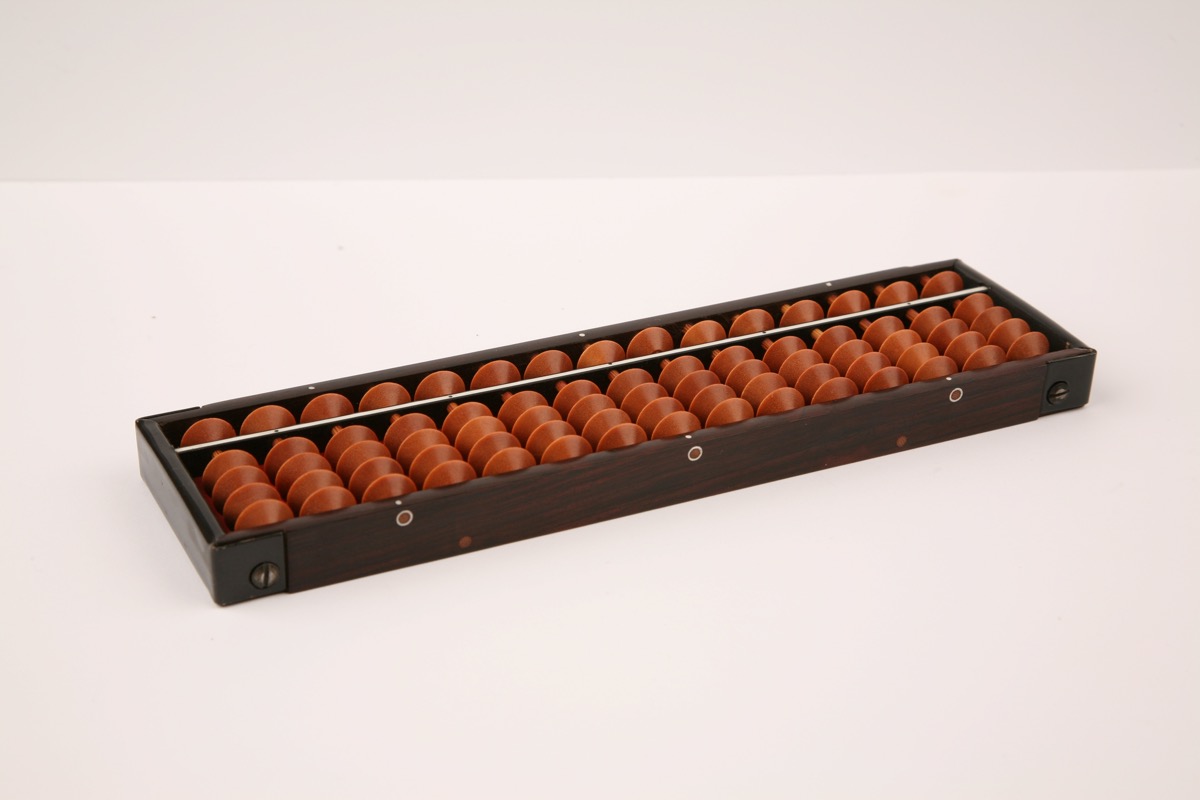
soroban or abacus, 20th Century
Origin
Maker
Class
calculating
Earliest Date
1950
Latest Date
1985
Inscription Date
Material
Plastic; wood; metal
Dimensions
Length 239mm; width 65mm; height 34mm
Special Collection
Hookham collection
Provenance
Donated in 1987.
Inscription
Description Notes
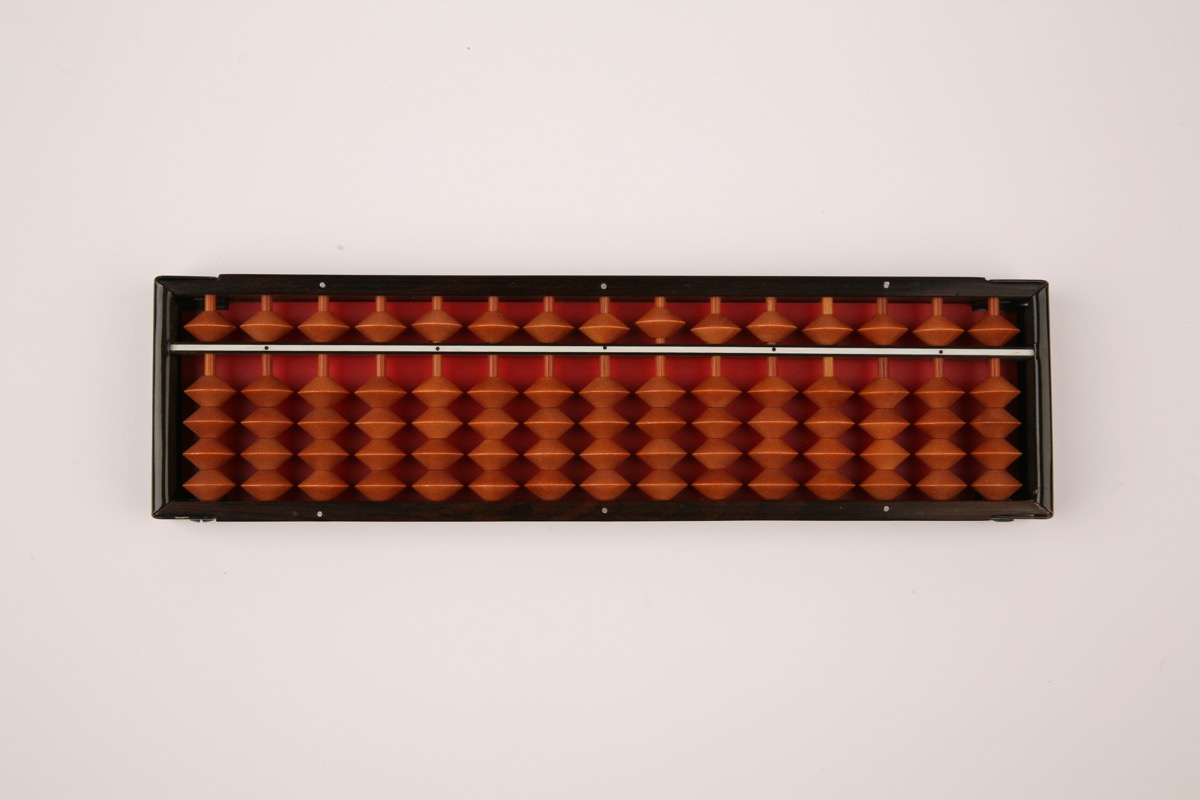
Wooden and metal framed soroban (i.e. Japanese abacus) with plastic sheeting at back.
Carries 15 columns with four beads below divider and one above on each column. Contained in black plastic box with red lid.
Condition good; complete.
References
Events
Description
The abacus is a manual calculating tool used to perform arithmetic. Originating around 2,300 BCE in Sumeria, early versions were simple boards with sand-covered surfaces for drawing calculations. The more recognisable abacus, which features beads sliding on rods, evolved later. It became prominent in ancient China, Japan, and other parts of Asia.
This 20th-century bead abacus is of Japanese origin and is typical of the period.
Although we now have computers and digital calculators, abaci are still in use as educational tools.
09/08/2024
Created by: Clare Rogowski on 09/08/2024
Description
The abacus was used for calculations too complicated to be done in the head, as a quicker alternative to using a pencil and paper. The word abacus comes from the Greek word for flat surface and originally it was simply a surface for putting pebbles on. However, many different types have developed and many involve beads running along wires or grooves. All use the principle of different columns of counters representing different units or collections of units e.g. one column for hundreds, one for tens, one for units etc.
This is a soroban: a Japanese modification of the Chinese abacus.
The Japanese first eliminated one bead from the upper deck and later another bead from the lower deck in each column of the Chinese abacus, making the Japanese abacus purely for the decimal system.
The rods (number of digits) usually increase to 21, 23, 27 or even 31, thus allowing calculation for more digits or representations of several different numbers at the same time. The beads on a soroban are usually shaped as a double cone (bi-cone) to facilitate ease of movement.
Soroban is taught in primary schools as a part of lessons in mathematics because the decimal numerical system can be demonstrated visually. When teaching the soroban, a song-like instruction is given by the teacher. Often, primary school students may bring along with them two sorobans, one with 1 upper bead and 5 lower beads, the other with 1 upper bead with 4 lower beads. Despite the advent of handheld calculators, some parents send their children to private tutors to learn soroban because proficiency in soroban calculation can be easily converted to mental arithmetic at a highly advanced level.
On November 12, 1946, a contest was held in Tokyo between the Japanese soroban, used by Kiyoshi Matsuzaki, and an electric calculator, operated by US Army Private Thomas Nathan Wood. The bases for scoring in the contest were speed and accuracy of results in all four basic arithmetic operations and a problem which combines all four. The soroban won 4 to 1 with the electric calculator prevailing in multiplication.
29/08/2007
Created by: S Davis on 29/08/2007
FM:45067
Images (Click to view full size):