Accession No
3962
Brief Description
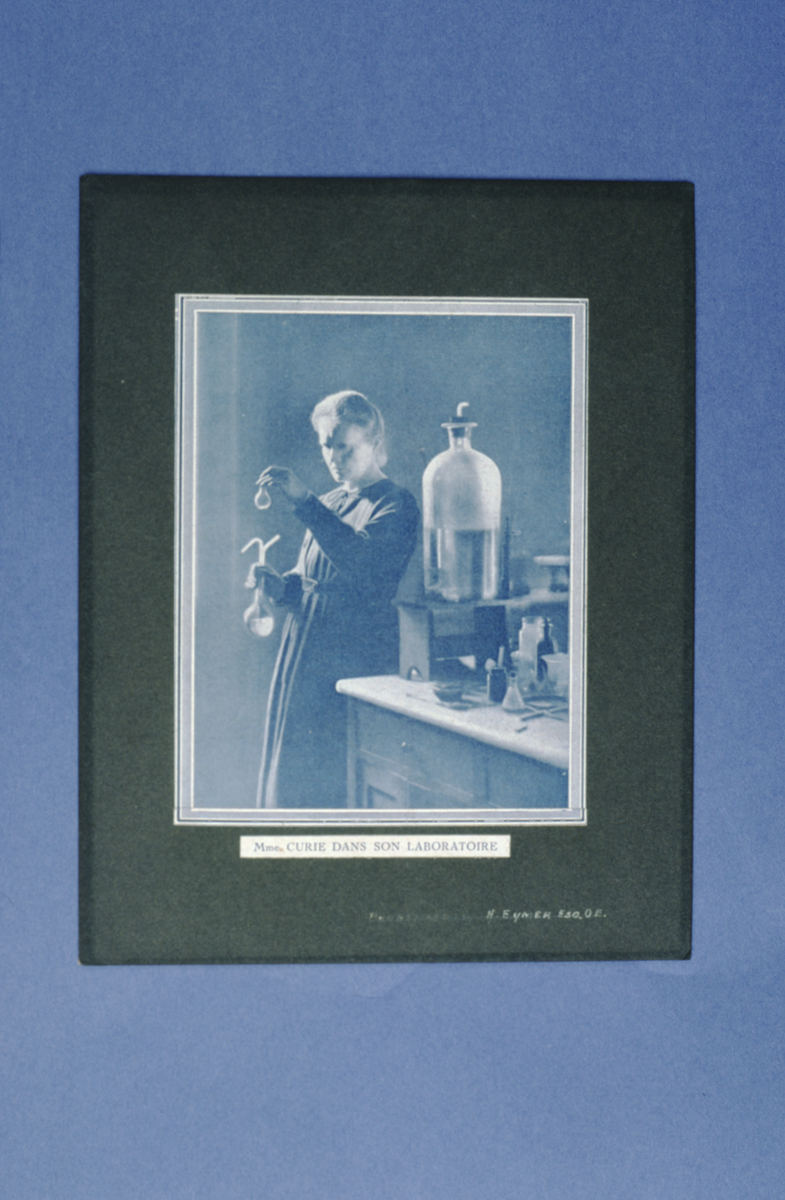
photographic print of Marie Curie at work in her laboratory, French, c. 1925
Origin
Maker
Class
ephemera; chemistry
Earliest Date
1925
Latest Date
1940
Inscription Date
Material
paper
Dimensions
breadth 179mm; height 229mm (mounted)
Special Collection
Provenance
Purchased from Christie’s, London; The Nicholas Webster Collection sale, lot 208, 26/09/1991
Inscription
‘Mme CURIE DANS SON LABORATOIRE’
‘PRESENTED by H. EYMER ESQ. O.E.’
Description Notes
Blue tinted photographic print of Marie Curie at work in her laboratory at the University of Paris. Pasted onto a dark brown mount. Pasted label with title below print:
‘Mme CURIE DANS SON LABORATOIRE’
‘PRESENTED by H. EYMER ESQ. O.E.’
hand-written note on mount in white ink.
Mounted and framed
Condition: fair; complete.
References
Events
Description
Born: 1867
Died: 1934
Marie Sklodowska was born in Warsaw Poland, the daughter of a secondary school teacher, from whom she gained her interest in science and some training. After leaving Warsaw due to involvement in a student revolutionary movement, Marie first went to Cracow and then in 1891, to France where she enrolled at the Sorbonne in Paris. It was here that she obtained Licenciateships in Physics and the Mathematical Sciences and met Pierre Curie, the Professor at the school of Physics who she married in 1895.
Marie Curie’s early research with her husband Pierre was carried out under poor laboratory conditions and both were forced to teach long hours in order to earn enough to support their research. Inspired by the discovery of radioactivity by Henri Becquerel in 1896, Marie and Pierre’s research centred on this area and led to their isolation of polonium and radium. In 1903 they were jointly awarded half of the Nobel Prize for Physics in conjunction with Henri Becquerel, for their radiation studies. Marie went on to develop methods for the isolation of radium from other radioactive elements in enough quantities to investigate properties, the most important of which was therapeutic. During World War I, Marie was an active promoter of the therapeutic properties of radium and she used it in remedial work to help alleviate pain and suffering.
Having attained her Doctor of Science degree in 1903, Marie succeeded her husband as head of the Physics Laboratory at the Sorbonne. In 1906 Pierre Curie was tragically killed when a horse-drawn carriage drove him down and Marie took over his role as Professor of General Physics in the Faculty of Sciences – the first time that a women had held this position.
In 1911 Marie received a second Nobel Prize, this time in chemistry, in recognition for her further work on radioactivity. She was held in high esteem throughout the scientific community and was a member of many top scientific Leagues and committee’s as well as receiving many honorary degrees in science and medicine.
Marie Curie died at Savoy in France in 1934.
FM:45186
Images (Click to view full size):