Accession No
0555
Brief Description
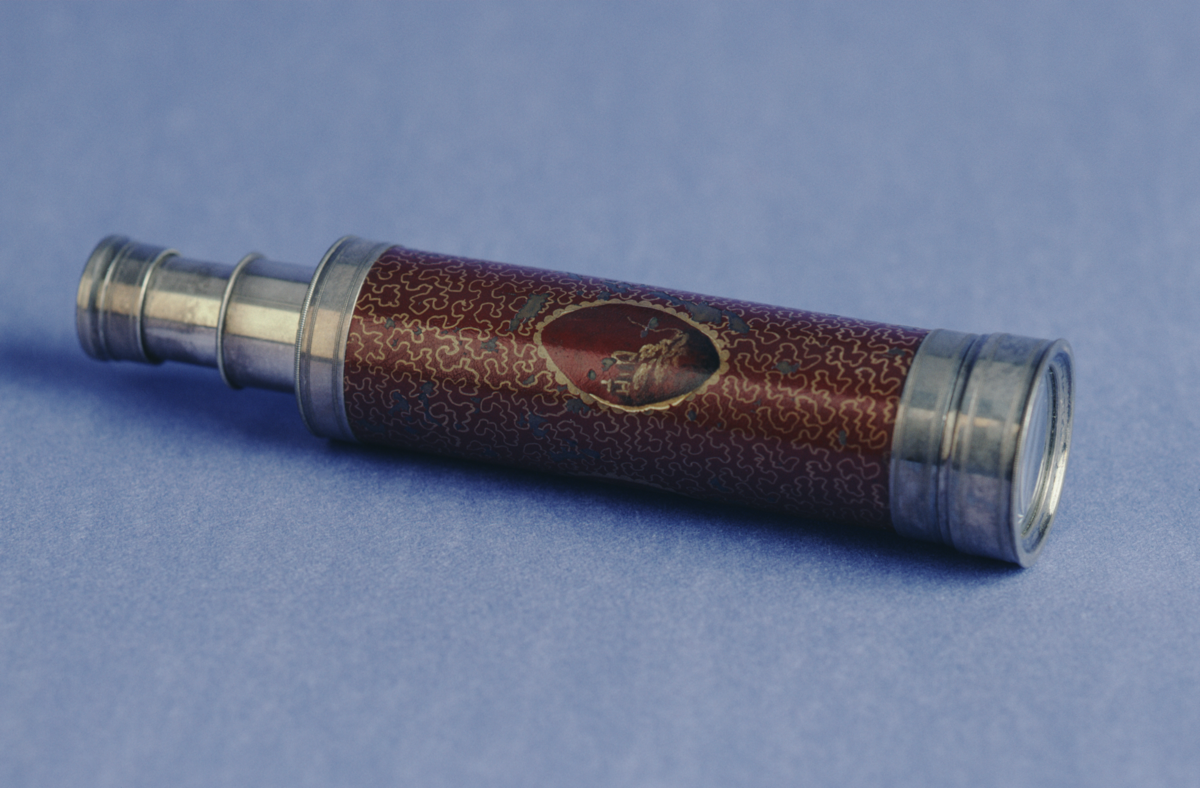
refracting telescope, by Gilkerson, English, circa 1820
Origin
England; London; Tower Hill
Maker
Gilkerson
Class
astronomy; optical
Earliest Date
1820
Latest Date
1820
Inscription Date
Material
metal (silver, brass); glass; enamel
Dimensions
length closed 133mm; diameter 36mm
Special Collection
Robert Whipple collection
Provenance
Purchased from J.W. Rose, Bath, on 20/04/1929.
Inscription
‘GILKERSON
TOWER HILL
LONDON’ (on eye-stop)
Description Notes
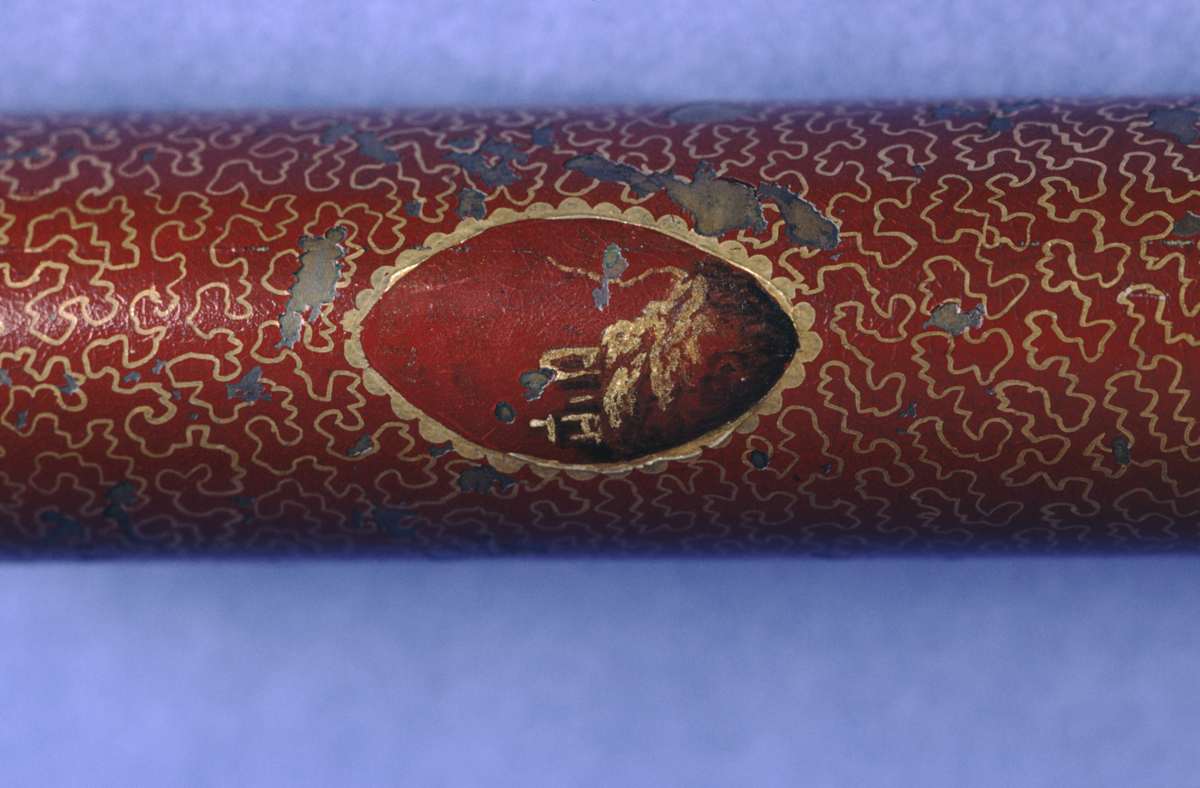
3 drawer hand-held refracting telescope. Red and gold japanned barrel bound with silver. Silver plated brass fittings and draw tubes. 4 lens erecting eyepiece, lenses in threaded brass mounts. Silver-plated eye-stop. Object glass in part-plated threaded brass mount.
Comes apart into 3 pieces
Condition fair (some chipping to japanning); complete
References
Events
Description
The refracting telescope uses a lens to focus the observed image. Its exact origin is disputed, but it first appeared among Dutch spectacle makers at the beginning of the seventeenth century.
Great discoveries were made using the refracting telescope. Galileo’s work Siderius Nuncius (The Starry Messenger, 1610) describes his discoveries of the mountains on the moon, new stars and the moons of Jupiter.
Galileo’s telescopes consisted of a concave and a convex lens which gave an upright image of low magnification. The Keplerian telescope, which was the main type used in astronomy before the invention of the reflecting telescope, has two convex lenses, which gave an upside-down image with a wider field of view. It can be modified for use on land by adding an extra eyepiece lens, which gives an upright image.
The main problem with refracting telescopes is that they suffer from chromatic aberration. When light travels through an ordinary lens each colour is bent through a different angle. A spectrum of colours would appear around the image being viewed.
An improvement to the quality of telescopic images came in 1758, when John Dollond started manufacturing a special lens made of two different sorts of glass. This reduced chromatic aberration by bringing two particular wavelengths of light into a common focus. Achromatic lenses and improvements in glass-making made both small and large refracting telescopes popular in the nineteenth century. Refracting telescopes are still in use today but are usually small telescopes designed for amateur users.
Created by: Jenny Downes
FM:45407
Images (Click to view full size):