Accession No
2964
Brief Description
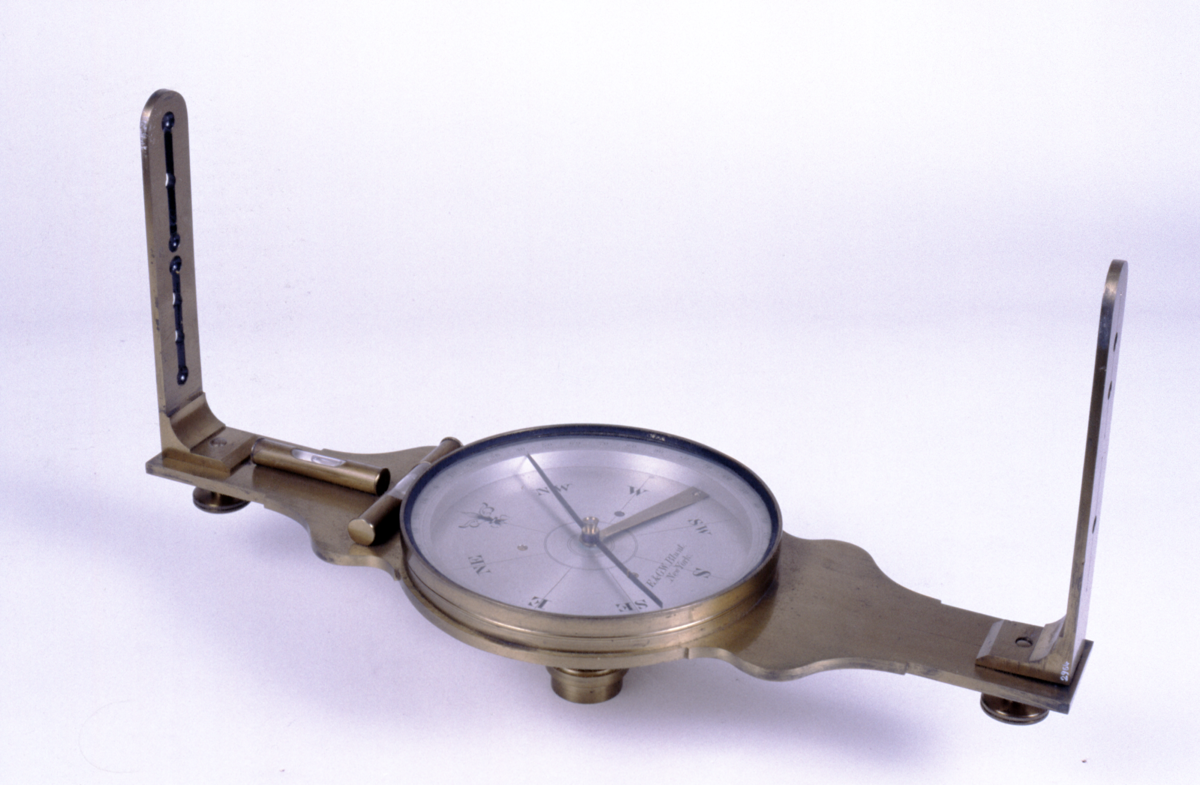
circumferentor, by E. and G. W. Blunt, U.S.A., 1860 (c)
Origin
U.S.A.; New York
Maker
E. and G. W. Blunt
Class
surveying
Earliest Date
1860
Latest Date
1860
Inscription Date
Material
metal (brass, silver, steel); wood (mahogany)
Dimensions
box length 415mm; breadth 200mm; height 112mm
Special Collection
Provenance
Purchased from Tesseract, Hastings-on-Hudson, New York, USA,1983. Purchased with the assistance of a Science Museum Grant-in-aid.
Inscription
‘E & G. W. Blunt
New York’
Description Notes
Brass; silvered 8 point compass rose divided 0-90-0 twice to 30’; fleur-de-lys North; brass lid; steel needle with clamp; 2 bubble levels with mutually perpendicular axes; detachable sight vanes with slit and pinhole sights; socket for attaching ball and socket joint with clamp. Fitted mahogany box.
References
Events
Description
The circumferentor is an instrument that derives from the reverse side of an astrolabe. It is used to measure horizontal angles, or vertical angles by suspending the instrument from its shackle.
The circumferentor was described by Arthur Hopton in 1611, though passing references had been made to it in earlier works. It became one of the standard pieces of equipment of the surveyor throughout the 17th and 18th centuries.
31/08/2006
Created by: updated by Ruth Horry on 31/08/2006
FM:45479
Images (Click to view full size):