Accession No
5358.12
Brief Description
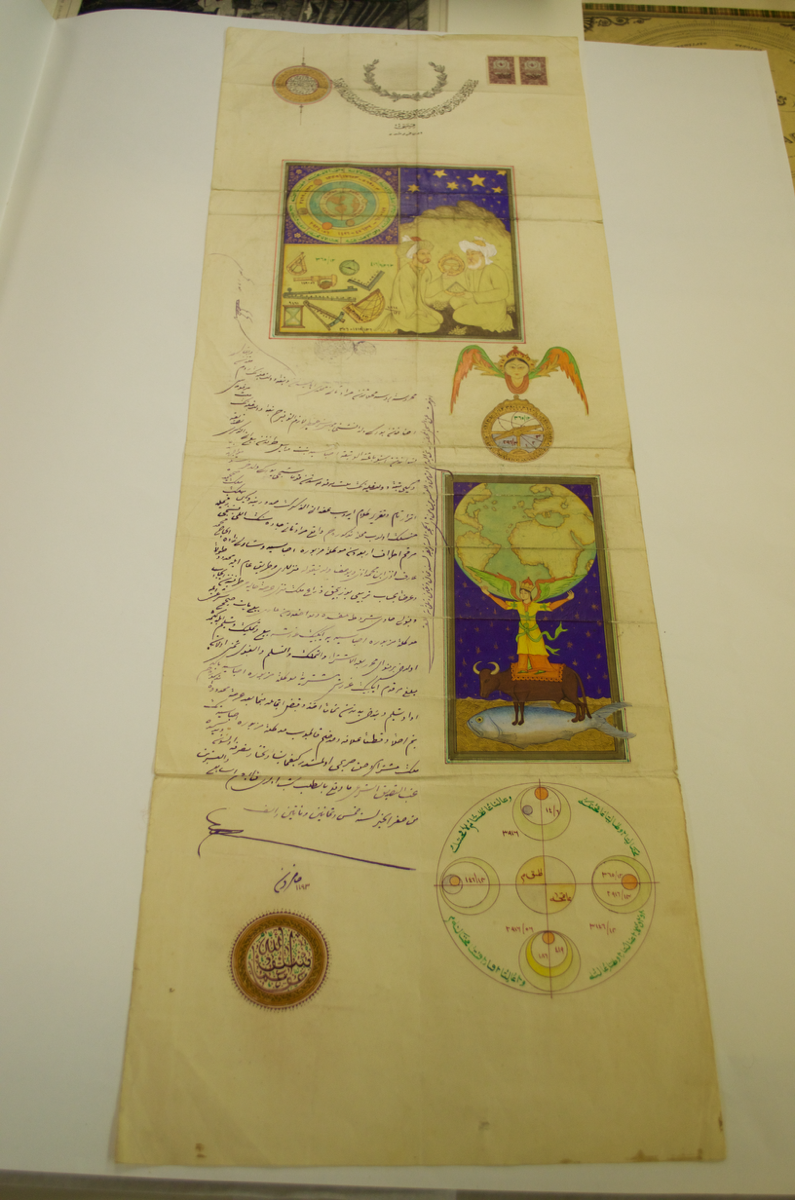
manuscript letter, dated 1868 AD, with fake image added in the late 20th Century showing astronomers and the globe and nonsense Arabic script, Ottoman Turkish, false date of 1779 AD but image is a late 20th-century forgery
Origin
Turkey; Istanbul [source of forgery - source of original manuscript sheet is likely to also be Turkey]
Maker
Class
astronomy; ephemera
Earliest Date
Latest Date
Inscription Date
Material
paper
Dimensions
width 287 mm; height 815 mm
Special Collection
Provenance
Purchased from Ottoman Miniatures, Haluk Ertezcanh, Sahaflar Carsisi No 18, Beyazit-Istanbul, Turkey from 10/12/1998.
Inscription
(Arabic labels on picture)
Description Notes
Ottoman Turkish manuscript letter, dated 1868 AD, with fake image added in late C20th showing astronomers and the globe, and nonsense Arabic script. False date of 1779 AD; image is a late C20th forgery.
Ottoman Turkish manuscript letter, signed and dated 27 Safar 1285 AH (corresponds to 19/06/1868 AD). At the top centre a circular embossed pattern surrounded by a black ink design. To the left of this a circular ?script design surrounded by a gold and black border. In the top right two postage stamps. Below these has been added a late C20th fake image in a red, green and gold border. To the right are two astronomers with astrolabe and quadrant, to the left a diagram of the solar system with the earth and six planets, below this are shown quadrant, square, calipers, sandglass, two ?sectors and two ??protractors. The bottom of the picture has been stamped with a large round stamp, and a small oval one, both with very little blue ink, this is falsely dated in different ink 1193 AH / 1779 AD, added by the late C20th forger to deceive. Below this the left hand side of the sheet has Arabic text somewhat crudely written in blue ink, while the right has a winged woman, an astrolabe, a picture within a coloured border of the globe, supported by a winged woman who is standing on a bull which in turn is standing on a fish. The bottom right of the sheet has an unidentified astronomical diagram similar to that on 5358.10, while the bottom right has a circular ?script design surrounded by a gold and black border.
There are three more postage stamps and a couple of words writing on the reverse which is otherwise blank.
Condition fair
The page has been folded several times and has one fold running lengthwise and ten folds running across it one of which is splitting at the middle and another at one edge. There is a small hole towards the bottom, the edges are battered, especially at the corners and there is surface dirt.
References
Nir Shafir; 'Forging Islamic Science'; Aeon; online article; 11 Sep. 2018: https://aeon.co/essays/why-fake-miniatures-depicting-islamic-science-are-everywhere Nir Shafir; ‘Forging Islamic Science: Fake Miniatures Detract from the Real Work of Early-Modern Ottoman Scientists’; American Scientist 107.3 (2019): 156–61; on p. 158. Nir Shafir; 'Fake Miniatures of Islamic Science'; in: Natalie Fritz and Paola von Wyss-Giacosa (eds.); Visual Reflections across the Mediterranean Sea (Siena: GMS SRL; 2023): 316-23.
Events
Description
This sheet is one of thirteen leaves of Ottoman Turkish manuscript acquired by the Whipple Museum from Istanbul in 1998. Intriguingly, onto each sheet has been added a medical or scientific illustration, hand-painted over the top of the manuscript text below. Confusingly, the images appear to bear no relation to the text onto which they have been added.
Investigation by several experts in the history of Ottoman and Islamic science has revealed these images to be forgeries. The manuscript sheets are original documents from the 18th and 19th century (letters or pages torn from religious and poetic books), but the images were likely added shortly before the sheets were acquired. The intent was clearly to deceive. Each image carries a date from the late 17th or 18th century, supposed owners' stamps, and 'nonsense' annotations have been added to give the air of scientific diagrams. (These annotations are 'pseudo-writing' - written by someone who evidently could not read Arabic or Persian or Ottoman Turkish!)
All of the images on the Whipple Museum's 13 sheets are modern copies or interpretations of earlier medical or scientific drawings. Some of the original images upon which these copies are based are of Persian or Turkish origin, whilst others are European. As such, these images need to be treated with great care. The forger's intent was clearly to present 'typical' Ottoman scientific imagery in a way that would appeal to a non-expert buyer; but the images themselves are not reliable sources for understanding the practice or visual culture of Ottoman science and art.
19/02/2018
Created by: Josh Nall on 19/02/2018
Description
[This is an old label containing errors - now redundant]
While the text of this manuscript dates from the sixteenth or seventeenth century, the illuminated images were painted much later in the mid-eighteenth century. It is likely that the images were produced as part of a growing eighteenth-century tourist trade interested in scientific manuscripts from the Islamic world. The manuscript pages were torn from their original volume and provided the background for the applied illustrations. The subject of the text does not coincide with that of the illuminations. The text is written in both Ottoman Turkish and Classical Arabic, and outlines the practical and liturgical ritual for a person to become ritually pure. In the Islamic world, trusts were set up by pious wealthy individuals in order the serve the community on their death. They were often in the form of hospitals, schools, libraries and institutions of learning, and the inscription suggests that this manuscript is a translation of an important religious text that was part of this trust system. The text promotes the edicts of the hanafi school of law and was likely produced in Anatolia, a non-Arabic speaking part of the Ottoman state, where hanafi law was promoted in its educational establishments. The eighteenth-century illustrations are astronomical or cartographic in nature. One depicts an astrolabe that stylistically resembles Moorish design, which would have been unfamiliar to sixteenth-century Islamic astronomers. The night sky represented is a post-Herschel vision of the heavens and closely resembles photographic images taken through a telescopic lens.
14/01/2014
Created by: Allison Ksiazkiewicz on 14/01/2014
FM:45710
Images (Click to view full size):