Accession No
3370
Brief Description
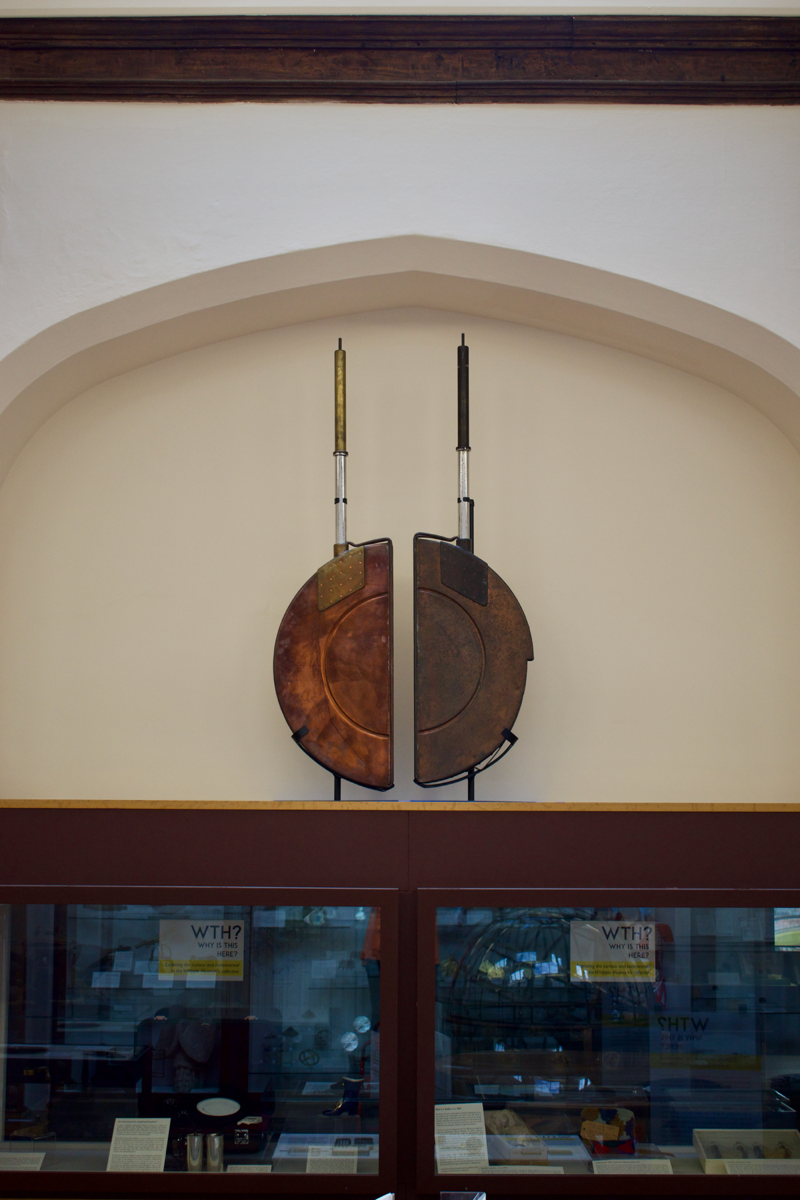
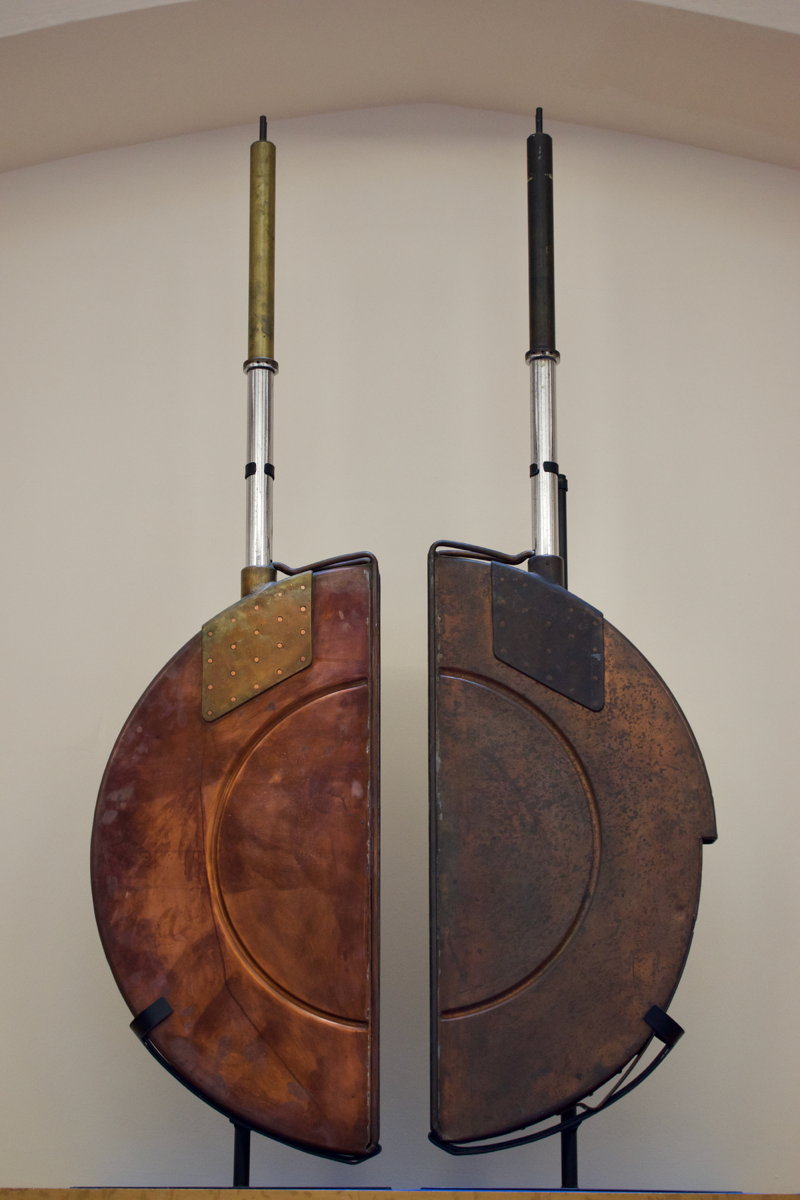
Dees from the Cambridge cyclotron, lead design by John Cockcroft, manufactured by Metropolitan Vickers, English, 1936-1938
Origin
England; Manchester [engineering]; Cambridge [constructed and used]
Maker
Metropolitan-Vickers [makers / engineers] John Cockcroft [lead designer]
Class
physics
Earliest Date
1936
Latest Date
1938
Inscription Date
Material
metal (copper; steel?)
Dimensions
1500mm length; 390mm width; 55mm depth
Special Collection
Cavendish collection
Provenance
Transferred from Cavendish Laboratory, University of Cambridge, Cambridge, England.
Inscription
Description Notes
Two Dees from the Cambridge cyclotron; 1936 (c)
Each dee is semi circular, comprised of two plates that are bolted together, with an opening down their diameter and another opening just off the mid point of the curve. Both sides of the dees have a semi circular indentation on their sides with a 490mm diameter. Attached, by bolts, to each dee is a metal cylinder, giving them their “D-shaped” appearance. Down the centre of this cylinder are two hollow copper tubes of 10mm diameter that stick out of the end and then run along the entire circumference of the dees.
Complete
References
Events
Description
The cyclotron is an early type of particle accelerator, invented by American physicist Ernest Lawrence in 1929. Cyclotrons accelerate charged particles (such as protons, electrons or ions) using a high frequency alternating voltage. The D-shaped electrodes, or 'dees', are mounted in a vacuum chamber between the two poles of a large magnet. The particles, injected near the centre of the magnetic field, accelerate only when passing through the gap between the electrically charged dees. They follow a spiral path increasing in radius until they hit a target at the perimeter of the vacuum chamber. The pipes leading into each dee were part of the original cooling system. Cyclotrons provide a source of high-energy beams for experiments in nuclear physics. The examples displayed here were used by researchers at the Cavendish Laboratory at the University of Cambridge.
FM:45718
Images (Click to view full size):