Accession No
5380
Brief Description
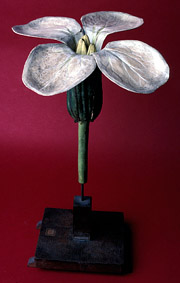
papier mâché botanical model, Erysimum cheiri (wallflower, or ‘giroflee’ in French), attributed to Louis Thomas Jérôme Auzoux, French, c. 1880
Origin
France
Maker
Auzoux, Louis Thomas Jérôme [attributed]
Class
natural history; demonstration
Earliest Date
1870
Latest Date
1890
Inscription Date
Material
wood; paper (card, cardboard, papier mâche); paint; metal (brass)
Dimensions
height 480mm; width of flower 300mm
Special Collection
Provenance
Purchased from Trevor Philip & Sons, 75a Jermyn Street, St James, London, England on 02/02/1999. 22 Botanical models were purchased as one lot. Purchased with grant aid from PRISM fund administered by the Science Museum.
Inscription
‘GIROFLEE’ [on stem]
Description Notes
Papier mâché botanical model, Erysimum cheiri (wallflower, or ‘giroflee’ in French), possibly by Auzoux, French, c. 1880. On a wooden stand. On the wooden base is a paper label with a blue border and handwritten inside the border is the number 376.
Two brass hook clasps on the body of the plant can be undone to allow for disassembly. Three of the four petals and two anthers are removable, held in position by metal prongs that insert themselves into the body of the plant. Once these are removed there is effectively half a flower remaining attached to the central stem; the stigma is now exposed. The petals are painted cream in colour. Square (ish) wooden base raised on protruding runners. The flower stem finishes to expose the central brass pole around which the papier mâche is constructed. This pole is fixed into a wooden upright of the base unit.
There is only one typewritten label and this is on the stem. It says ‘GIROFLEE’. Small labels depicting hands indicate where to disassemble and reasemble the model.
References
Events
Description
The Wallflower model was produced by Louis Thomas Jérôme Auzoux (1797–1880) as a teaching and reference model for botany students. Institutions, such as Cornell University and Mount Holyoke in the United States, purchased models such as these to demonstrate their ability to compete against established teaching programmes and to circumvent traditional modes of acquiring botanical knowledge. As a medical student in Paris, Auzoux developed a special papier-mâché mixture (containing cork and clay as well as paper and glue) in order to produce anatomical models that could be taken apart piece by piece. Traditional wax media used in earlier modes of model-making was expensive and fragile. Auzoux’s factory in St. Aubin d’Ecrosville became a commercial success. His models were used by schools, universities and hospitals, as well as by private individuals who could rent models at low costs. Responding to changing trends in scientific research and education, the company eventually expanded to include examples of animals and plants.
05/11/2013
Created by: Allison Ksiazkiewicz on 05/11/2013
FM:45739
Images (Click to view full size):