Accession No
5791
Brief Description
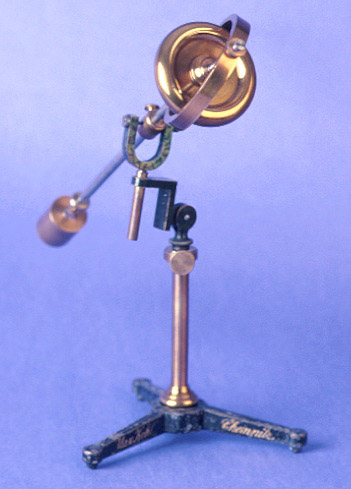
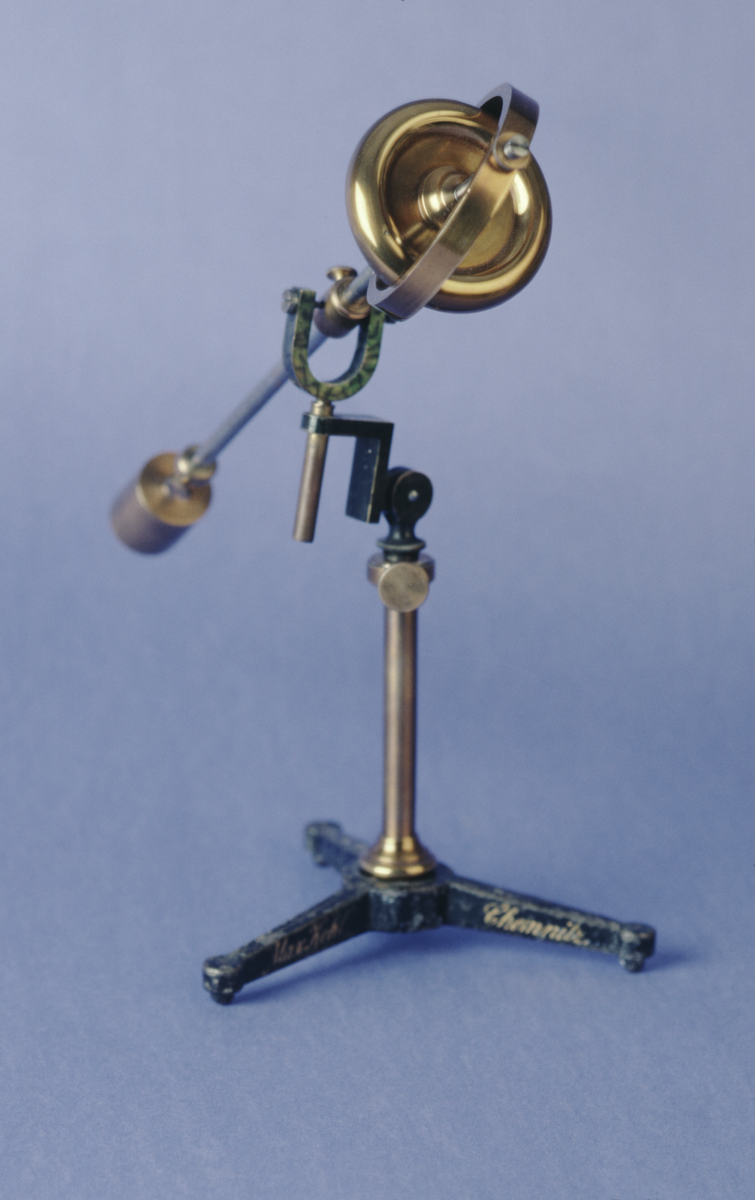
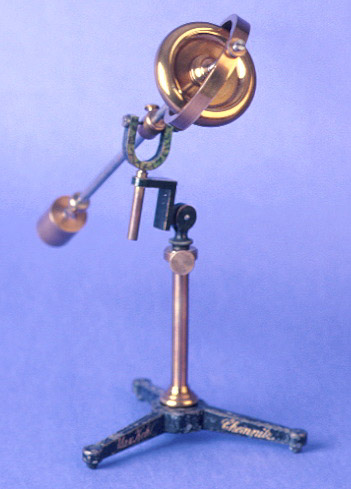
Late 19th Century gyroscopic demonstration apparatus, made by Max Kohl.
Origin
Maker
Max Kohl
Class
demonstration
Earliest Date
1800
Latest Date
1900
Inscription Date
Material
metal (brass, lacquered brass, steel, gilt); enamel
Dimensions
height 350mm; width 150mm; breadth 150mm
Special Collection
Provenance
Purchased from Christie’s South Kensington, 85 Old Brompton Road, London, SW7 3LD on 1/6/2000. Lot 163 in sale MSI-8778.
Inscription
On tripod foot
“Max Kohl”; “Chemnitz”
Description Notes
A late 19th Century gyroscopic demonstration apparatus, signed on the black enamelled tripod foot “Max Kohl”; “Chemnitz”.
The lacquered-brass gyro with steel arm and compensating weight has a fully adjustable attachment to the brass column stand and tripod foot which is black-enamelled and gilt decorated.
References
Events
Description
Jean Bernard Léon Foucault (famous for inventing ‘Foucault’s pendulum’ to demonstrate the rotation of the earth) invented the gyroscope in 1852. The name gyroscope literally means “to view the turning”, and exploits the physical principle that a spinning mass maintains a constant direction. The device typically consists of a disk (rotor) with an axle through the centre, mounted in a gimballed frame to allow movement in all directions. It can be used to demonstrate the Earth’s rotation or for measuring and maintaining orientation. The Americans and the Soviets used it in this way at the height of the Cold War, for the guidance systems in their submarines, missiles and aircraft.
Some believe that Foucault took the inspiration for the gyroscope from Captain John Serson’s ‘whirling speculum’ invention, which was created in the early 1740s. This device is thought to be the first that used the principle that a spinning mass maintains a constant direction.
21/05/2009
Created by: Nathalie Botcherby [work experience student] on 21/05/2009
FM:46194
Images (Click to view full size):