Accession No
5851
Brief Description
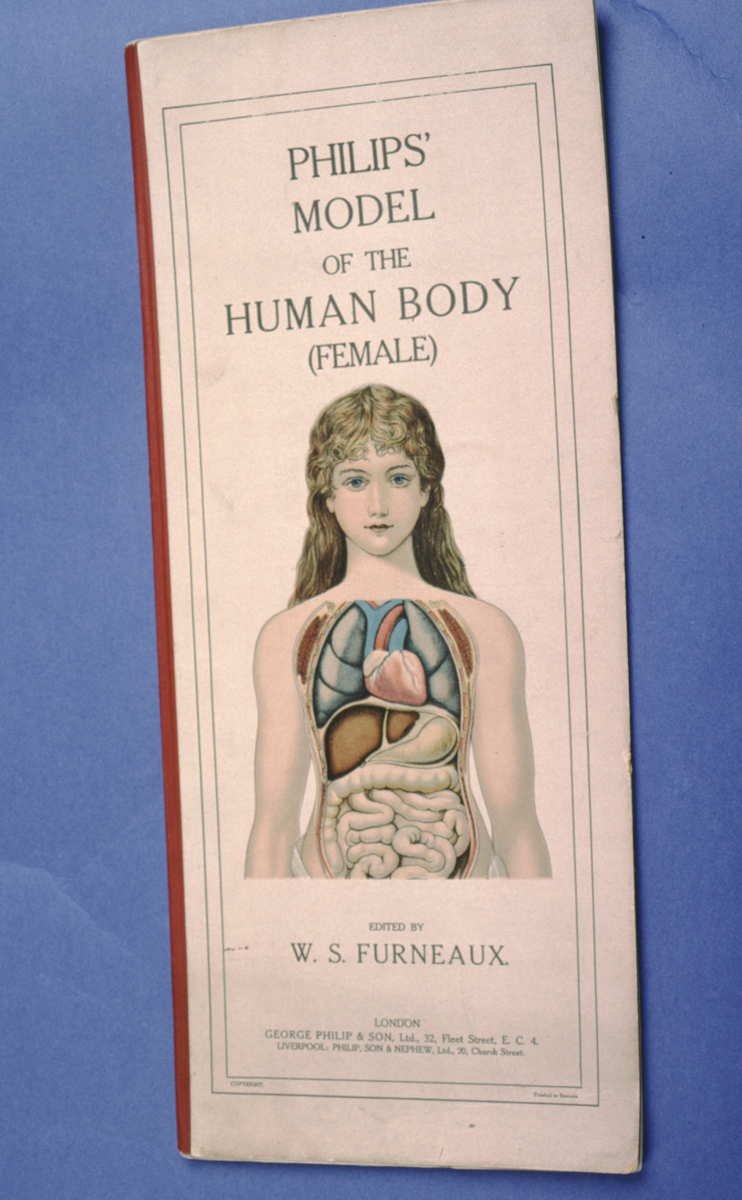
fold-out anatomy book, 'Philips’ model of the human body (female)', by W. S. Furneaux, English, 1900 (c)
Origin
England; London; 32 Fleet Street, E. C. 4; and England; Liverpool; 20 Church Street
Maker
George Philip and Son Ltd. Philip, Son and Nephew Ltd. Furneaux, W. S. [editor]
Class
biology; physiology; demonstration; books
Earliest Date
1880
Latest Date
1930
Inscription Date
Material
paper (card); cloth (canvas); rope (string)
Dimensions
length: 490mm, width 250mm
Special Collection
Provenance
Purchased from Trevor Philip & Son, 75a Jermyn Street, St James’s, London on 01/11/2001.
Inscription
on front cover at top;
PHILIPS’
MODEL
OF THE
HUMAN BODY
(FEMALE)
on bottom of the cover;
EDITED BY
W.S.FURNEAUX
LONDON
GEORGE PHILIP & SON, LTD., 32, Fleet Street, E. C. 4.
LIVERPOOL: PHILIP, SON & NEPHEW, Ltd., 20, Church Street.
COPYRIGHT Printed in Bavaria
Description Notes
Book entitled 'Philips’ model of the human body (female)', fold-out book of human anatomy, edited by W. S. Furneaux, English, c. 1900. Uniform with the Popular Manikin (accession number 5852) the book comprises a number of coloured plates with 16 pages of explanatory text.
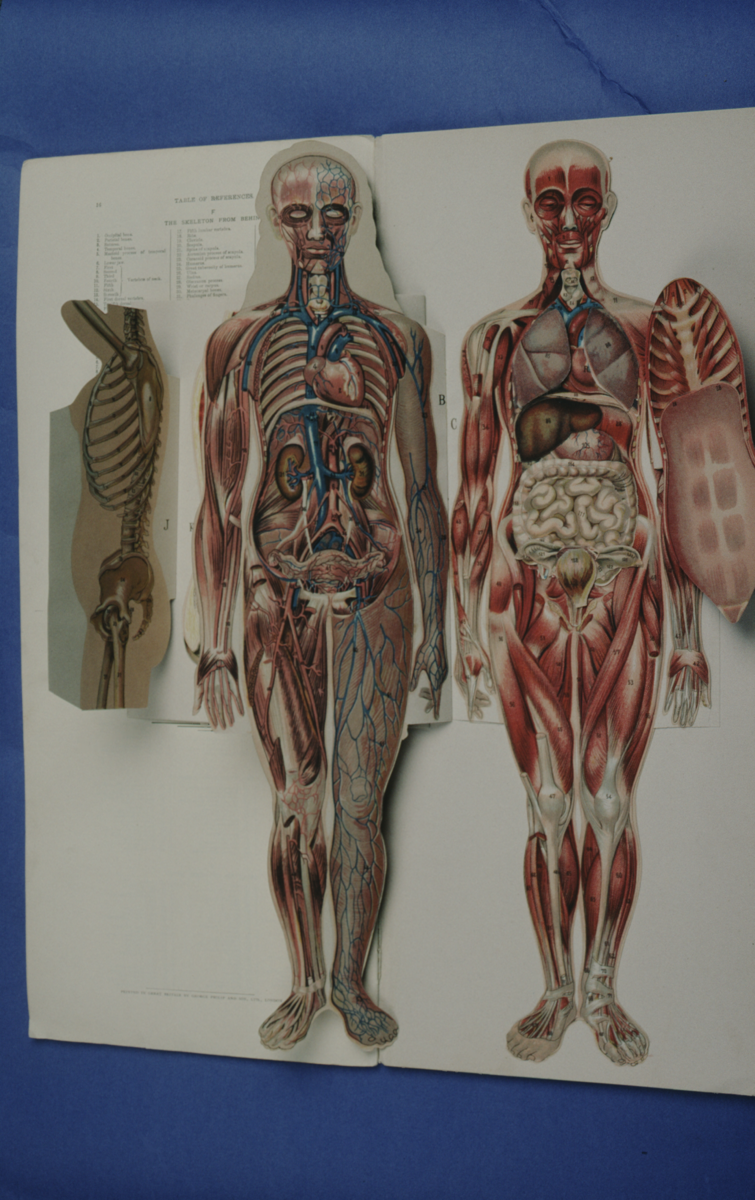
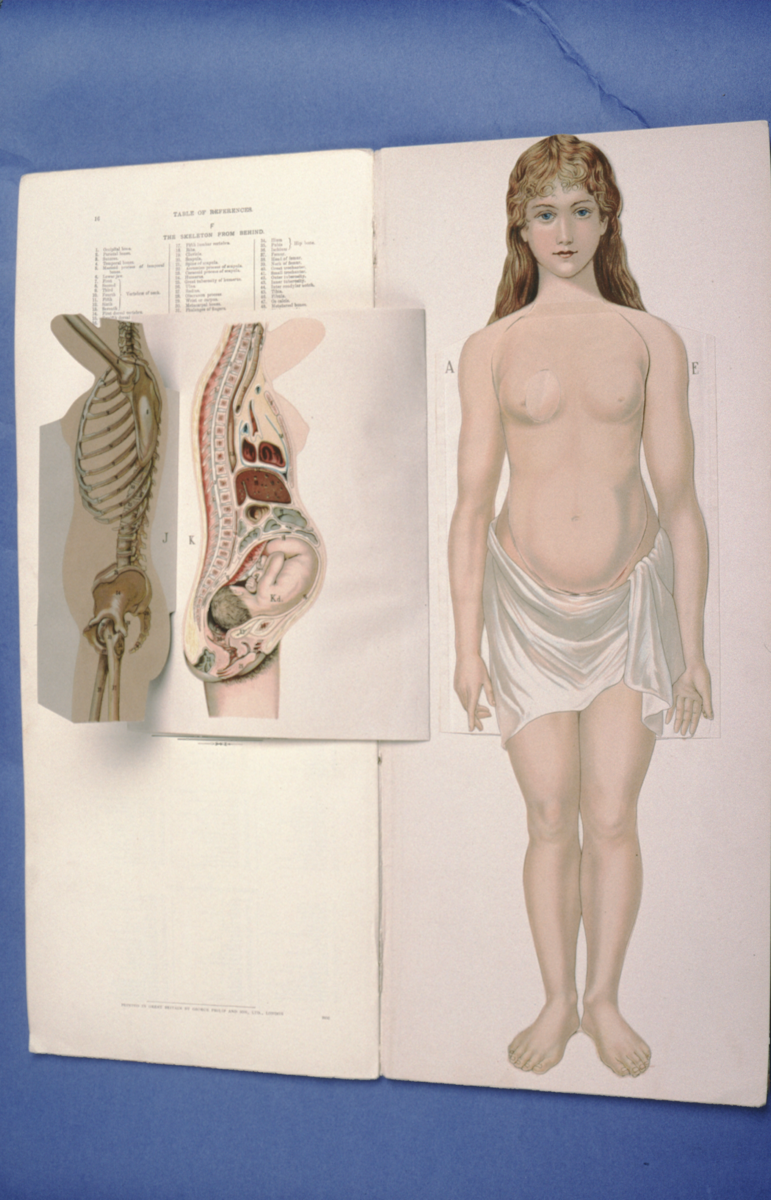
On the inside back page of the book is a coloured diagram of a woman which consists of a foldout piece to show the profile of the body and a baby's position in the womb and 7 other detailed panels. There is also a flap over the left breast which show the glands. The torso (diagram A) lifts up to reveal the internal organs. The whole of the body folds over to show the veins (diagram B) and internal organs on the other side. On the opposite side (diagram C) the whole body is drawn with the muscles represented. The front torso of this diagram opens out to show all of the internal organs again. All of the pieces do, however, move so the lungs open out to show the internal veins and the heart is divided up into its relevant chambers. Diagram D shows the back of the body with the muscles represented. Diagram E is the skeleton of the body. Diagram F is the skeleton of the body from the back. Diagram G shows the veins of the body without any internal organs.
References
Events
Description
The second half of the nineteenth century was a period of education reform in Britain. Domestic ‘supplement’ guides to health were increasingly made available and used by women who were traditionally responsible for the health of the family. This paper-flap model of human anatomy functioned as a form of virtual dissection for a non-expert audience and most likely was targeted to a middle-class market. Philips’ illustrated guide could have been used as a teaching aid for children at home or school. By this time, a ‘tactile’ pedagogy had become institutionalized in England’s elementary schools. Learning by handling objects became known as ‘object lessons’. This example of Philip’s paper-fold model is female. The paper flaps can be turned aside to reveal her muscular, vascular and nervous systems, as well as her skeleton. A loin cloth is depicted across her genitals. An explanatory text accompanies the paper model.
18/02/2014
Created by: Allison Ksiazkiewicz on 18/02/2014
FM:46265
Images (Click to view full size):