Accession No
5853
Brief Description
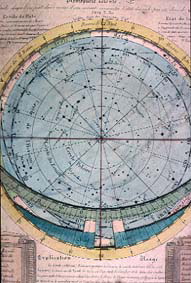
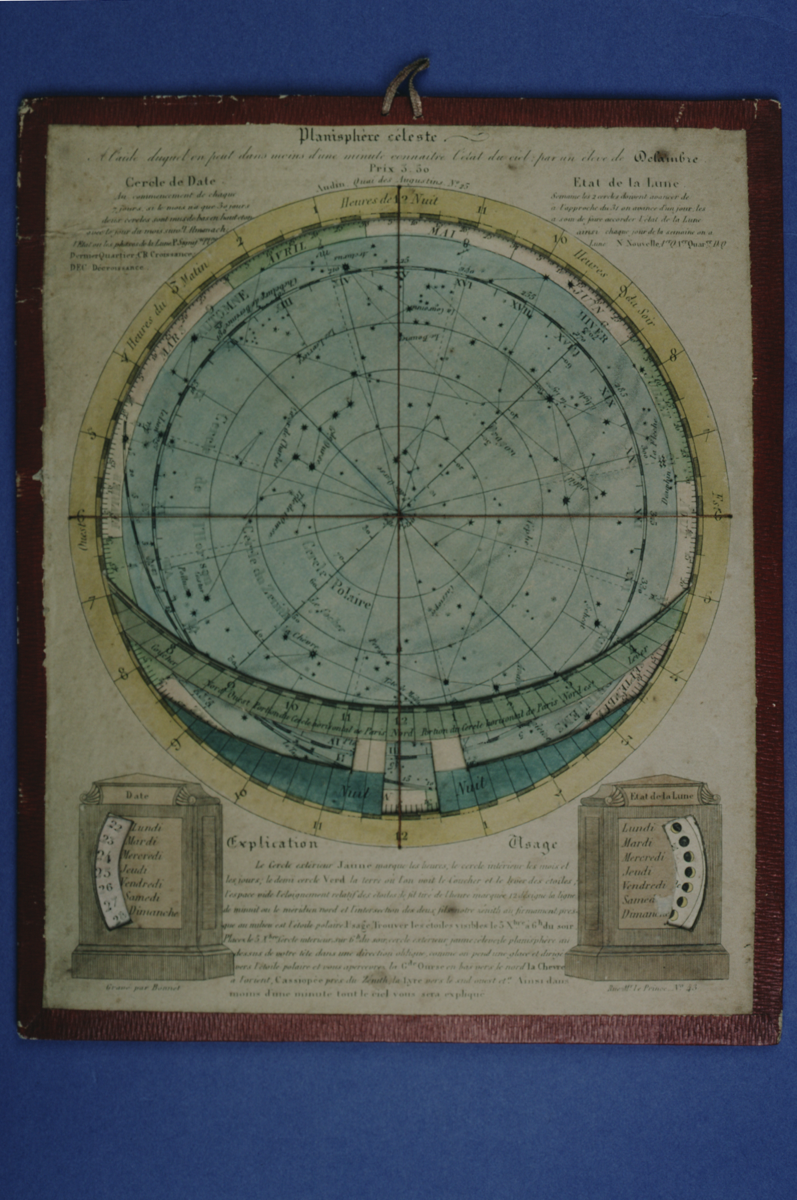
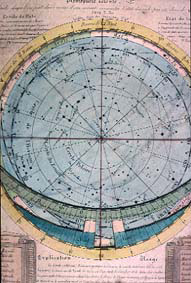
celestial planisphere, hand-coloured, by Audin (élève of the astronomer Jean Baptiste Joseph Delambre (1749-1822)), French, 1820 (c)
Origin
Maker
Audin
Class
astronomy
Earliest Date
1749
Latest Date
1822
Inscription Date
Material
paper (card and other); rope (string)
Dimensions
width 220mm; height 275mm
Special Collection
Provenance
Purchased from Trevor Philip & Sons Ltd, 75a Jermyn Street, St James’s, London, SW1Y 6NP on or before 07/11/2001.
Inscription
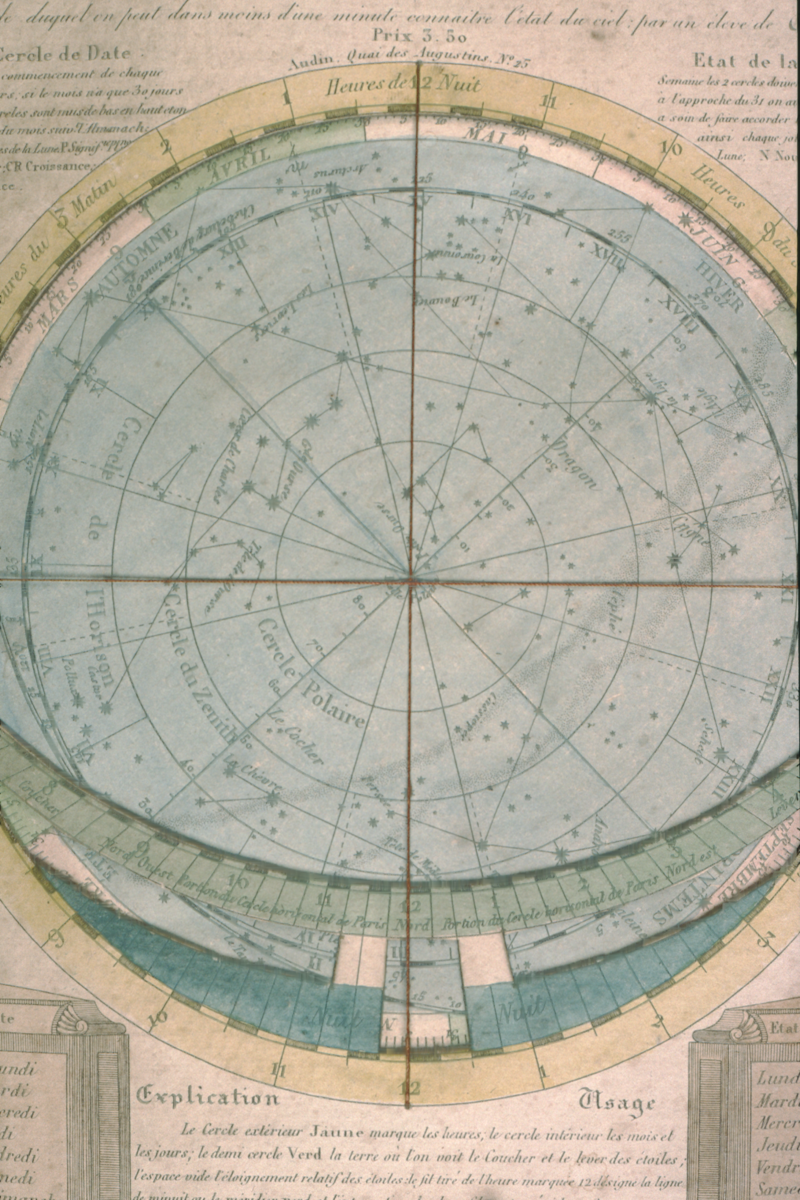
Planisphere celeste
A l’aide duquel on peut dans moins d’une minute connaitre l’etat du ciel; par un eleve de Delambre.
On left hand side of the planisphere;
Cercle de Date
Au commencement de chaque
7 jours; si le mois n'a que 30 jours
deux cercles sont mus de bas en haut eton
avec le jour du mois suiv. L’Almanache:
L’Etat ou les phases de la Lune. P. Signif. leplne.
DERNIER QUARTIER; CR Croissance;
DEC Decroissance.
In centre of planisphere;
Prix 3.50
Audin. Quai des Augustins. No.25
On the right hand side of the planisphere;
Etat de la Lune
Semaine les 2 cercles doivent avancer de
a l’approche du 31 on avance d’un jour; les
a soin de faire accorder l’etat de la Lune
ainsi chaque jour de la semaine on a
Lune; N.Nouvelle; 1er Q 1er Quar er D Q
Inscription at bottom of planisphere;
Explication Usage
Le cercle exterieur Jaune marque les heures; le cercle interieur les mois et
les jours; le demi cercle Verd la terre ou l’on voit le Coucher et le lever des étoiles;
l’espace vide l’elognement relatif des etolies de fil tire de l’heure marquee 12 designe la ligne
de minuit ou le meridien nord et l’intersection des deux fils notre zenith au firmament: presque
au milieu est l’etoile polaire. Usage. Trouver les etolies visibles le 5X bre a 6h du soir.
Placex le 5x.bre, Cercle interieur, sur 6h du soir, cercle exterieur jaune; levez le planisphere au dessus de votre tete dans une direction oblique, comme on pend une glace et dirige vers l’etoile polaire et vous apercevres la Gde Ourse en bas vers le nord la Chevre a l’orient, Cassiopee pres du Zenith, la Lyre vers le sud ouest et a.. Ainsi dans moins d’une minute tout le ciel vous sers explique.
Description Notes
A French celestial planisphere c.1820. Hand coloured. Published by Audin, “élève” of the astronomer Jean Baptiste Joseph Delambre (1749-1822).
Consists of a rectangular shape of thick card with three mobile squares which act as “dials” mounted on the back piece of card. When turned the dials rotate the three separate areas on the front piece of card which comprise of two calendars, one of the moon (Etat de la Lune)and one of the date, and the circular planisphere itself. The date section has written in list form the days of the week which remain static while the date in number form is rotated by the dial. The moon cycle is in the same format with the days of the week listed and images of the stages of the moon are rotated by the dial.
The planisphere itself has the hours of the day and night marked around the area that rotates. A cross of orange string marks the centre of the planisphere. There is also a piece of fabric knotted through two holes in the top of the planisphere with which to hang the planisphere up with.
References
Events
Description
Celestial planisphere
A planisphere is a device that shows the groups of stars (constellations) that can be seen in the sky at any time of the year in a particular location.
Different stars are visible in the sky depending on where you are on the earth’s surface. A planisphere is therefore designed for a certain area, showing the stars visible in that particular latitude zone (the position above/below the equator).
A planisphere consists of a star chart, i.e. a map of the sky, with the days of the year around the edge. The star chart is attached at its centre to a circular overlay with the hours of the day around the edge. The overlay has a window or hole so that only a portion of the sky will be visible in the window at any given time. Both parts are mounted so that they are free to rotate about a common pivot point at their centres. By lining up the correct date with the time of day you will get a map of what you can see in the sky at that time.
Since the planisphere shows the three-dimensional night sky on a flat surface, there is some distortion of distances and/or area, depending on what ‘projection’ is used to map the celestial sphere onto the plane surface.
15/04/2008
Created by: Ruth Horry on 15/04/2008
FM:46270
Images (Click to view full size):