Accession No
5899
Brief Description
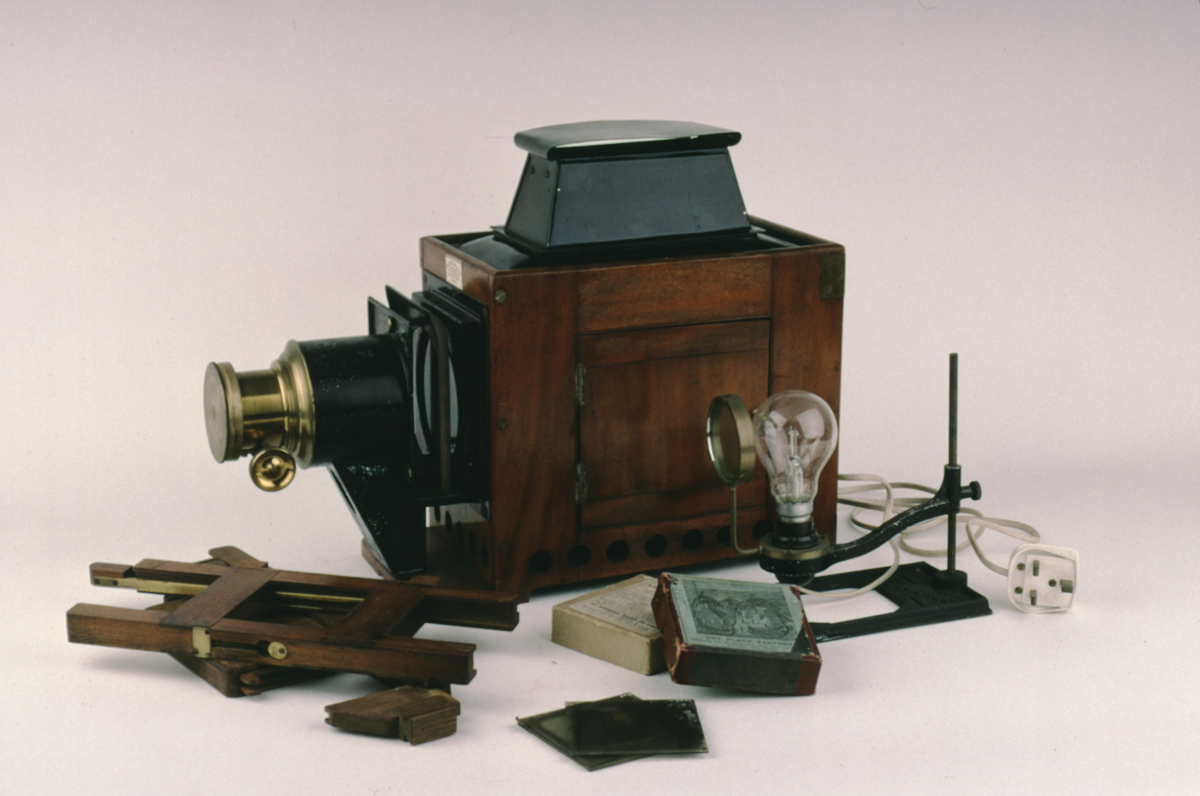
magic lantern with electric light source, with 115 slides (various subjects) and two slide holders, by Newton and Company, English, circa 1895
Origin
England; London; 3 Fleet St
Maker
Newton and Company [lantern] Beard, R. R. [one slide carrier]
Class
optical; demonstration
Earliest Date
1895
Latest Date
1895
Inscription Date
Material
wood (mahogany, boxwood); metal (brass, steel, cast iron); plastic (ivorine, rubber, moulded); glass
Dimensions
lantern min length: 460mm; width: 168mm; height (with cap): 319mm slides: 82mm x 82mm
Special Collection
Provenance
Donated by the Farmland Museum and Denny Abbey on or before 30/01/2003. Donated to Denny Abbey but was never accessioned into their collection.
Inscription
On plaque above lens:
NEWTON & Co.
OPTICIANS
TO THE QUEEN
3, FLEET STREET
London
On slide carrier:
"ECLIPSE"
R.R. BEARD
PATENT
Description Notes
Magic lantern with electric light source, with 115 slides (various subjects) and 2 slide holders, by Newton & Co., circa 1895.
Mahogany box with ventilation holes around the base, and two hinged doors at the back and side. Black painted steel lining on the inside, with a black-painted removable chimney. Two large condenser lenses. Steel mount at the front of the lantern carries a sprung bracket for the slide holders, and the brass mounted objective lens, with knurled focussing wheel (no longer works) and a brass lens-cap.
Later (early-mid 20th century) electric light source: cast iron sliding foot carries a column, with a clamped light bulb and brass ringed glass cover.
Two boxwood slide holders are present. One is signed on a small ivorine plaque and has a loading mechanism; the other is plain, with two movable slots
115 Slides covering a wide range of subjects, contained in 12 boxes.
Condition: (lantern, light source and slide holders) good, the slides are generally fair to good.
References
Events
Description
Magic lanterns are an early type of image projector. They use a powerful light source to project images onto a screen or wall. They were the precursors to modern slide, overhead and motion picture projectors. Although first developed in the 17th century, it was in the late 18th and 19th centuries that the design of the instrument became developed enough to make magic lantern shows a popular form of general entertainment and scientific and artistic education.
The basic elements of a magic lantern are a metal or wooden body, a light source, a condensing lens, a focusing lens, and interchangeable slides that were commonly produced in sets. The light source can be a candle, limelight, or an oil or gas lamp, with later magic lanterns utilising electric arc lamps and eventually electric bulbs.
A concave mirror behind the lamp reflects the light forwards and this is bent inwards by a set of condenser lenses so that it passes through the picture on the slide. The light then travels through a projection lens, which can be moved backwards or forwards to focus an image on a screen.
Early lantern slides were hand painted on glass, but by the late nineteenth century a number of companies were mass producing slide sets utilising photographic transparencies. Hand cranked mechanisms were sometimes also built into the slides to produce elaborate animated effects. Slide sets might show recent events, exotic locations from around the world, or illustrate tales and fables. For scientific lecturers, the magic lantern was an invaluable instrument for illustrating their public talks, enabling the projection of spectacular astronomical images or massive diagrams of plants and animals.
03/04/2014
Created by: Joshua Nall [Based on entry by Toni Parker, 01/02/2001] on 03/04/2014
FM:46345
Images (Click to view full size):