Accession No
5919
Brief Description
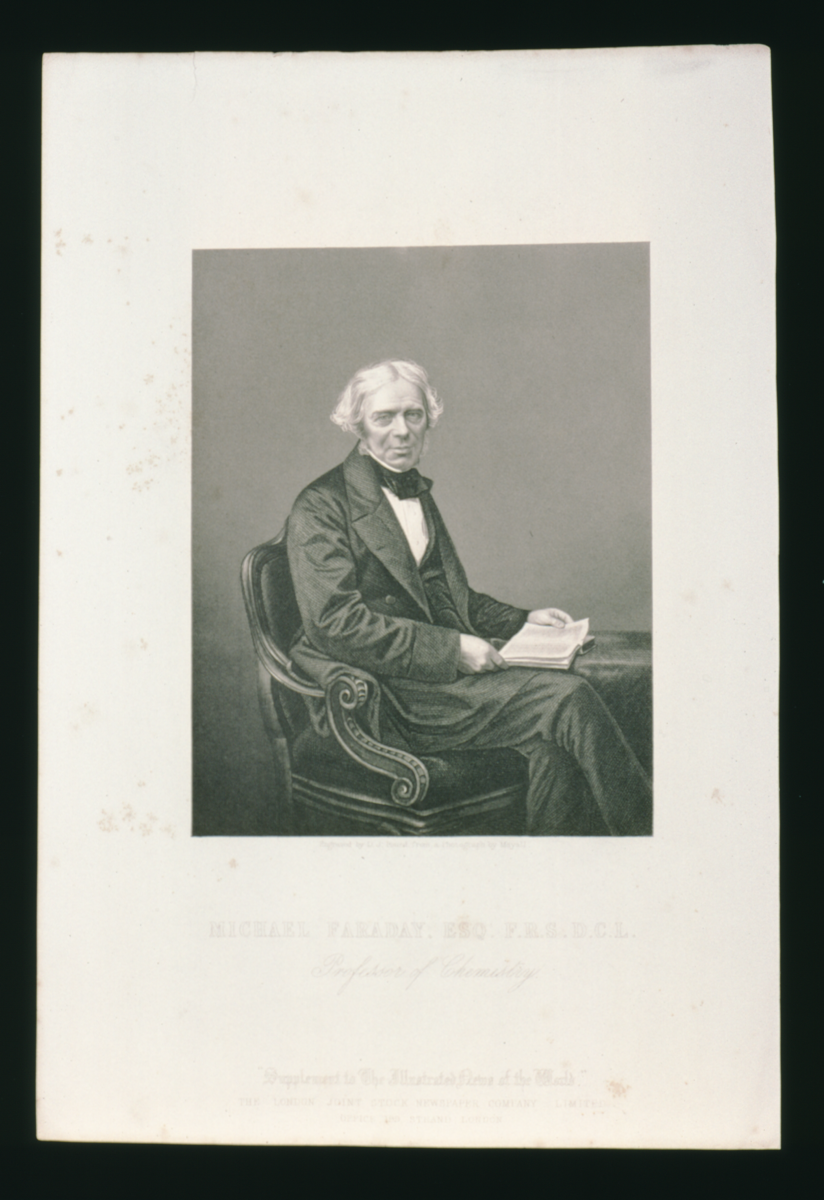
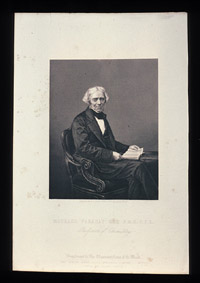
print of Michael Faraday, Professor of Chemistry, from a photograph by Mayall, and sheet of biographical information, by D. J. Pound, English, 19th Century
Origin
England; London
Maker
Pound, D. J. [engraver] Mayall [original photographer]
Class
prints
Earliest Date
1800
Latest Date
1900
Inscription Date
Material
paper
Dimensions
Length 411mm; width 268mm
Special Collection
Provenance
Purchased on or before 16/05/2003.
Inscription
Engraved by D.J.Pound from a Photograph by Mayall.
MICHAEL FARADAY, ESQ. F.R.S.D.C.L.
Professor of Chemistry
“Supplement fo The Illustrated News of the World.”
THE LONDON JOINT STOCK NEWSPAPER COMPANY LIMITED
OFFICE, 199, STRAND, LONDON
Description Notes
One black and white print showing a portrait of Michael Faraday (1791-1867) sitting on a chair with a book in his hand.
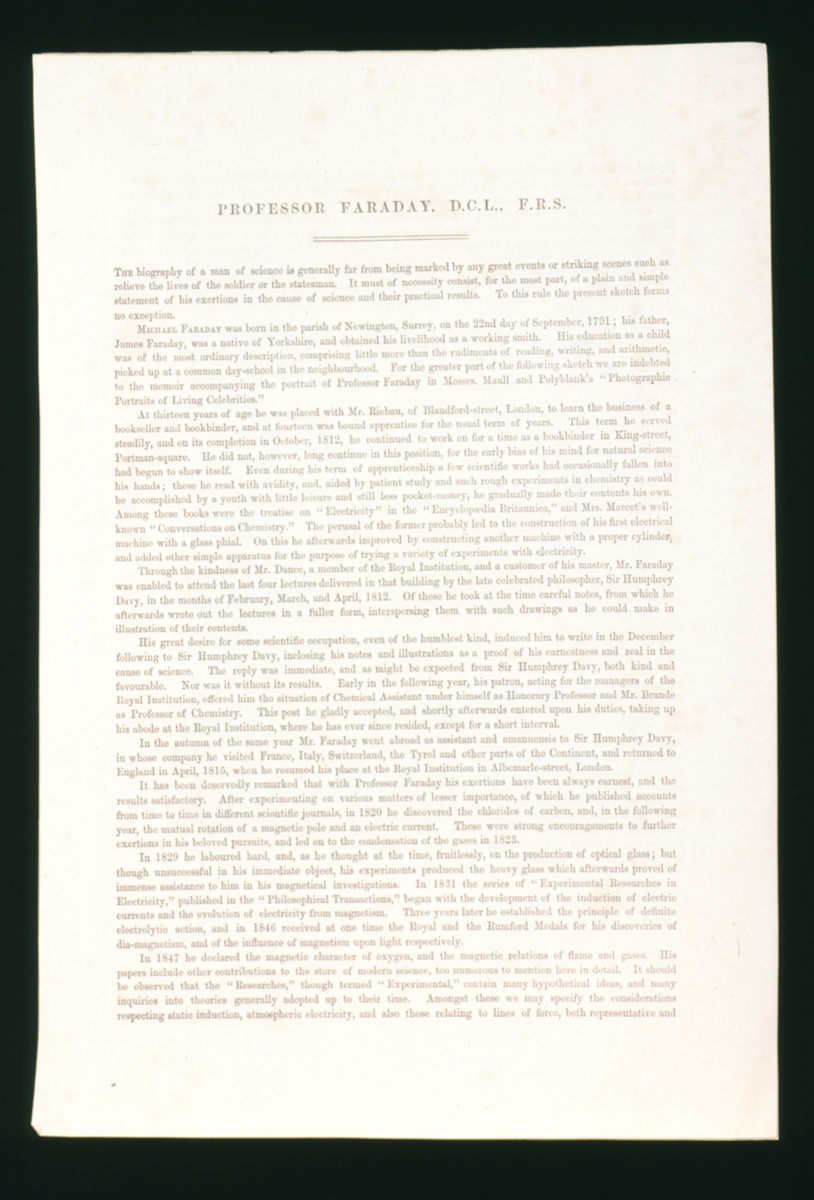
One sheet with biographical information about Professor Faraday on both sides of the sheet.
References
Events
Description
Michael Faraday was born on 22nd September 1791 and received no formal education. As a young teenager he became an apprentice to a bookbinder and the books he worked with ignited his interest in science.
In 1812 he attended four lectures by the chemist, Humphry Davy, at the Royal Institution. Faraday wrote up his notes from these lectures and presented them to Davy, at the same time applying for a job. As a result, Faraday was appointed assistant to Davy in the laboratory of the Royal Institution. He travelled around Europe with Davy and his wife and met a large number of influential scientists.
In his initial years at the institution Faraday discovered two new chlorides of carbon and succeeded in liquefying chlorine and other gases. In 1821 he published his work on electro-magnetic rotations but he was accused of failing to acknowledge Davy. He was also accused of stealing the initial idea from the chemist, William Hyde Wollaston. Thus, despite proving that gas could be transformed to a liquid state, his application to become a fellow of the Royal Institution was tainted by the Wollaston controversy.
His relationship with Davy had been soured and it was only after Davy’s death in 1829 that Faraday was free to make his more worthwhile discoveries. His ideas led him to believe that since an electric current could cause a magnetic field, a magnetic field should be able to produce an electric current. This principle of induction was demonstrated in 1831 and it proved to be a landmark in applied science. In the 1830s he also discovered the battery (electropotentials), the electric arc (plasmas) and the Faraday cage (electrostatics). He also introduced the Friday Evening Discourses in 1826 and the Christmas lectures in 1827. Faraday’s experiments led in 1834 to what became known as Faraday’s laws of electrolysis and his discovery in 1845 that an intense magnetic field can rotate the plane of polarized light is now known as the Faraday effect.
As his health began to deteriorate he reduced his amount of research. He was offered the presidency of the Royal Institution in 1864 but he declined it, not wishing to take any prominent role.
He died on 25th August 1867 and is buried in Highgate cemetery.
22/07/2003
Created by: Tudor. Rebecca on 22/07/2003
FM:46378
Images (Click to view full size):