Accession No
5922
Brief Description
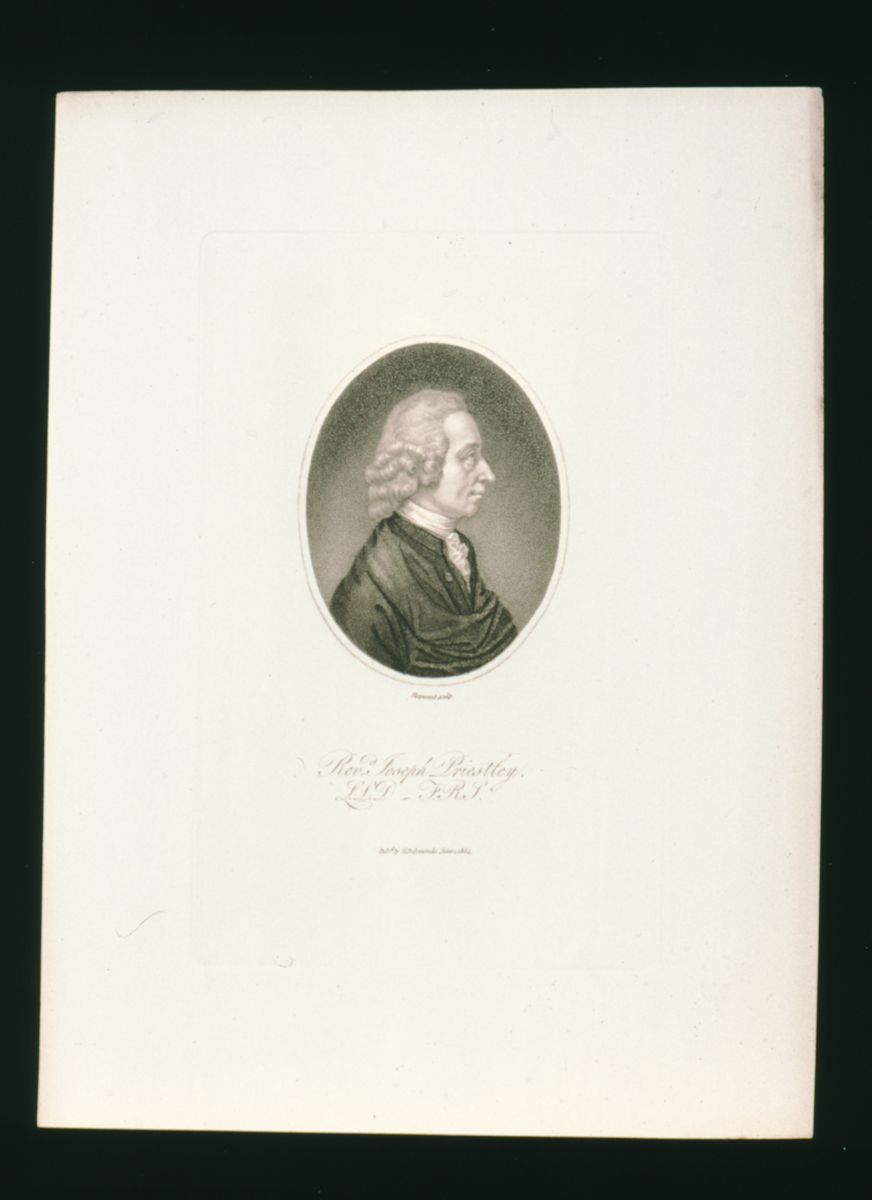
Print of Reverend Joseph Priestley, stipple engraving published by H.D. Symonde, 1804.
Origin
UK
Maker
Published by H.D.Symonds
Class
prints
Earliest Date
1804
Latest Date
1804
Inscription Date
1804
Material
paper
Dimensions
Length 261mm; width 185mm
Special Collection
Provenance
Purchased on or before 16/05/2003.
Inscription
Hopwood sculp.
Rev.d Joseph Priestley.
L.L.D - F.R.S.
Pub.d by H.D.Symonde. June.1.1804.
Description Notes
Print of Reverend Joseph Priestley (1733-1804), chemist, stipple engraving published by H.D. Symonde, 1804.
References
Events
Description
Joseph Priestley is credited for laying the foundations of Chemistry. He is best known for his experiments on oxygen but also made significant contributions to the fields of theology, education, moral philosophy and physical science.
He was born in March 1733 at Fieldhead near Leeds and was adopted by his aunt and uncle, Sarah and John Keighly, at the age of nine. Many of the dissenting ministers frequented the house and Priestley was exposed to discussions of theological questions and to liberal political attitudes. He left school after a bout of tuberculosis but continued to teach himself many languages together with the rudiments of geometry, algebra and mathematics.
He began to question the Calvinist faith so decided to attend the more liberal Daventry Academy to train for the ministry. His first position was at Needham Market in Suffolk but he felt more welcome at his second appointment in Nantwich, Cheshire where the congregation was more accepting of his unorthodox theology.
He became a tutor at the new Dissenting Academy in Warrington where he married Mary Wilkinson, the daughter of John Wilkinson, one of the leading figures of the emerging Industrial Revolution in England.
During his trips to London he became friendly with figures such as Richard Price and Benjamin Franklin and introduced to scientific society. His ‘The History and Present State of Electricity’ led to his election as a Fellow of the Royal Society in 1766.
Priestley successfully isolated dephlogisticated air which later became known as oxygen. These experiments on air began in 1767 and peaked in 1774. The situation of his house near to a public brewery led to many experiments on fixed air (carbon dioxide).
After being refused a position on Captain Cooke’s second voyage because of his religious beliefs, he accepted a position with the Earl of Shelburne as librarian and tutor to his sons. It was here that he published ‘Disquisitions Relating to Matter and Spirit’ and ‘Experiments and Observations’. He travelled with Shelburne to the continent and whilst in Paris he met with Lavoisier and spoke about his recent isolation of gas from the red oxide of mercury. It was with this information that Lavoisier was able to develop the scheme of the role of oxygen in burning.
He resumed his active ministry in Birmingham where he joined the Lunar Society with Josiah Wedgwood, Matthew Boulton, James Watt, Erasmus Darwin and William Small.
He continued to uphold his dissenting beliefs and published three works which directly attacked the orthodox religion. They caused huge controversy and a mob burned his house with most of his scientific instruments inside. Priestley fled to London but the attacks on him through cartoons, letters and verbal abuse continued. He had become an honarary citizen of France, which was at war with England, and was forced to resign his membership with the Royal Society. Eventually he decided to emigrate to America to join his sons.
In America, Priestley became the founder of the first Unitarian church and was greatly admired by Jefferson. He died on February 6th 1804.
28/07/2003
Created by: Tudor. Rebecca on 28/07/2003
FM:46381
Images (Click to view full size):