Accession No
5925
Brief Description
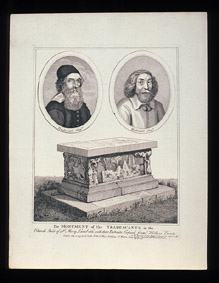
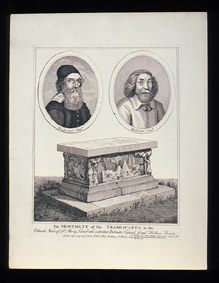
print of the Monument of the Tradescants and their portraits, by N. Smith after Wenceslaus Hollar, English, 1793
Origin
England; London
Maker
Hollar, Wenceslaus [original artist] Smith, N. [publisher]
Class
prints
Earliest Date
1793
Latest Date
1793
Inscription Date
1793
Material
paper
Dimensions
Length 294mm; width 228mm
Special Collection
Provenance
Purchased on or before 20/05/2003.
Inscription
Tradescant Sen.r
Tradescant Jun.r
The MONUMENT of the TRADESCANTS, in the Church Yard of St Mary Lambeth, withe their Portraits, Coped from Hollars Prints.
Published July 15. 1793 by N. Smith N.o 18 G.t Mays Buildings S.t Martins Lane
See M.r Lysons’s Surry P289 D.r Ducarels Appx to the History of Lambeth & M.r Pennants London 29 30 & 31
Description Notes
Print showing black and white stipple engravings of Tradescants Senior (d.1637) and Junior (1608-1662) (both named John), and their monument.
References
Events
Description
The Tradescants were gardeners who were responsible for introducing many new plants to England and it is argued by some that they founded English gardening as we know it.
John Tradescant the elder (c.1570-1638) was appointed gardener to Robert and William Cecil, the first and second Earls of Salisbury. He travelled to the Continent in pursuit of botanical specimens with which to enhance the gardens of his patrons. Following a voyage to Russia with Sir Dudley Digges, Tradescant brought the larch tree to England. Similar voyages brought the introduction of the apricot, the lilac and, later, the poppy.
Tradescant moved to Canterbury and Essex working under people such as Lord Wotton and the first Duke of Buckingham. By 1630 he had been appointed Keeper of his Majesty’s Gardens, Vines, and Silkworms at Oatlands Palace.
In 1625 or 1626 he leased an estate in Lambeth where he housed his collection. This collection, known as ‘Tradescant’s Ark’ was added to by his son and soon became the most extensive in Europe and the first collection accessible to the general public.
John Tradescant the younger (1608-1662) was admitted a freeman of the Worshipful Company of Gardeners and made voyages to Virginia to collect specimens. He too was summoned to the court of King Charles I as keeper after the death of his father and it is thought that he introduced pineapples and daffodils to the country.
The early 1650s were spent making a catalogue of the contents of ‘Tradescant’s Ark’. Tradescant wanted the whole collection to be present to the University of Oxford, but he wanted to ensure that his second wife, Hester Pooks, could enjoy it and the income from it for the rest of her life. Elias Ashmole, another collector of curiosities, had become friendly with Tradescant and he tricked Tradescant into signing a Deed of Gift awarding the Closet of Rarities to himself. Tradescant thought that it would be jointly owned by Hester and Ashmole, but shortly after John’s death, Ashmole took Hester to court, gained control of the collection and presented it to Oxford in his own name. This is what is now the Ashmolean Museum. It is widely thought that Hester committed suicide in her pond, and she was buried in the monument with the three generations of Tradescants (John senior, John junior, and John junior’s son, John).
The monument of the Tradescants, originally of 1662, was repaired in 1773 and again in 1853. Sculptural work on it includes the arms of the Tradescant family, Greek pillars, a pyramid, an obelisk and a view of Egyptian buildings. At the corners, large trees are depicted supporting the top and framing the sides.
04/06/2003
Created by: Tudor. Rebecca on 04/06/2003
FM:46384
Images (Click to view full size):