Accession No
5986
Brief Description
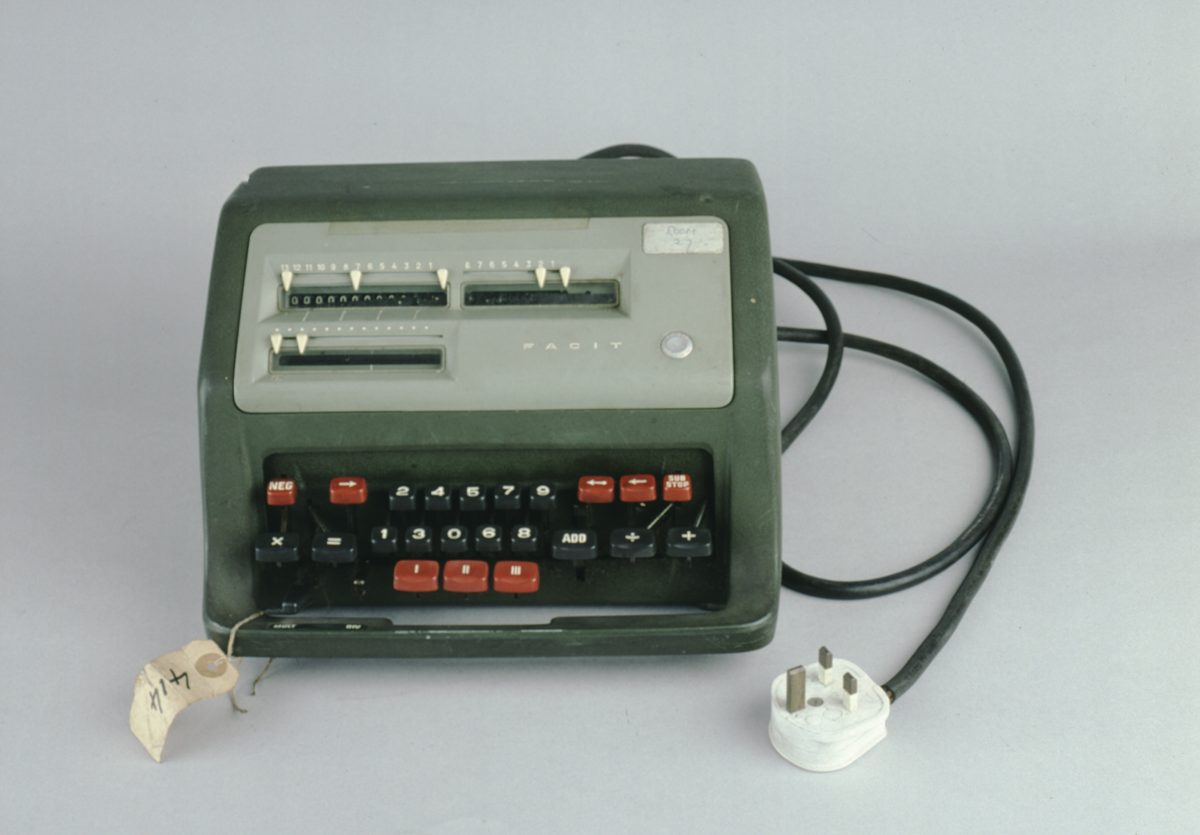
electric calculating machine by Facit; circa 1952
Origin
Sweden; purchased in UK
Maker
Facit
Class
calculating
Earliest Date
1952
Latest Date
1952
Inscription Date
Material
metal (steel, brass); plastic
Dimensions
Length 275mm; width 310mm; height 190mm
Special Collection
Provenance
Donated on or before 26/11/2003. The donor bought the Facit new in 1952 with her first project gant award.
Inscription
FACIT FACIT SWEDEN Atvidagerg
BLOCK & ANDERSON
LIMITED
LONDON AND DARLINGTON
BRANCHES THROUGHOUT
THE COUNTRY
On Base: MADE BY
ATVIDABERG-FACIT
SWEDEN
Protected by patents
in Sweden and other countries
Model CAI-13
652505
Description Notes
Electric calculating machine with galvanised steel shell. 23 plastic keys on steel arm levers. 3 plastic windows with number dials, sliding plastic cursors are positioned above the windows. The machine has an electrical cable with three pin plug.
condition: good
References
Events
Description
During myD.Phil years in the Department of Zoology at Oxford, I used a Facit calculator (made in Sweden) operated by turning a handle (slow but reliable), then briefly an unsatisfactory semi-automatic model. In 1952, our postgraduate work completed, my colleague Donald Michie and I were awarded a 3-year project grant (by the Agricultural Research Council) entitled “Studies on extrachromosomal inheritance in mammals” in Professor Peter Medawar’s department at University College London. This Facit, one of the first fully electric models, was among our first purchase on that grant.
For three years at UCL we used the Facit for all our routine statistical calculations, including a lengthy multivariate analysis of mouse sex ratio data.1 For the subsequesnt four years we were located at the Royal Vetinary College in London, and the Facit was used much more intensively. Two series of experiments in particular depended heavily on statictical analysis: one on foetal and placental growth, in relation to variables which included the number of foetuses in each uterine horn and in the uterus as a whole,2,3 and the other on variability, both in susceptibility to anaesthesia of inbred mice and F1 hybrids, and in postnatal growth of mice reared in hot and cold stress conditions.4,5 Much of the calculation involved the analysis of variance, including the derivation of partial regression equations. The Facit proved particularly useful, since it allowed the sum x and the sum of squares to be calculated and accumulated simultaneously.
In 1959 I moved to the institute of Animal Genetics in Edinburgh, where there was a machine that could be programmed to do standard statistical tests by inserting cards. The Facit sat in my office. I used it occasionally, and my three small children used it very often. That it survived intact was a tribute to its robust construction. After 13 years I moved back to University College London. Most statistics were by now done by computer programs, but the Facit was handy for small calculations, and was still in good working order when it went into storage in 1992, after 40 years of faithful service with no repairsever required.
1. Howard, A., McLaren, A., Michie, D. and Sander, G. (1955) Genetic and environmental influences on the secondary sex ratio in mice. Journal of Genetics51: 200-214
2. McLaren, A. and Michie, D. (1960) Control of pre-natal growth in mammals. Nature 187, 363-365
3. Healy, M.J.R., McLaren, A. and Michie, D. (1960). Foetal growth in the mouse. Proc.Roy.Soc.B 153:367-379
4. McLaren, A. Comparison of the reactions of inbred F1 hybrids and random bred mice to a narcotic drug. Journal of Genetics 54:440-455
5. Ashoub, M.R., Biggers, J.D., McLaren, A. and Michie, D. (1958). The effect of the environment on phenotypic variability. Proc.Roy.Soc.B. 148:192 - 203
Created by: Anne McLaren; previous owner; October 2003
FM:46449
Images (Click to view full size):