Accession No
6114
Brief Description
chemistry ball-and-stick molecular model kit, British, 1930s
Origin
Britain
Maker
Class
chemistry; demonstration
Earliest Date
1930
Latest Date
1939
Inscription Date
1939
Material
wood; metal (brass, other); paint; lacquer; paper (cardboard, paper); cloth (felt)
Dimensions
length 245mm; width 125mm; height 100mm (in box)
Special Collection
Provenance
Purchased from a private individual via eBay.co.uk, on or before 09/03/2007 The eBay sellor was given the kit by Richard Schardt, who taught Biology at Leighton Park School, Reading, Berkshire - from 1941-46 and 1949-79.
Inscription
‘BRITISH MADE’ [stamped into inner box lid]
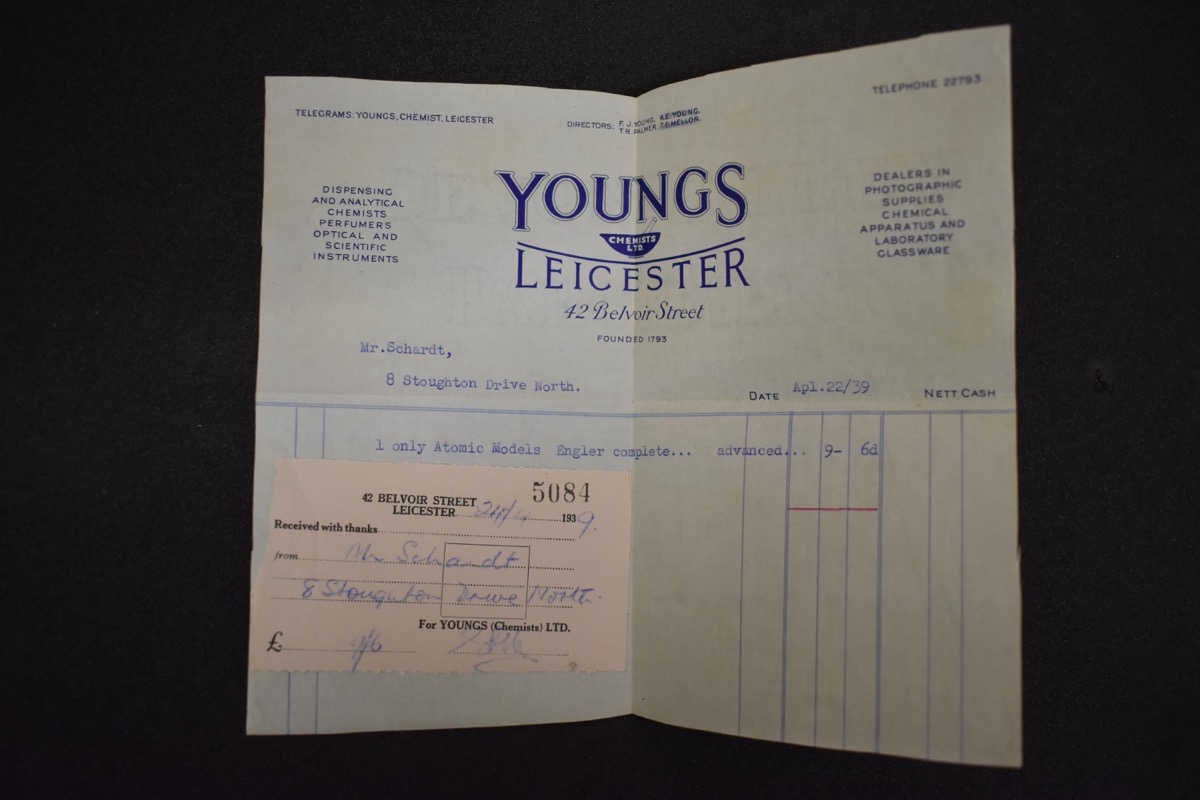
‘YOUNGS
CHEMISTS LTD
LEICESTER
42 Belvoir Street
Founded 1793
DISPENSING AND ANALYTICAL CHEMISTS PERFUMERS OPTICAL AND SCIENTIFIC INSTRUMENTS
Mr. Schardt,
8 Stoughton Drive North. DATE: Apl.22/39
1 only Atomic Models Engler complete... advanced... 9- 6d’
Description Notes
Chemistry ball-and-stick molecular model kit; possibly British; 1930s.
Complete with original purchase invoice from Youngs Chemists Ltd. of Leicester, dated April 22nd 1939.
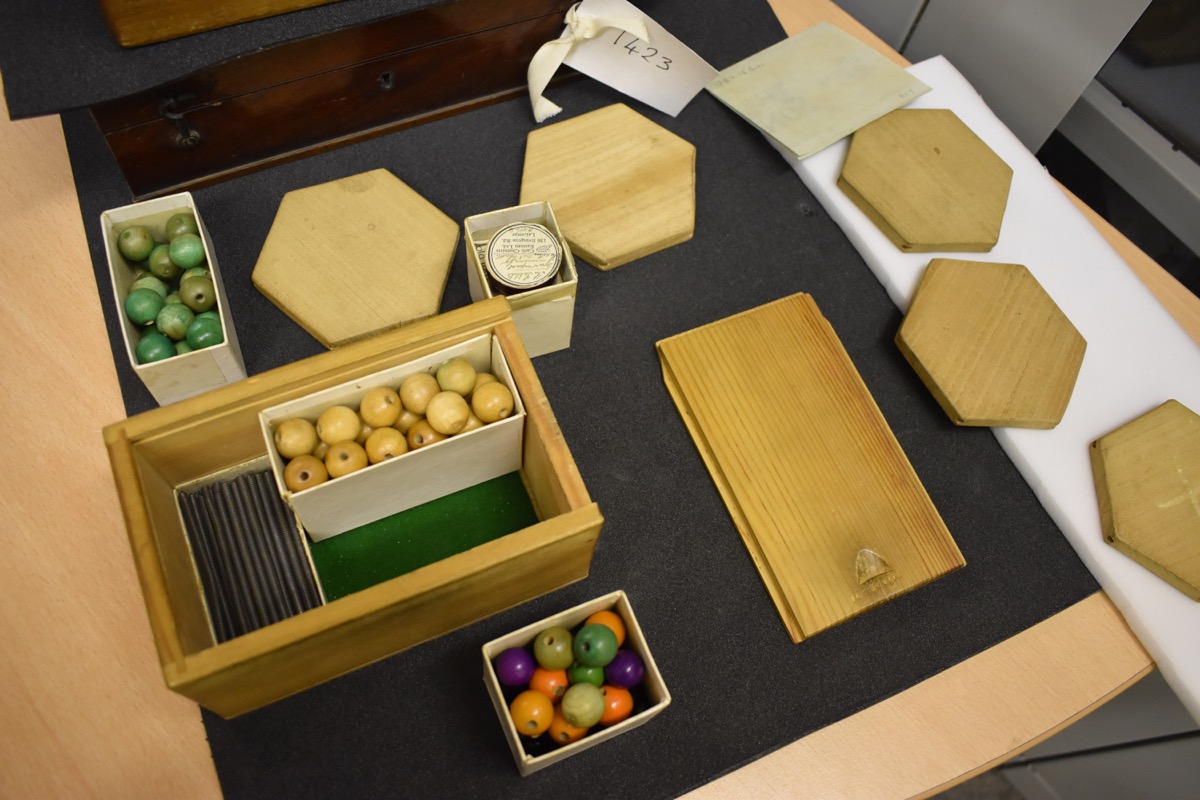
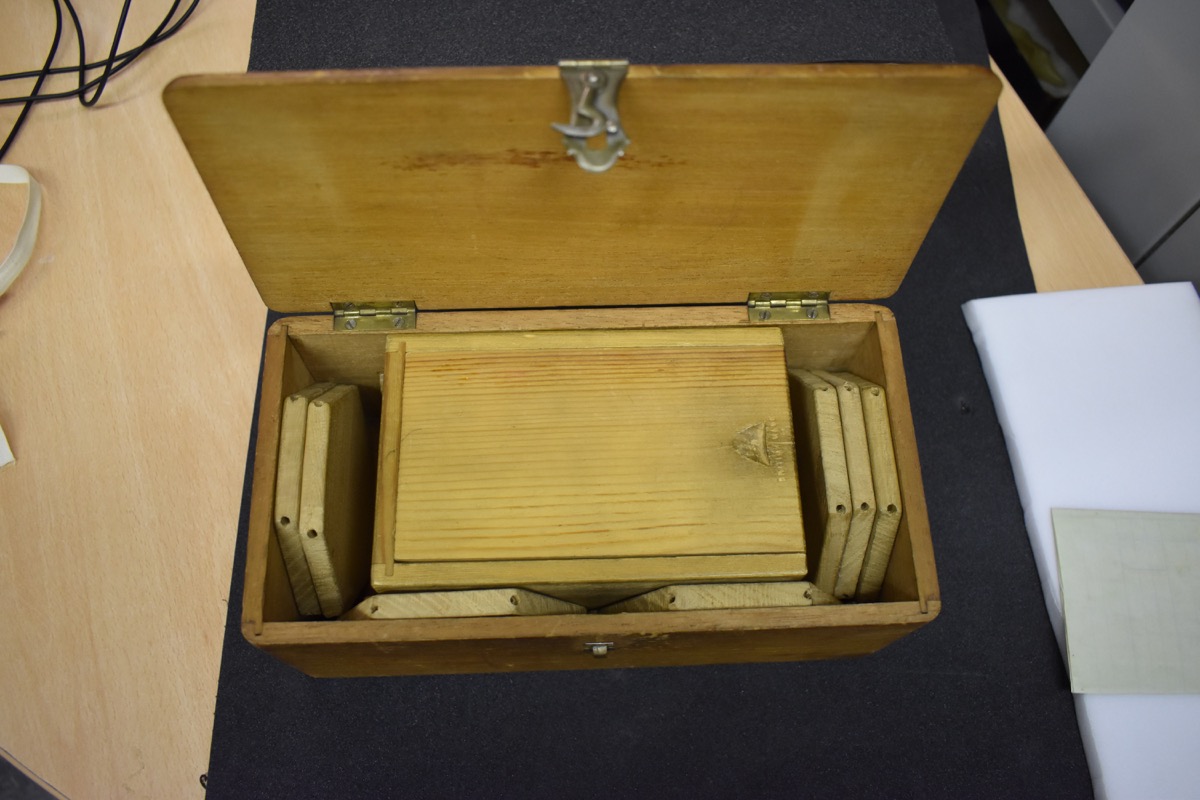
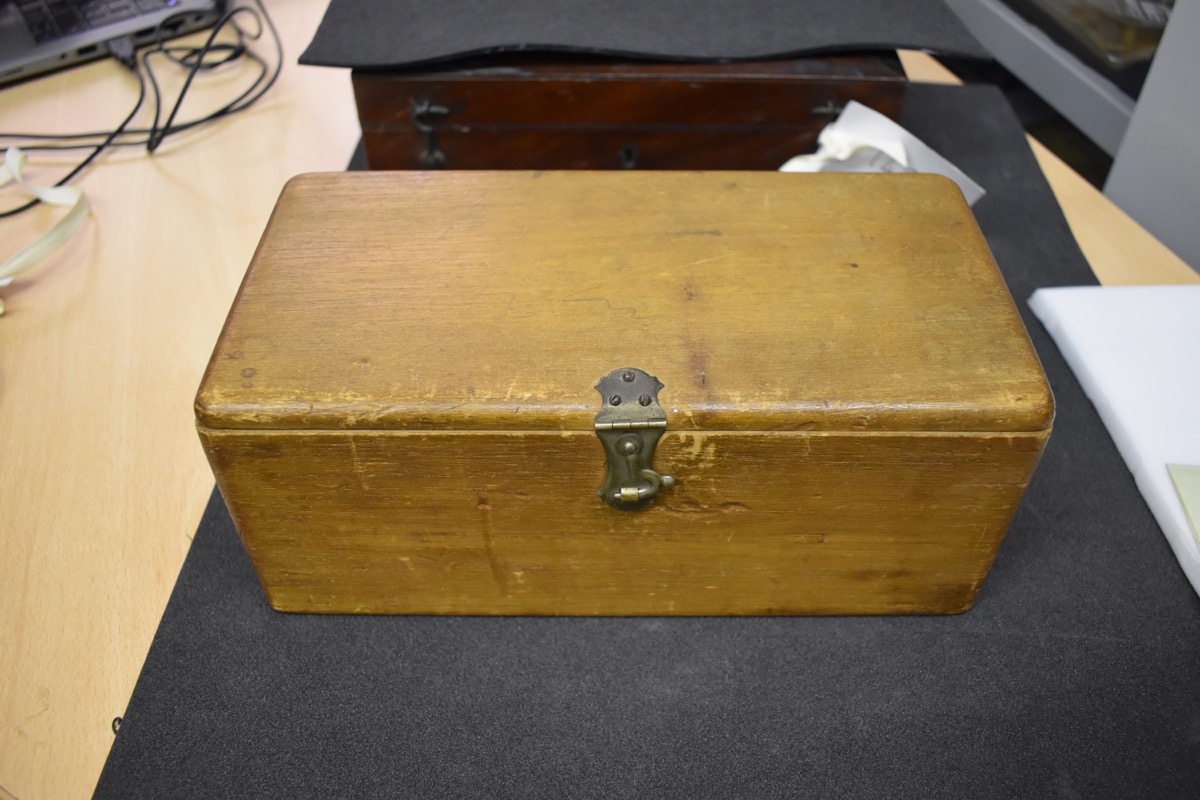
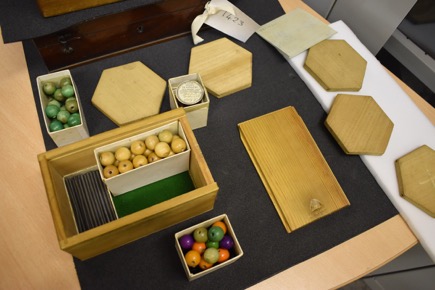
Set is contained in its original wooden box, with green felt on the bottom. The atoms are contained in a smaller wooden box with a sliding lid.
This model kit is used to represent the structure of simple organic molecules. Set contains painted and laquered wooden balls, representing atoms, each with a number of holes drilled into them. Each colour represents a different element, with the number of holes indicating the atom’s valency (the number of bonds it can make with other atoms).
Colours of atoms:
assumed element colour number of balls
carbon
(4 holes, sp3 hybridised config.) black 17
hydrogen (1 hole) natural wood 30
unknown (1 hole) green 30
carbon? (3 holes, sp2 hybrid config) red 7
oxygen? (2 holes) red 3
unknown (2 holes) purple 2
unknown (4 holes) orange 5
unknown (2 holes) dark blue 1
unkown (1 hole) dark green 1
Seven of the red wooden balls have had an additional hole drilled, probably by the owner, in order to make suspected sp2 hybridised configuration of carbon (one double bond and two single). In one instance the extra hole has been filled in and painted over.
The blue, purple and dark green balls are smaller than the others and are possibly not original to the set.
Seven wooden hexagons are included, which represent six membered rings. Each hexagon has holes to attach the joining atoms. There is also one double hexagon, which indicates two adjoining six membered rings. Hexagons slot into the spaces inside the box.
The atoms are connected together with metal springs of two lengths, which represent the lengths of bonds between the atoms. Both springs and balls are stored in cardboard containers. Small springs are stored in an empty medicine container (labelled as such on the lid).
A hexagon wooden piece is possibly missing (a gap in the box).
Condition good; wooden box has some old score marks and ink stains on the underside.
References
Events
Description
There are several main types of atomic models in use today. Two of the most common are 'ball and spoke' and 'space-filling' types. Each model type displays different information about molecules. Whilst ball and spoke models are designed to show how the atoms bond together, space-filling models accurately demonstrate the size and shape of the molecule. This model kit uses the ‘ball and spoke’ type of modelling to represent the structure of simple organic molecules. Different types of atoms or elements are represented as coloured wooden balls. The number of holes in the wooden ball indicates the atom’s valency (the number of bonds it can make with other atoms). Models are essential to teaching and research in chemistry. They are useful tools for visualising the structures and shapes of groups of atoms, which is important in understanding molecular behaviour. Complete with original purchase invoice from Youngs Chemists Ltd. of Leicester from April 1939, this kit was owned by Richard Schardt who taught biology at Leighton Park, a public school with an excellent reputation for the study of natural history.
10/03/2014
Created by: Allison Ksiazkiewicz on 10/03/2014
FM:46583
Images (Click to view full size):