Accession No
6150
Brief Description
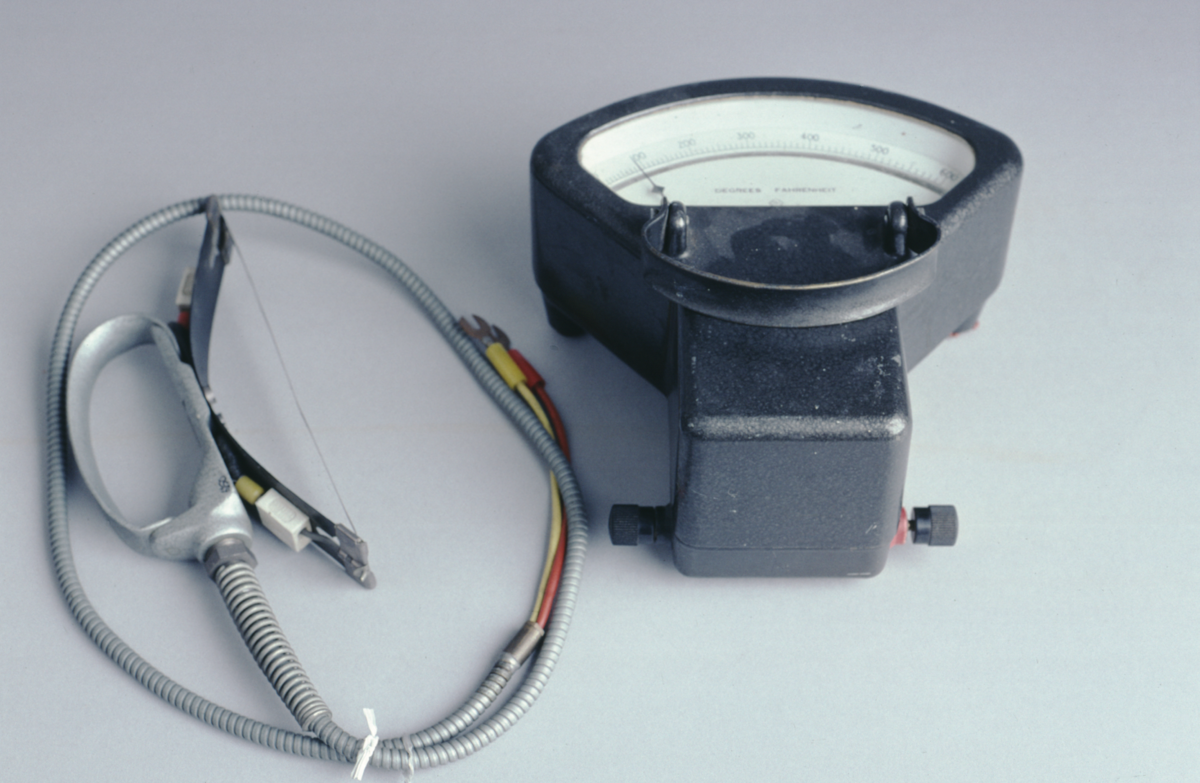
surface thermocouple pyrometer, by Cambridge Instrument Company Ltd., English, 1959-1963
Origin
England; Cambridge
Maker
Cambridge Instrument Company Ltd.
Class
electrical; metrology; thermometry
Earliest Date
1959
Latest Date
1963
Inscription Date
Material
metal (galvanized steel; aluminium; copper); plastic; glass; rubber
Dimensions
object 1: length 193mm; width 198mm; height 123mm object 2 (coiled): length 290mm; width 180mm; height 34mm
Special Collection
Provenance
Donated on or before 23/01/2003. The donor collected the instruments over many years, predominantly from private sales, some were obtained direct from the manufacturers who were going to throw them out.
Inscription
“CAMBRIDGE INSTRUMENT CO. LTD. LONDON AND CAMBRIDGE”
“INST NO C663048”
“AUTO COMPENSATED COLD JUNCTION”
“BATCH 82”
Description Notes
object 1:
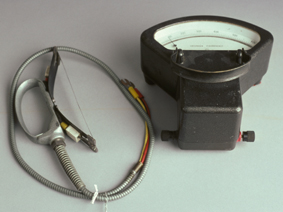
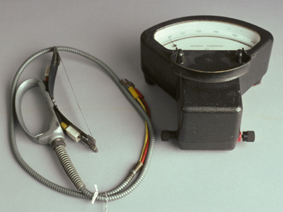
Indicator, comprising of a dark grey galvanized steel case that is Y-shaped, with a handle attached to its upper surface. At the top of the Y is a semi-circular shaped glass window, behind which is the needle dial, which ranges from 0 to 600 degrees fahrenheit. On the bottom surface are three rubber feet and an attachment for a tripod stand (tripod not included with this object). At the bottom of the Y on either side of the case is two screw attachments for the thermocouple’s wires.
object 2:
Strip pattern thermocouple, comprising of 1120mm long electrical cable (sheathed in flexible aluminium) attached to a galvanized steel handle, attached to which is a semi-circular steel strip. Held in tension between the steel semi-circular strip is the thermocouple strip, which consists of a thinly rolled strip consisting of two dissimilar metals welded together (types of metal unknown). This thermocouple strip is attached at both ends to electric cable.
References
Events
Description
Thermometers cannot be used to accurately measure the temperature of the surface of a body, as they will tend to measure the temperature of the air around the surface, even if pressed against it.
Instead, surface temperature can be measure extremely accurately using a surface thermocouple pyrometer. This comprises of a thin strip supported in a frame which forms a handle. The strip comprises pieces of two dissimilar metals having suitable thermo-electric constants, welded together end to end, and rolled out so as to form a flexible continuous strip. The hot junction is at the centre of the metal strip, and when the thermocouple is allowed to rest lightly upon a heated surface, a thermal potential difference is established between the two dissimilar types of metal, due to their differing thermo-electric constants. Due to the thermoelectric effect, this thermal potential difference generates a voltage potential difference, which the indicator box attached to the thermocouple then converts to a temperature reading.
Because thermal potential difference between the two metals increases with surface temperature, differing surface temperatures produce differing voltage potential differences, allowing for accurate variable measurement of temperature.
02/08/2007
Created by: Joshua Nall on 02/08/2007
FM:46615
Images (Click to view full size):