Accession No
6160
Brief Description
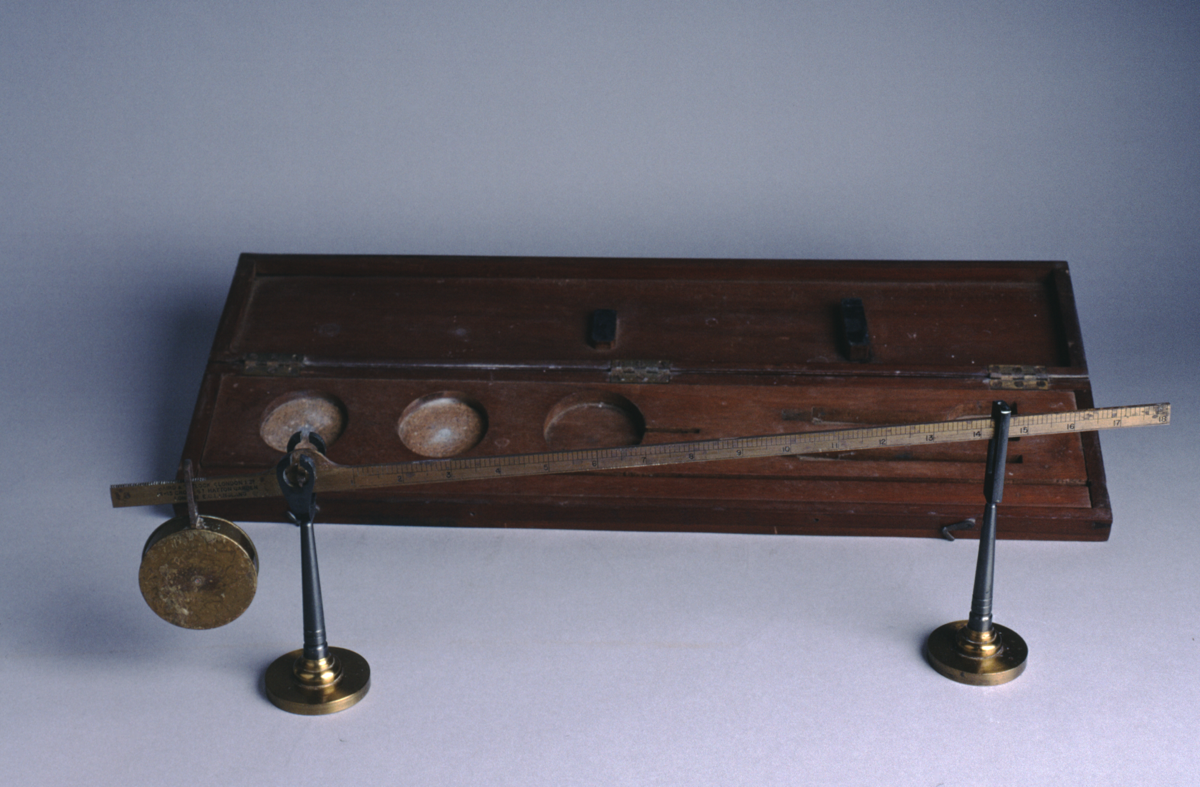
Walker’s geological balance, in wooden box, by Baird and Tatlock (London) Ltd., English, early 20th century
Origin
England; London; Hatton Garden, 14-15 Cross Street, EC1
Maker
Baird and Tatlock (London) Ltd.
Class
earth sciences; balances
Earliest Date
1900
Latest Date
1930
Inscription Date
Material
metal (brass, steel); wood (mahogany); cork
Dimensions
Length 585mm; width 119mm; height 45mm
Special Collection
Provenance
Purchased from Tesseract, Box 151, Hastings-on-Hudson, New York 10706, on or before 16/08/2007.
Inscription
‘BAIRD & TATLOCK (LONDON) LTD
[BTL logo]
LONDON, ENGLAND’ (on top of box)
‘BAIRD & TATLOCK (LONDON) LTD
14-15 CROSS ST HATTON GARDEN
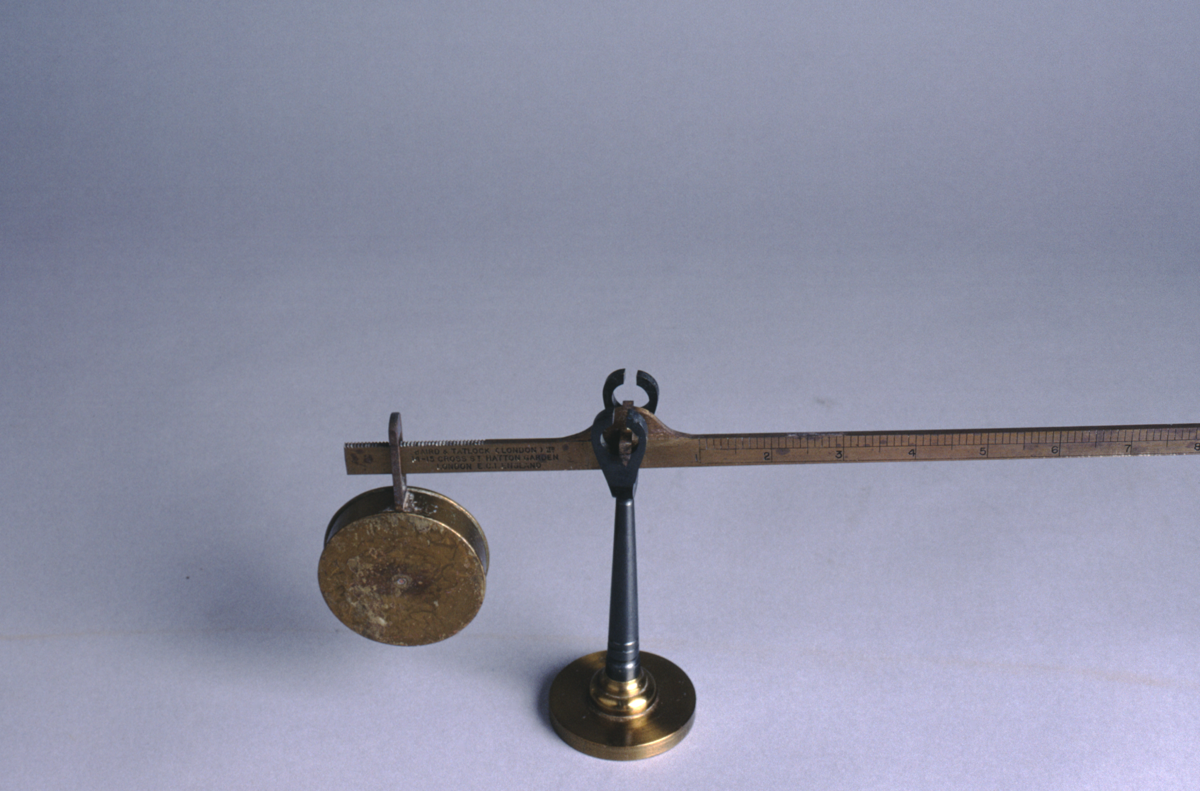
LONDON E.C.I. ENGLAND’ (on main beam of balance)
Description Notes
Walker’s geological balance in wooden box, English, early 20th century.
Long main beam of lacquered brass with notches on one side, divided 1 - 18“, numbered by 1, and subdivided by tenths. Beam sits on twin chemically-darkened brass supports with turned lacquered brass bases. On one of the supports the beam sits on a pivot (a knofe-edged rod perpendicular to the beam), and at the other end it sits in a slot so that it can move up and down (the degree to which it moves depending on how far from the pivot along the length of the beam this support is). A circular weight has squiggle-worked brass and is slotted onto the beam on the other side of the pivot to the main length of the beam.
All parts fit into cut-out spaces inside the hinged mahogany box. The spaces for the bases to the supports are inlaid with cork. Two small blocks of wood glued to inside of box are positioned to hold the weight and the upright parts of the supports in place. Box has two metal catches.
Good/fair condition. Much of the lacquer, especially on the weight, is badly corroded. Pivot on main beam is rusting.
References
Events
Description
How to set up the balance:
The main beam rests on its pivot, which sits on the two circular openings at the top of one of the support stands. The other end of the beam is fed into the vertically-oriented slot at the top of the second support stand, so that it can move upwards in the slot to an angle above horizontal determined by the second support’s distance from the pivot. The weight is hung from the beam on the other side of the pivot, on one of the notches.
How to use the balance:
A rock or mineral is tied with fine thread and suspended from the beam. The distance from the pivot at which it has to be placed in order for the beam to regain a horizontal orientation is then recorded, using the scale along the beam (when the beam is horizontal, it comes to rest on the bottom of the vertical slot in the second support stand). The rock is then suspended in a beaker of water (with any air bubbles removed carefully using a brush) and the new balance distance noted. A simple subtraction and ratio gives the specific gravity of the specimen.
17/08/2007
Created by: S Davis on 17/08/2007
FM:46623
Images (Click to view full size):