Accession No
6176
Brief Description
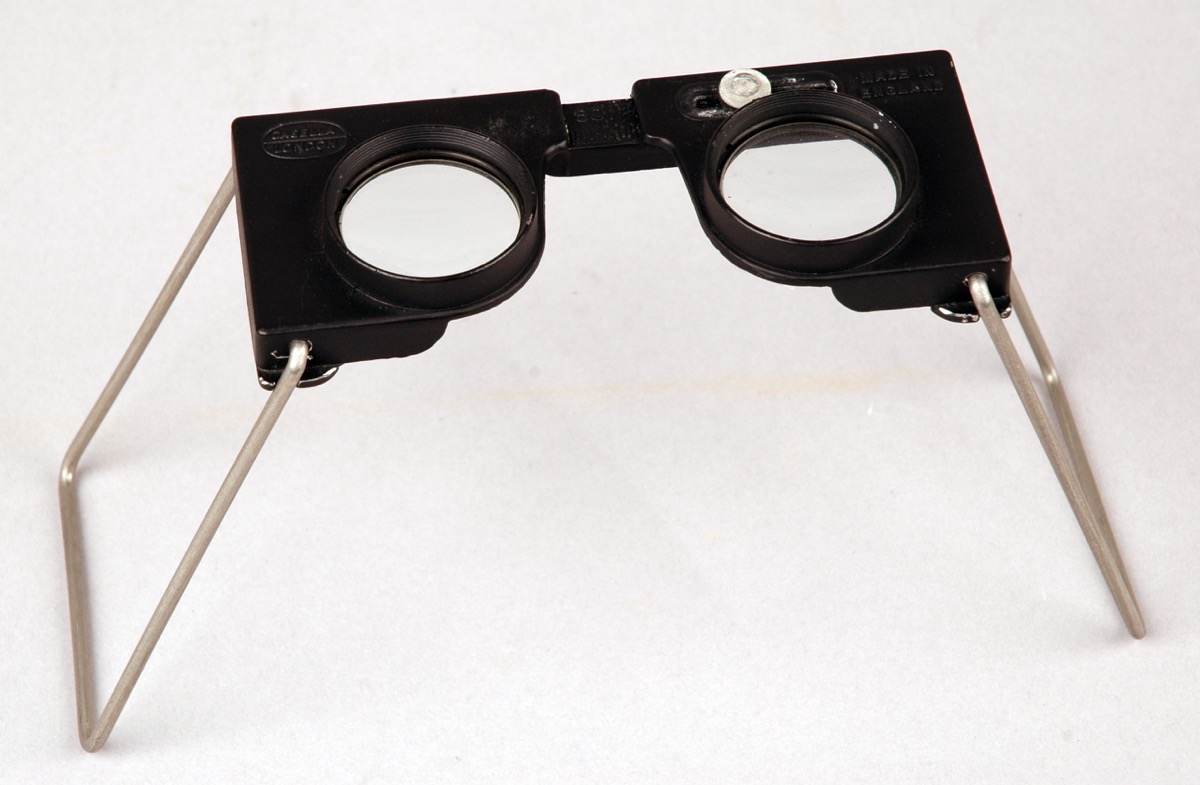
pocket stereoscope (a.k.a. stereoscopic viewer), used by Brian Harland during the surveys of Svalbard between 1949 and 1993, by Casella, English, c. 1930-1980
Origin
England; London
Maker
Casella
Class
surveying; earth sciences
Earliest Date
1930
Latest Date
1980
Inscription Date
Material
metal (steel); glass
Dimensions
(when stored flat) width - 130mm; height - 75mm; depth - 25mm
Special Collection
Brian Harland collection
Provenance
Donated on or before 10/7/2003.
Inscription
CASELLA LONDON
MADE IN ENGLAND
Description Notes
Pocket stereoscope (a.k.a. stereoscopic viewer) used by Brian Harland to give an impression of a 3 dimensional image from two photographs.
Steel frame (painted black) containing two glass lenses side by side. Frame around right-hand lens can move by sliding back and forth against frame around left hand lense, allowing the distance between the two lenses to be adjusted.
Two steel feet are attached to the frame - these can be folded out to hold the frame horizontally above a surface, or folded in to allow easy storage and transportation.
References
Events
Description
A stereoscope creates a 3-D image from drawn objects or photographs. It does this as the lenses in the instrument are arranged so that the left eye only sees the left side of the photograph, and that right eye only sees the right side of the picture, i.e. two different images of the objects are projected to the eyes.
In 1857, the German scientist Hermann von Helmholtz (1821–1894) developed a new device—the telestereoscope—intended to exaggerate the perception of relief. By enlarging inter-ocular distance, the telestereoscope produced the effect of stereoscope vision using a higher difference between retinal images than natural perception. Helmholtz observed that the use of stereoscopic pictures could ‘give a much clearer representation of the form of a landscape than the view of the landscape itself.’ A few years earlier, Brewster had already emphasized the capacity of the stereography to enhance the experience of perception. By increasing the distance between the two points of shot, the augmented parallax permitted ‘a better and more relieved representation’ of the object. A complex debate developed in the years following Helmholtz’s invention regarding the role of optical toys and stereoscopy. Some natural philosophers believed that stereography should investigate the natural experience of perception. Other natural philosophers conceived stereography as a means of enhancing natural vision. Helmholtz’s telestereoscope was an important instrument in the development of binoculars. At this period, Zeiss’s engineers were fully aware of the functioning of Helmholtz’s instrument. In 1893, Ernst Karl Abbe (1840–1905), the leading scientist of the firm Zeiss, obtained a patent for his prismatic binoculars, and explicitly referred to the telestereoscopes of Helmholtz.
08/07/2014
Created by: Allison Ksiazkiewicz on 08/07/2014
FM:46642
Images (Click to view full size):