Accession No
6231
Brief Description
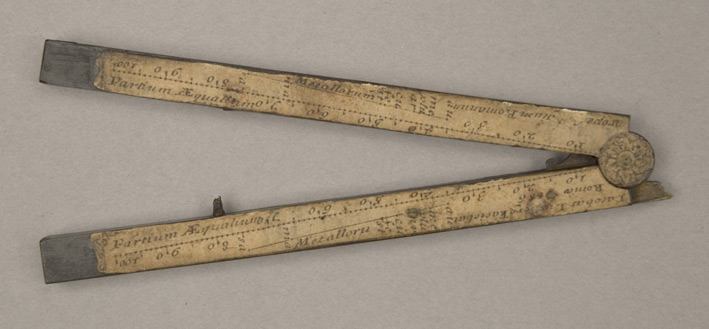
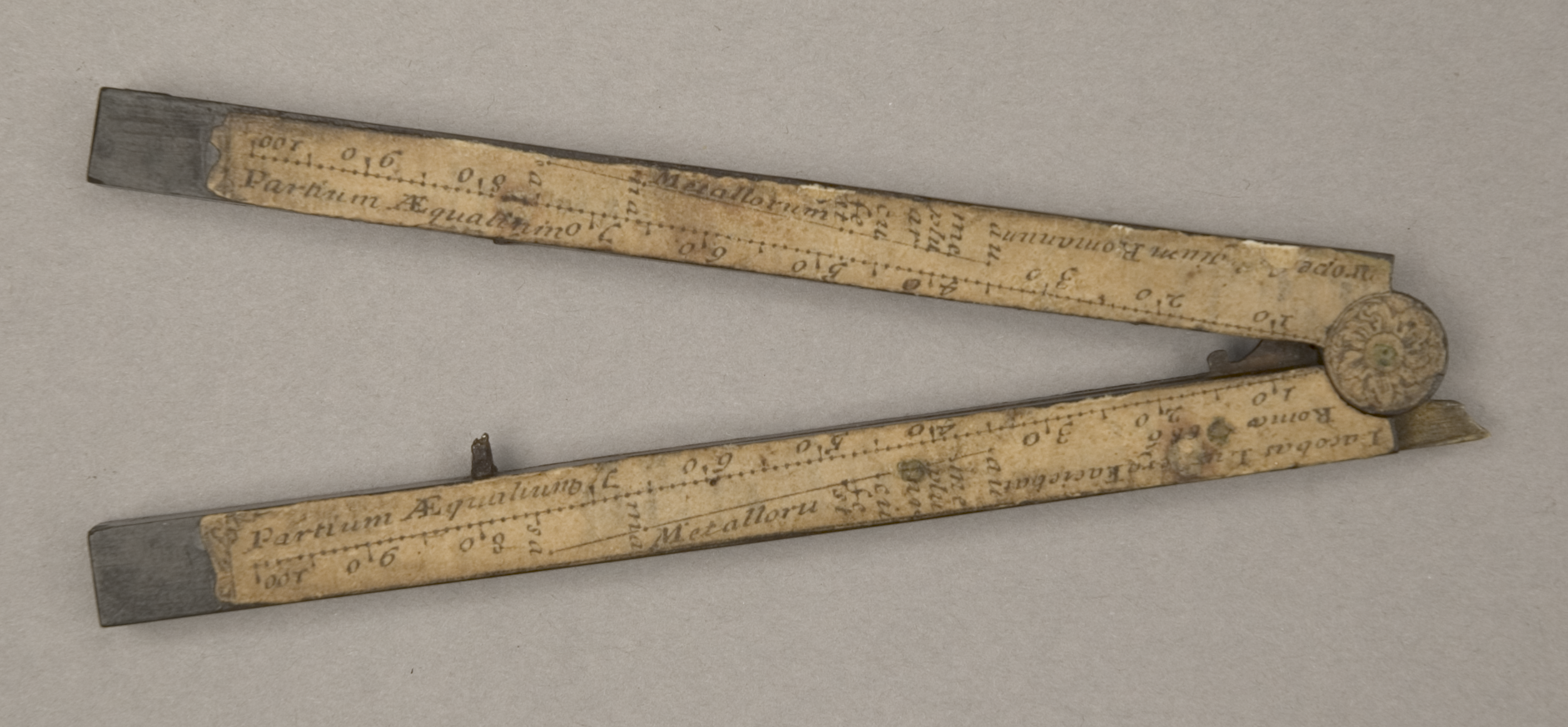
paper-on-wood sector, by Giacomo [Iacobas] Lusuerg, Italian, 1686
Origin
Italy; Rome
Maker
Lusuerg, Giacomo [Iacobas]
Class
calculating; mathematics
Earliest Date
1686
Latest Date
1686
Inscription Date
1686
Material
wood (mahogany?); paper; brass (hinge and fastening pin)
Dimensions
length; 105mm, width (at widest part); 19mm, depth; 5mm
Special Collection
Provenance
Purchased from Christie’s, 85 Old Brampton Road, South Kensington, London, SW7 3LD. Travel Science and Natural History, 23/4/2008, lot 293.
Inscription
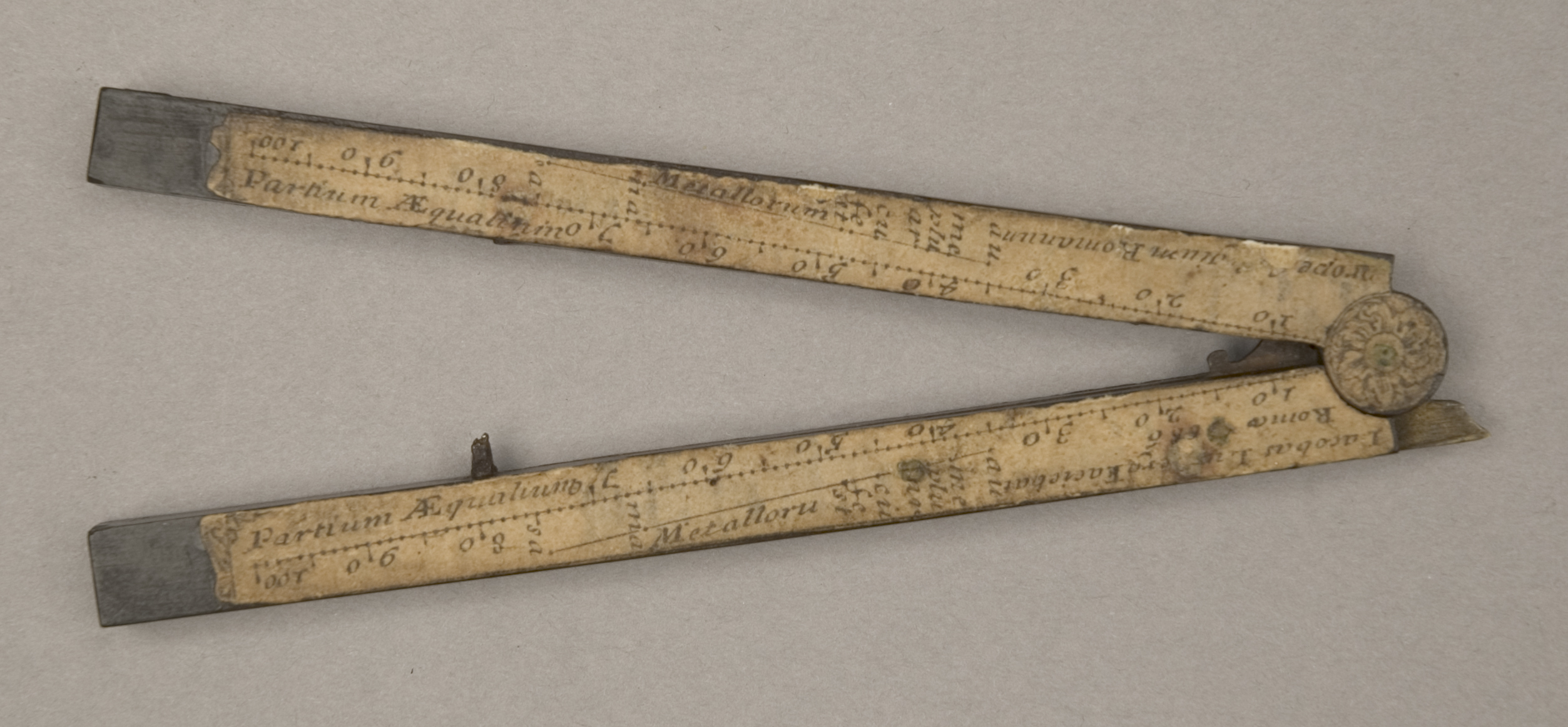
signed: Iacobas Lu[su]erg Faciebat Roma 1686
Description Notes
Paper-on-wood sector, by Giacomo [Iacobas] Lusuerg, Italian, 1686.
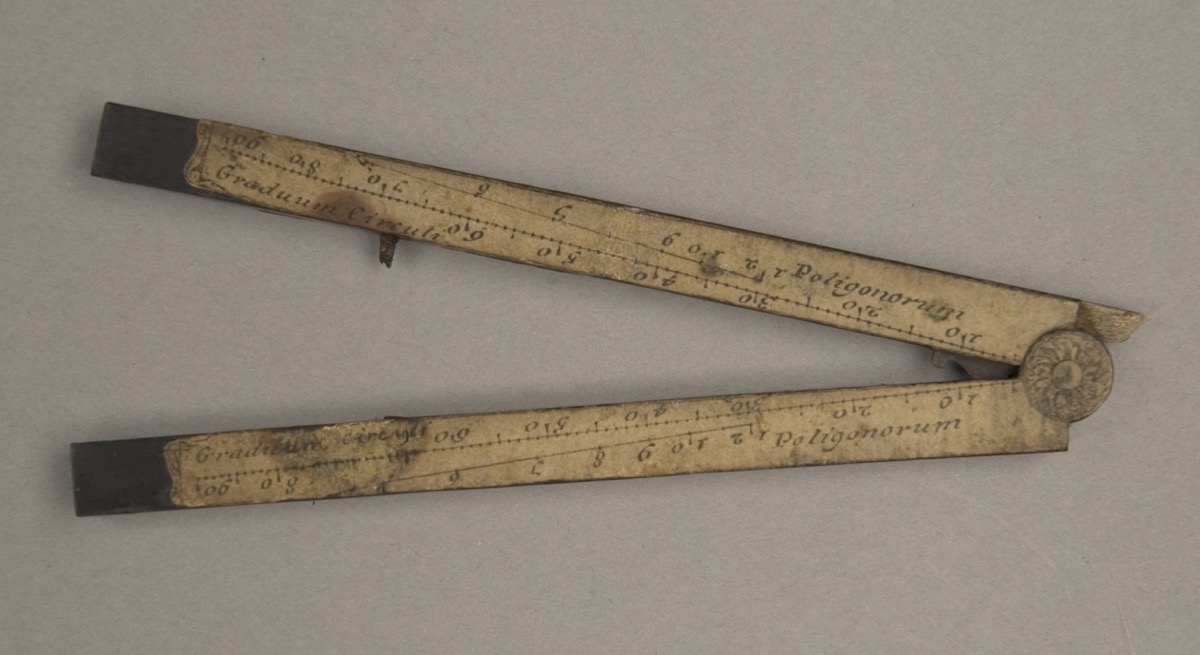
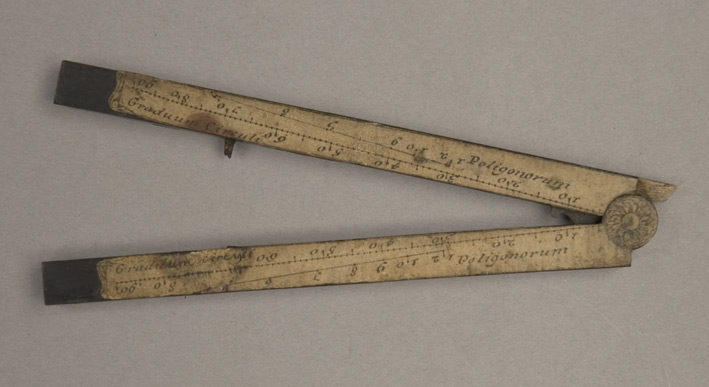
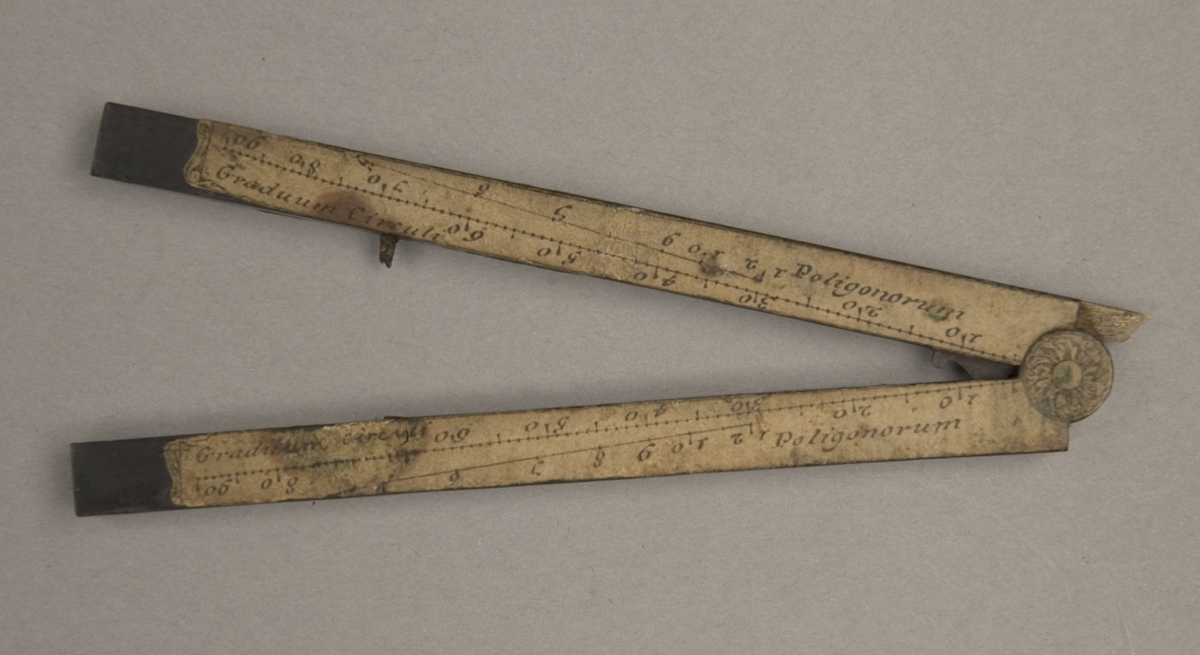
A rare 17th century paper-on-wood sector made by Giacomo Lusuerg in Rome. Paper depicting manuscript scales for Poligonorum, Graduum Circula, Metalorum, Partium Aequalium is pasted onto the wood of both sides of the instrument. Foliage decoration can be found on the hinge.
In good condition; very fragile at hinge.
Paper maintains clear decoration but yellowed with age. Four possible scorch marks can be identified and three have been repaired prior to purchase by museum.
Small crack on one of the wooden legs, possibly a weakening of the wood as a result of the hole on the opposite side made to accommodate fastening pin. The hole itself has caused the wood around it to fracture but the piece remains attached. The fastening pin is rusted/corroded.
References
Events
Description
Sector
Sectors were used for calculation by navigators, surveyors, gunners and draftsmen (and, famously, by Galileo) from the about the mid 16th century to the mid 19th century. During the 16th century, they were used as general mathematical tools, but the introduction of logarithms drastically expanded their application. Usually made of brass, wood or ivory, they look like a jointed rule with scales engraved on either side.
Sectors use the principle of similar triangles (that the ratio of lengths of two sides of similar triangles will always be the same) with scales of proportion for calculating mathematical functions such as finding the line of equal parts, inscribing a rectangular polygon inside a circle of a given radius and protracting angles. This made them useful for similar calculations to a slide rule. It is extremely rare for rudimentary paper-on-wood sectors such as this one to survive.
Maker
Giacomo Lusverg first established himself as an instrument-maker in Moderna. He then later moved to Rome, where he lived and worked from 1672 until his death in 1689. During this period he manufactured ‘very fine surveying and astronomical instruments’.
Display label: Sectors were used as general mathematical tools and, in particular, for calculation by navigators, surveyors, gunners and draftsmen from the 16th to the 19th century. They make use of the principle of similar triangles – that the ratio of the lengths of two sides of similar triangles will always be the same – in order to perform various mathematical calculations. Giacomo Lusuerg was a renowned Italian instrument-maker, based first in Modena and later in Rome. He produced many different kinds of mathematical, drawing, and surveying instruments. It is extremely rare for rudimentary paper-on-wood sectors such as this one to survive.
FM:46704
Images (Click to view full size):