Accession No
6618
Brief Description
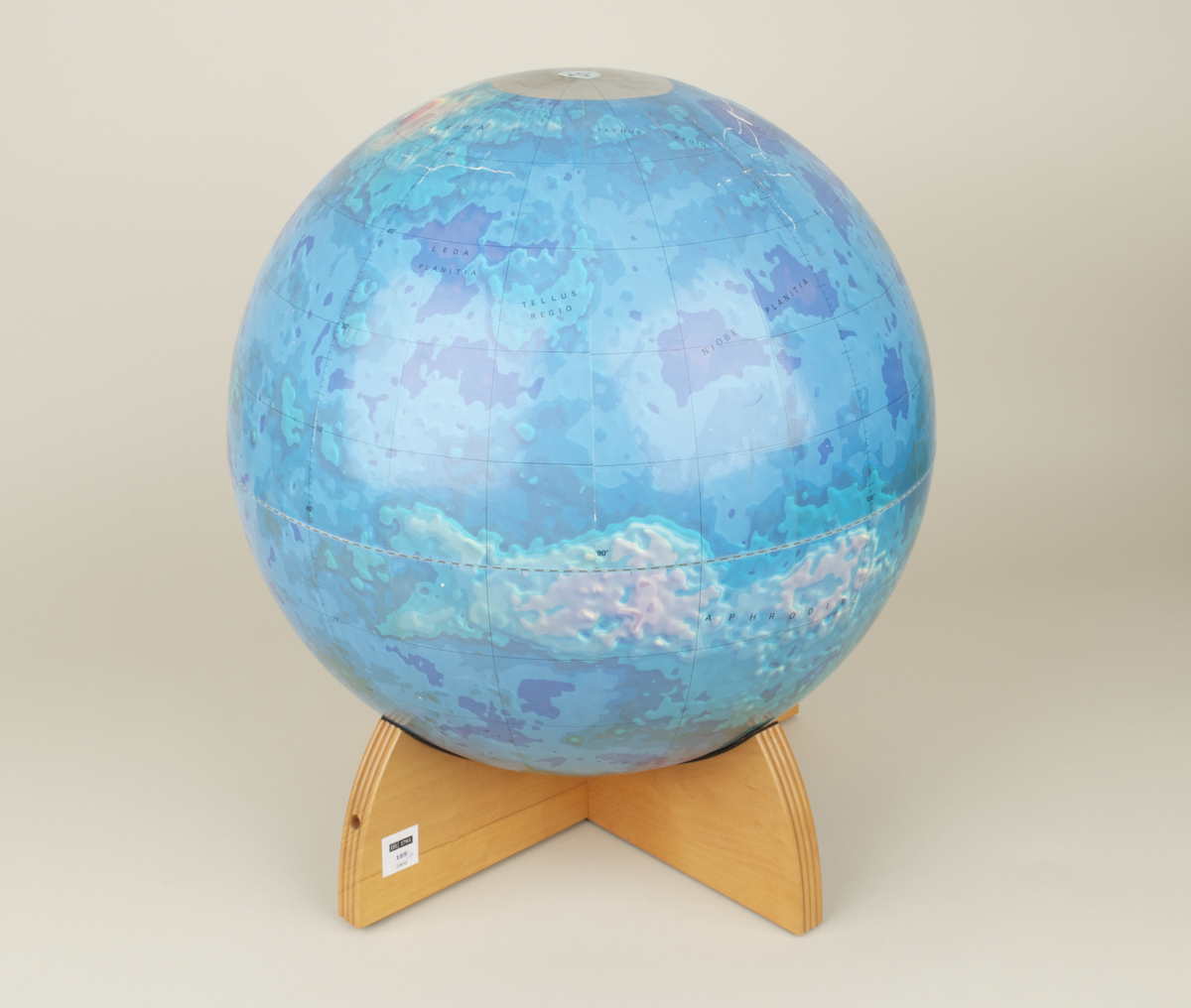
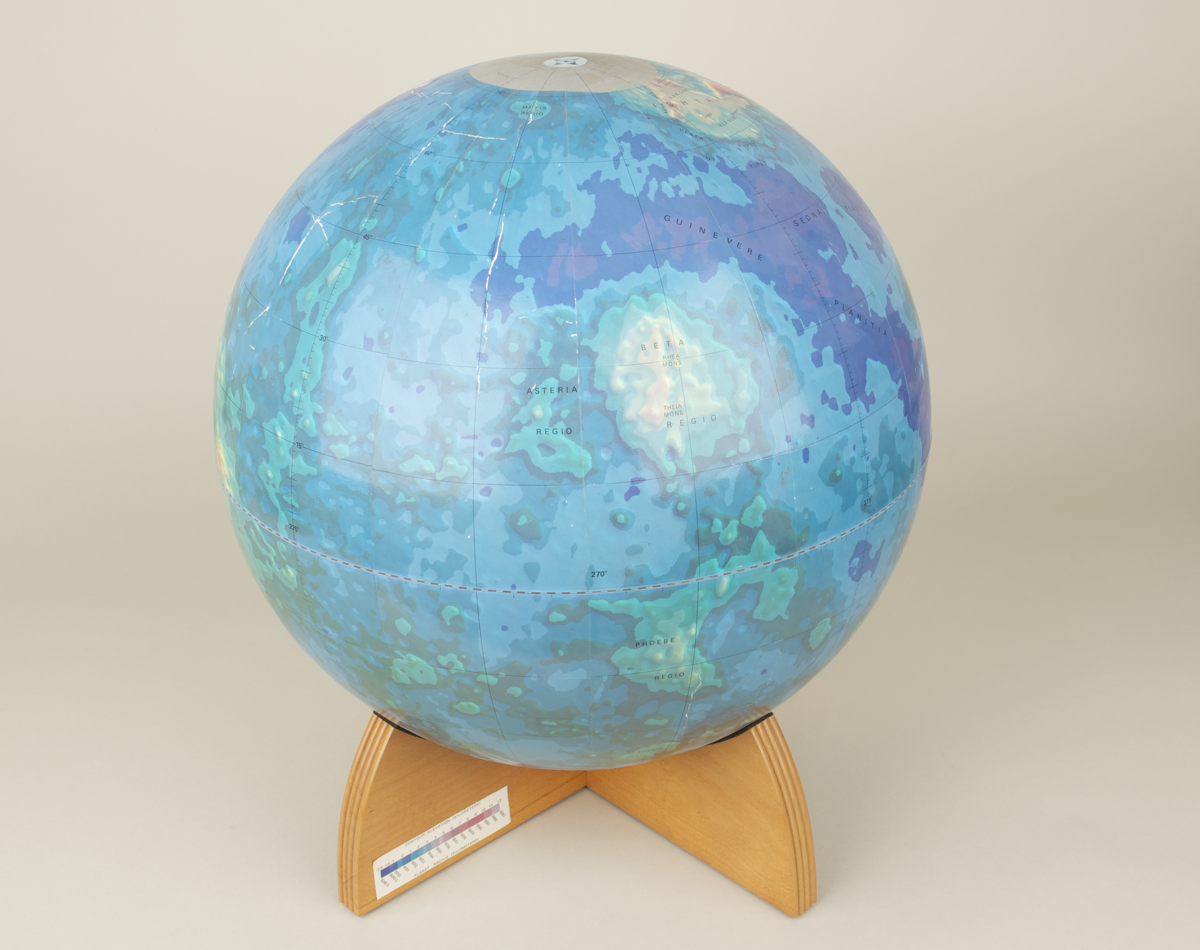
15 3/4-inch false-colour globe of Venus, by Replogle, U.S.A, 1981
Origin
Chicago; Illinois; USA
Maker
Replogle Globes Inc.
Class
astronomy; cartography
Earliest Date
1981
Latest Date
1981
Inscription Date
1981
Material
paper (laminate card; laminate paper); plastic (perspex?); paste (glue); wood (pine?); cloth (felt); metal (steel; brass)
Dimensions
Diameter: 400mm Height: 450mm Width of base: 370mm
Special Collection
Provenance
Purchased from Bonhams 580 Madison Ave., New York, NY, USA, on 05/12/2012. Auction 20830: Illuminating Space: Images from a Private Virginian Collection, Bonham’s New York. Lot no. 169 (with Wh. 6619).
Inscription
Description Notes
15 3/4-inch false-colour globe of Venus, by Replogle, U.S.A, 1981.
Plastic globe with printed laminate paper gores. Metal pins at poles (obscured by ’N’ and ‘S’ paper stickers) . Longitude marked at every 45o; latitude every 15o. Contour elevation of surface represented by colour, from deep blue (lowest point) to a variety of reds for higher elevations. Overall, blues predominate. Major regions named. Polar regions coloured beige and marked ‘No data’. According to label on base, scale is approximately 1:29,783,500 (1 mm = 30 km; 1 inch = 470 miles).
Comes with fitted wooden base with cross design. Felt on curved top of stand to cushion globe. Printed label glued to base with details of scale, provenance of radar data (Pioneer-Venus Orbiter Spacecraft, NASA), data processing (M.I.T and U.S Geological Survey), cartography (U.S. Geological Survey) and identity of commissioning organisation (NASA, Pioneer Program and Geology Program, Office of Space Science). Further sticker with coloured scale of elevation above and below mean radius (kilometres).
Condition fair (some white cracks on surface)
References
Events
Description
In December 1978, Pioneer Venus Orbiter entered the orbit of Venus. One of the experiments performed by this craft determined the topography of the planet. This information was subsequently mapped (by U.S. Geological Survey) and manufactured into this Replogle globe in 1981. Contrasting this object with Wh.6619, a 1995 globe of Venus that was based on the later Magellan spacecraft data, is instructive: the topography is, understandably, much less finely depicted here and the surface has a blotchy, pixelated quality.
Replogle Globes was founded in the 1930s by Luther Replogle, a school supply salesman who believed that there was a wider market for globes than in school classrooms. For his first globes, Replogle used gores from English manufacturers, and after a decade of business, Replogle Globes had become an established and prolific manufacturer of school globes. The company continues to produce a variety of globes to this day.
18/10/2016
Created by: Steven Kruse; Allison Ksiazkiewicz on 18/10/2016
FM:47169
Images (Click to view full size):