Accession No
6679
Brief Description
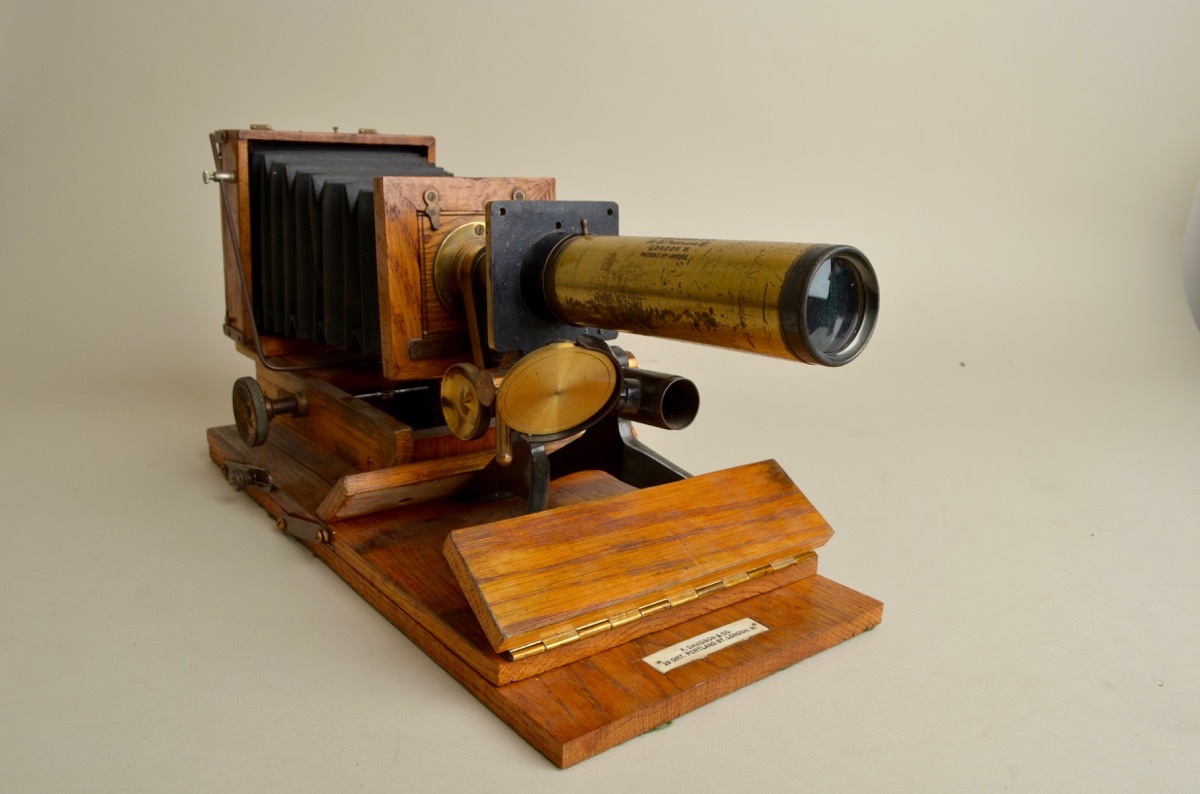
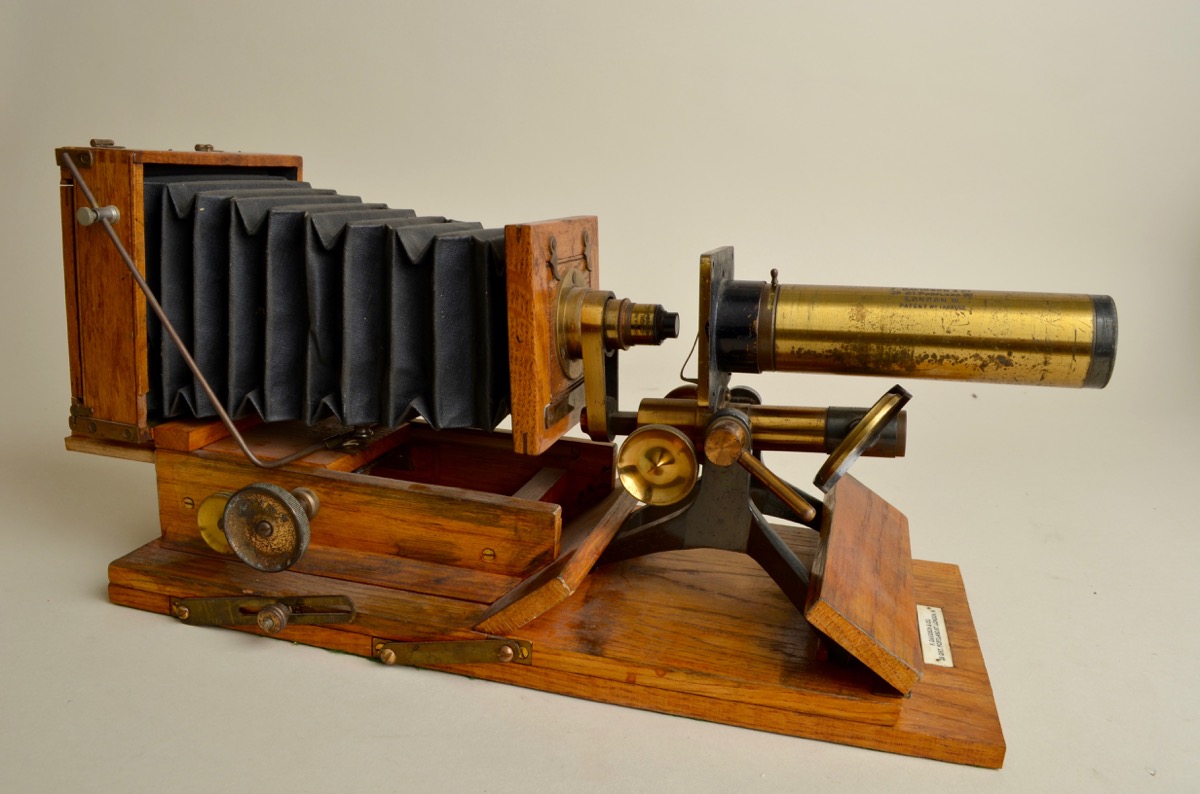
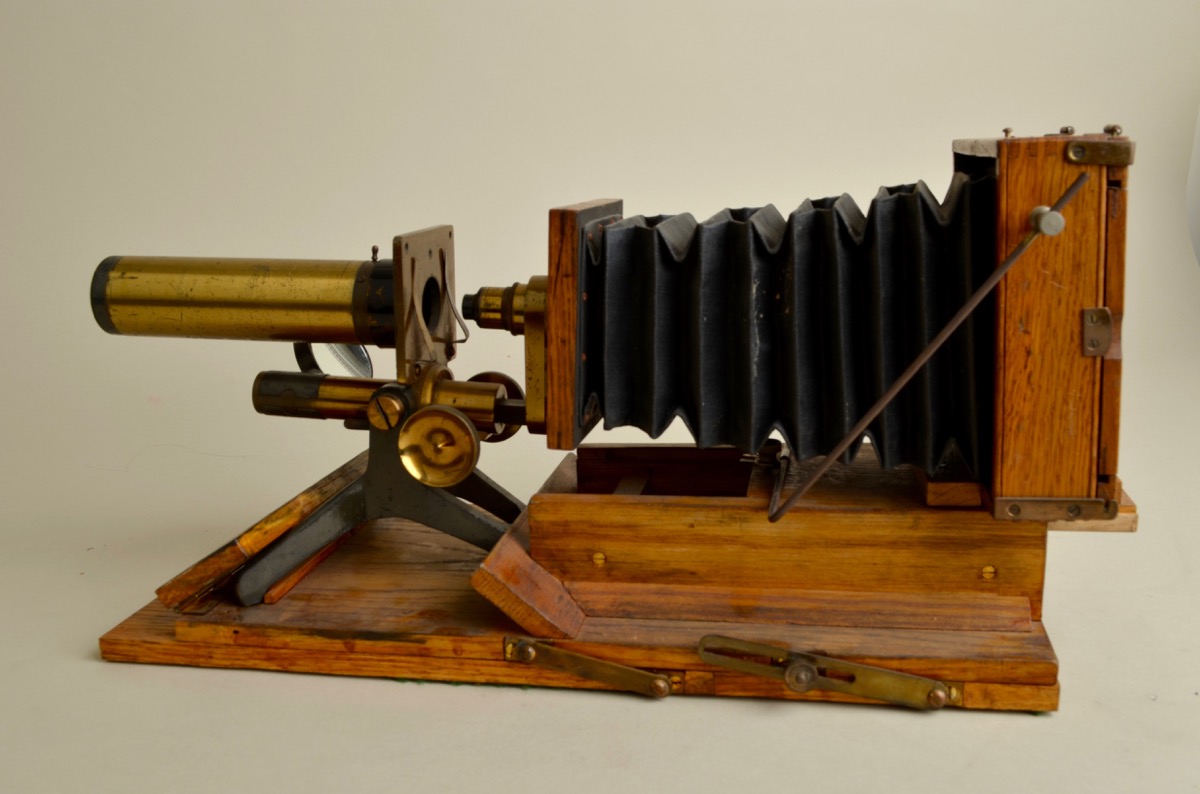
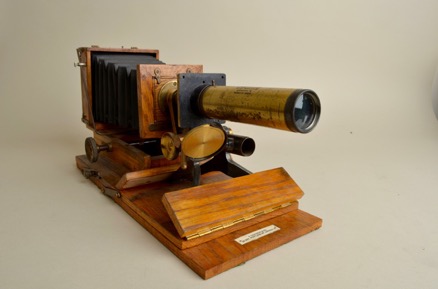
photomicrographic camera and microscope, by F. Davidson and Company, English, 1920 (c)
Origin
England; London; 29 Great Portland Street
Maker
F. Davidson and Company
Class
optical; microscopes
Earliest Date
1900
Latest Date
1940
Inscription Date
Material
metal (brass); wood (oak); glass; cloth/leather (? bellows); ivory
Dimensions
430mm (width) x 195mm (depth) x 210mm (height)
Special Collection
Michael J. Clark Bequest
Provenance
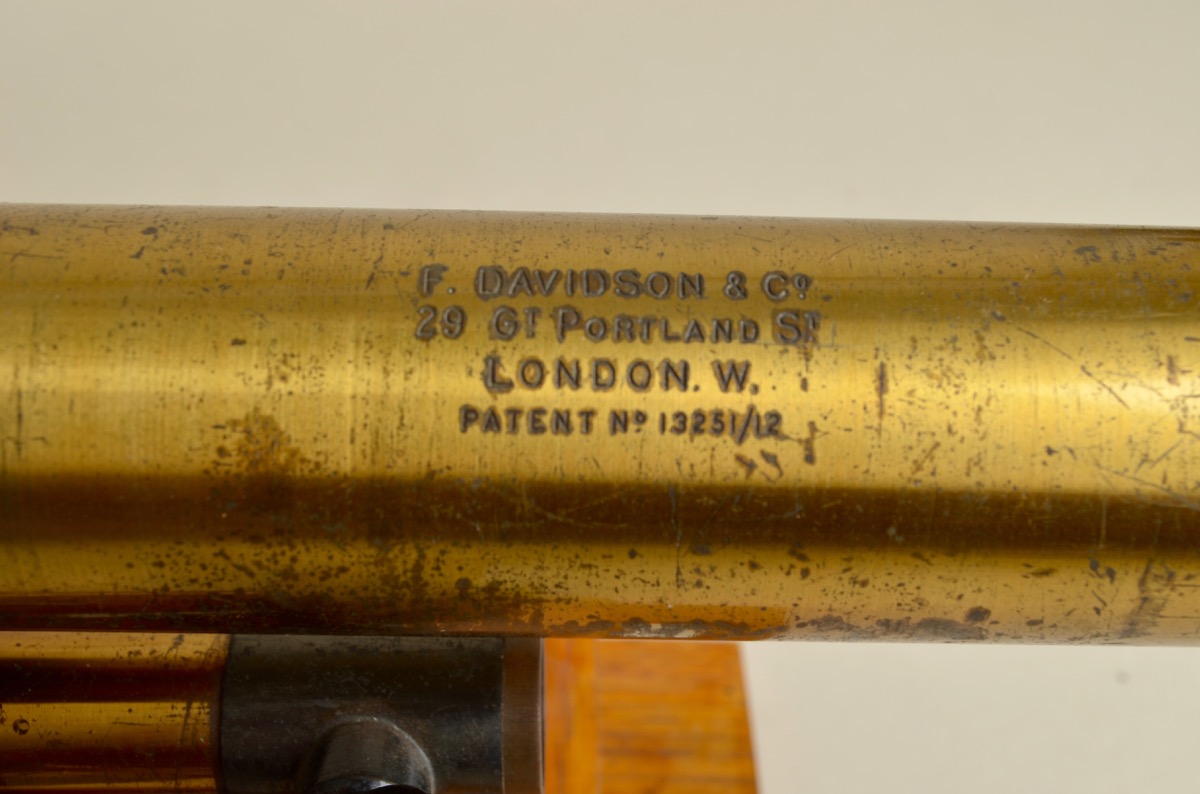
Inscription
On body tube:
F. Davidson & Co.
29 Gt Portland St
London. W.
Patent No. 13251/12
On camera:
F. Davidson & Co. 29 Grt Portland St. London W.
On base:
F. Davidson & Co,
29 Grt. Portland St. London W.
Description Notes
Photomicrographic camera and microscope, made by F. Davidson and Co., English, ca. 1920
Microscope with attachable camera allowing for photomicrography. The body tube sits on a square brass base with two clips underneath it for affixing slides; next to the body tube is a swinging concave mirror in a gimbal; next to the mirror there is a rod attached to a knob that tightens to prevent the microscope from pivoting on its centre (this is necessary, when the camera is attached, so that the setup remains parallel to the ground); finally, a small knob on the body tube allows adjustment of the size of the microscope's aperture (?). Two knurled knobs attached to pinion and rack adjust the distance between the body tube/stage and the microscope's "base" -- a double-lens tube attached to a square oak platform. This oak platform nests into a hole in one end of the camera, also of oak, with small metal clamps to keep it in place; a bellows connects this end with the larger end of the camera, which has a hinging frosted glass back with clamp.
The foot of the microscope is a raised, heavy metal tripod; the camera has a thin metal stand that keeps it upright. On the camera there is an ivory (?) inlay, with the inscription "F. Davidson & Co. 22 Grt Portland St. London".
The microscope-camera sits on a third element, a solid oak base. The foot of the microscope sits nearest the ivory inlayed label, with a small hinging plank of oak to keep it in place; the camera sits on a raised platform, and the plate end of the camera nests between two fixed bars on a moving segment of the raised platform. There is a knurled brass knob that moves the platform, and the plate end of the camera with it, allowed for carefully controlled opening the bellows to the desired extension. A second, smaller knurled knob is connected to a rod that turns a small oblong piece of wood underneath the moving oak platform; this may have been used to fix the moving platform in place, though it no longer accomplishes this. The entire solid oak base is of two parts, with the microscope-camera sitting on a top plank, which is connected to a second, longer bottom plank by four pivoting metal bars on tracks. This allows the camera to be raised or moved forward and backward relative to the bottom plank, though the purpose of this is unclear.
Condition: good, complete
References
Events
FM:47376
Images (Click to view full size):