Accession No
6783
Brief Description
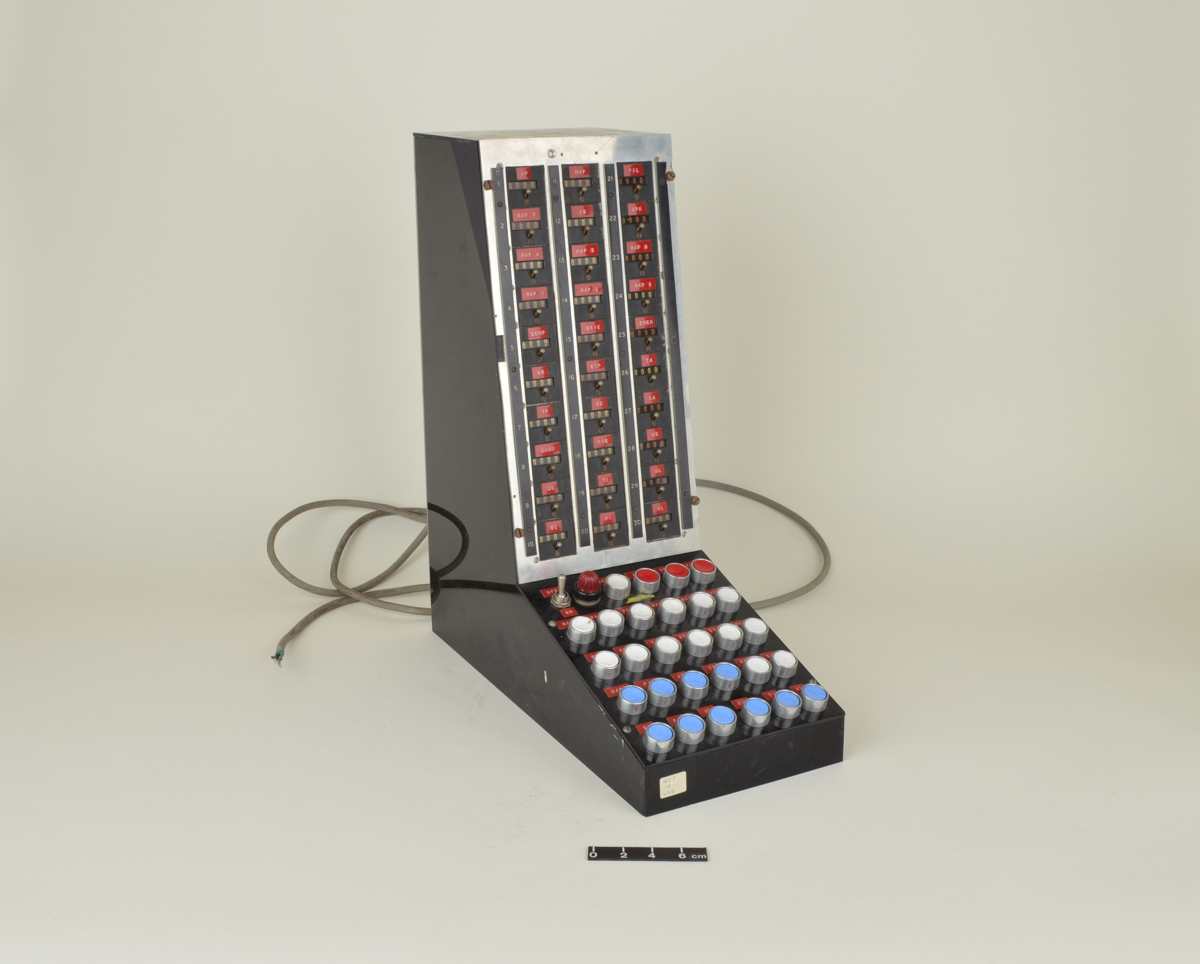
pollen counter, custom-made for Harry Godwin, English, mid-20th Century
Origin
England
Maker
Class
earth science
Earliest Date
1901
Latest Date
1985
Inscription Date
Material
plastic (acrylic), metal
Dimensions
width 177mm; depth 402mm; height 459mm
Special Collection
Cambridge Quaternary Research Collection
Provenance
Donated by the Department of Geography, University of Cambridge. Custom-made for Sir Harry Godwin, FRS, founder of the Subdepartment of Quarternary Research.
Inscription
Description Notes
Pollen counter, English, mid-20th Century.
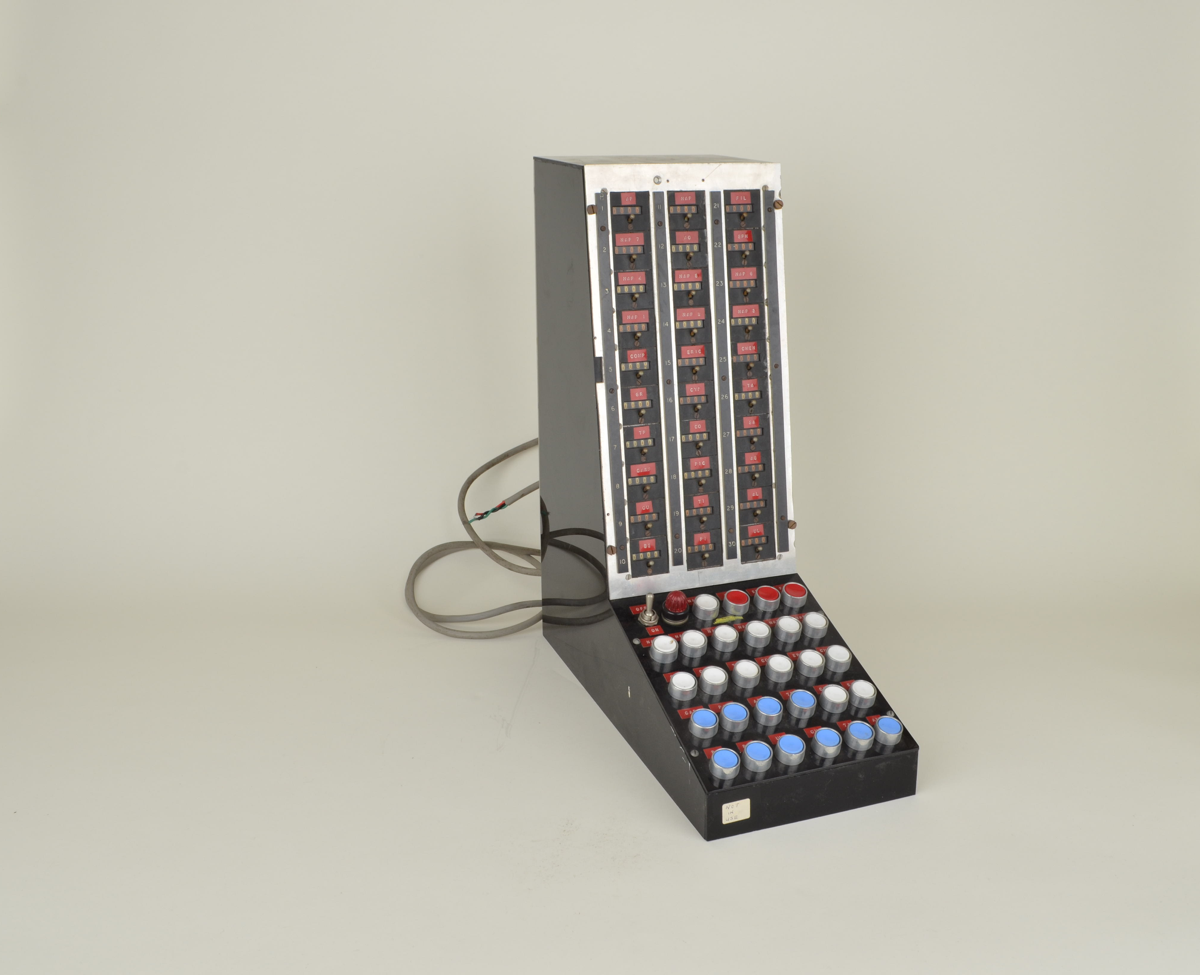
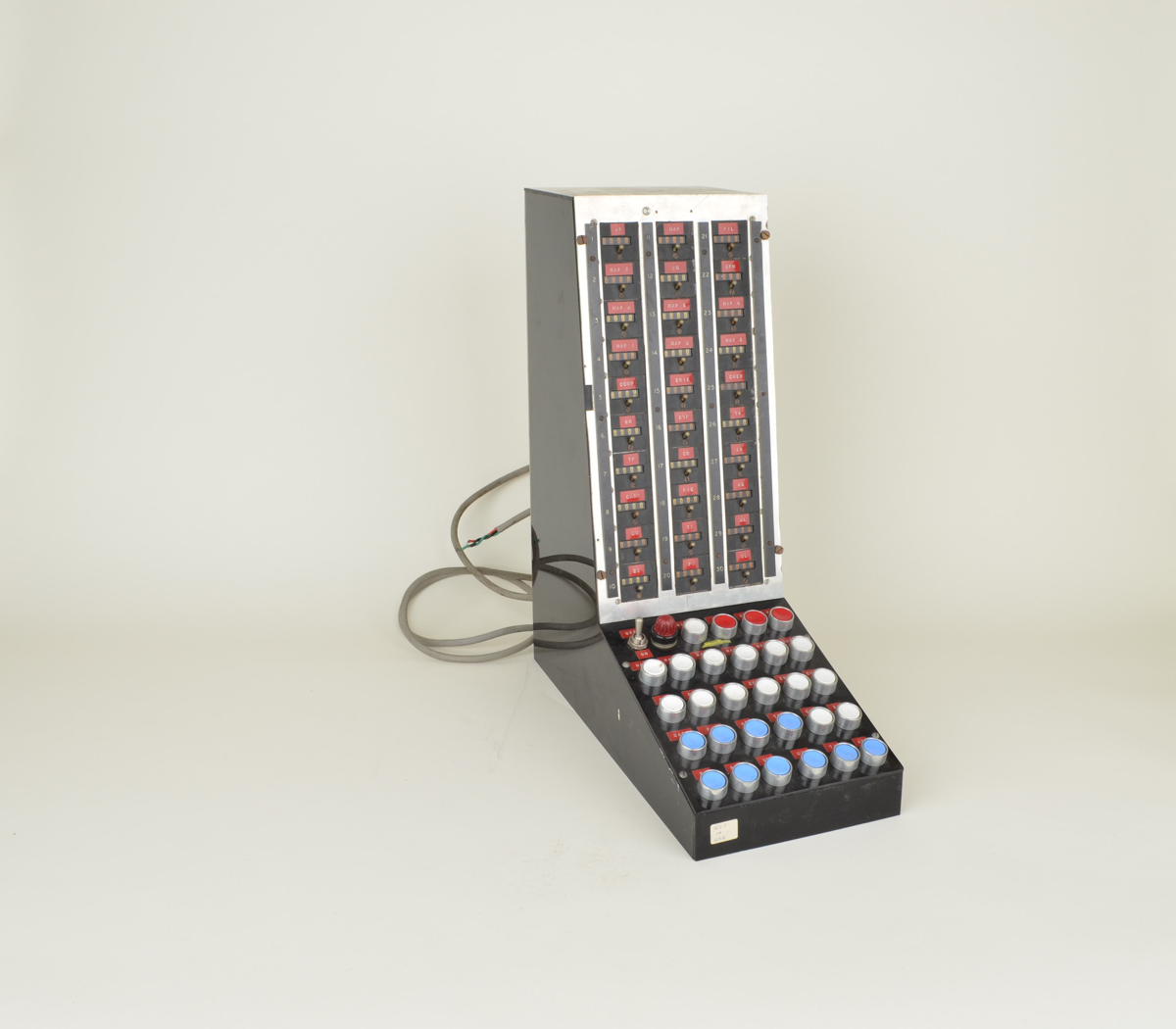
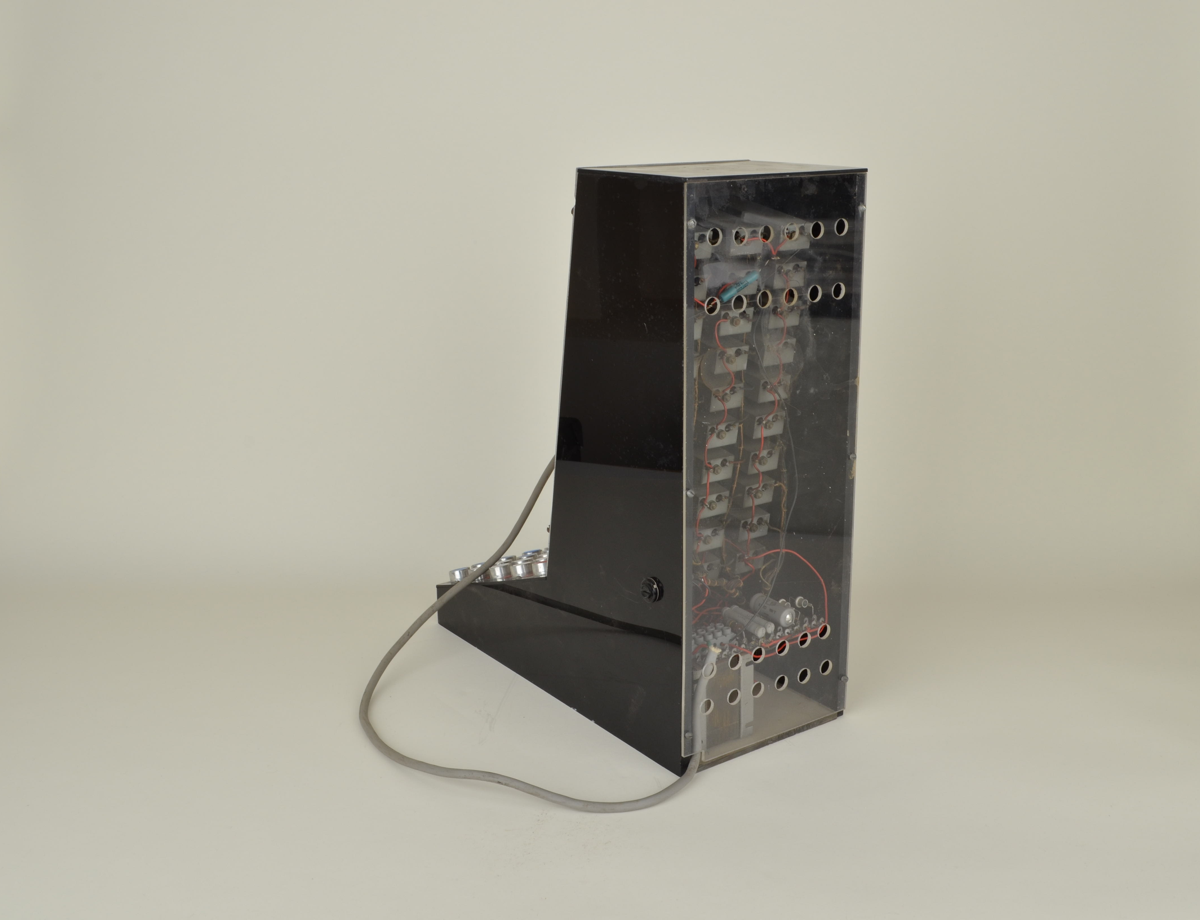
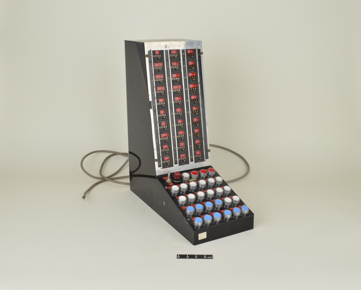
The object is a tall box made of acrylic, black (sides and top) and clear (rear and bottom). The front comprises two panels: the bottom panel, a shallow panel featuring 28 buttons (3 red, 10 blue, 15 white) along with a red light and a toggle switch; the top panel is almost vertical and features 30 4-digit counters arranged in 3 columns of 10. The buttons and counters are labelled with red embossed tape, bearing abbreviations.
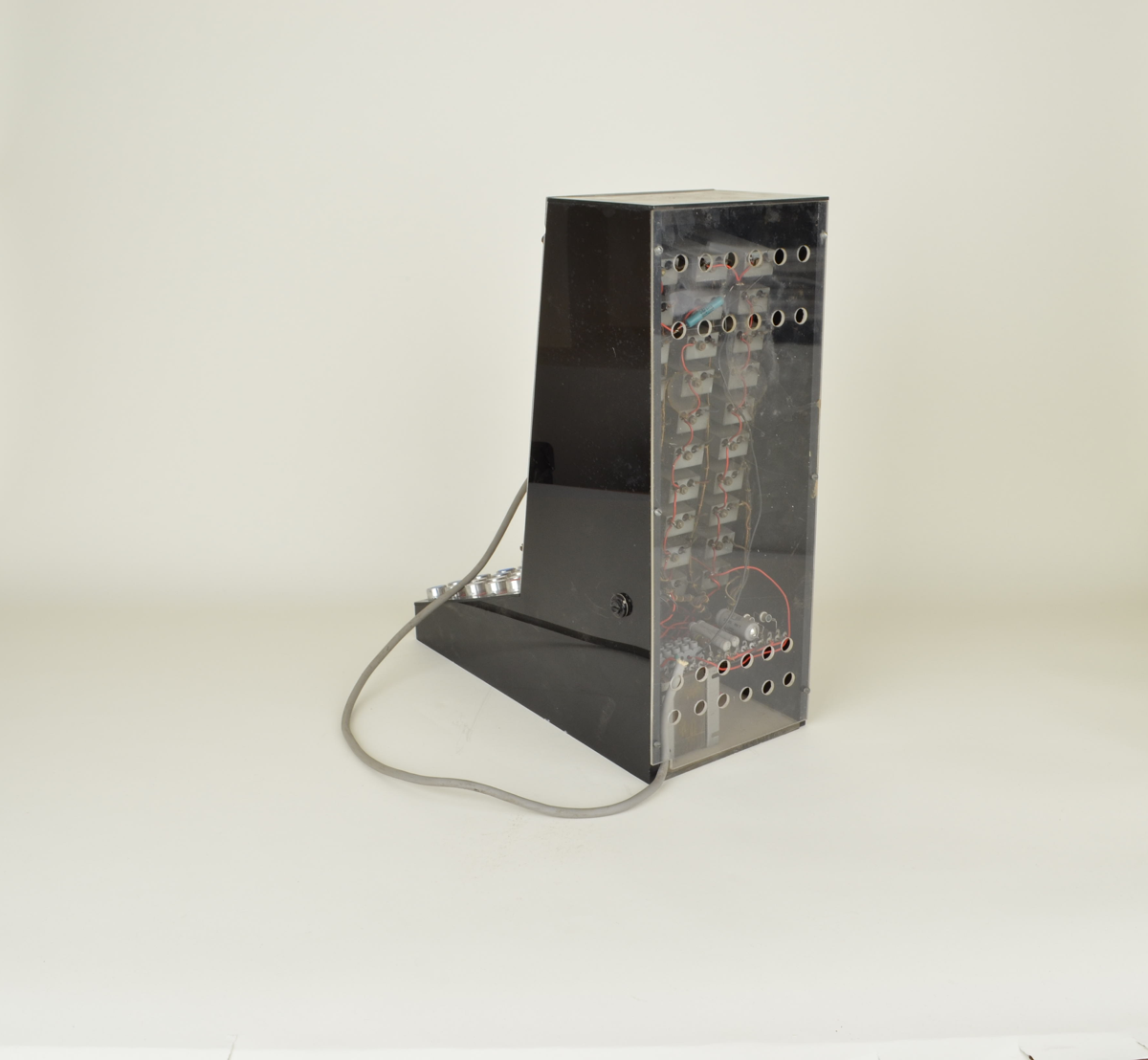
In the back, electrical components can be seen: there are relays and resistors, and a series of wires that connect the buttons on the front panel to the counters above them. There is a long, grey wire with its end exposed emerging from the back of the machine.
There are no other markings (e.g. a maker's mark) and the construction of the machine appears handmade. This machine is most likely one-of-a-kind, custom made for Harry Godwin.
References
Events
Description
This one-of-a-kind machine is a pollen counter, made specially for Harry Godwin and used primarily by Robin Andrew. Part of studying samples involves the painstaking process of identifying and counting pollen grains from different species. Pressing any button on the lower panel increases the corresponding counter on the upper panel by 1. Each button — and counter — is labelled with an abbreviation for a common type of pollen.
Though this machine’s function is simple, in the age before computers, a task like this had to be done by hand, and it had to be done carefully. As it was something that needed to be done often, this custom-made machine helped minimise the risk of errors.
[exhibition label, 18/05/2023]
Robin Andrew
---
Robin Andrew came to Cambridge in 1947 and was an important collaborator of Godwin’s. Robin wasn’t trained as a botanist, but she had an excellent eye for detail and was talented at using a microscope. She began as a part-time technical assistant, helping to count pollen samples and build up a collection of pollen reference slides.
She took to her role well and flourished, helping to advance the practice of pollen identification under Godwin’s guidance. In 1980, she produced a “Practical Pollen File” which included detailed descriptions of the pollen of every species of British plant she could manage. The file was later revised and published in 1984 and, along with the slides she helped to produce, was of huge help to students and researchers alike.
She was well-known in the department for her friendly and helpful nature, and continued working even past retirement age.
Quaternary Research
---
The Quaternary Period is the period from about 2.58 million years ago up to the present. Quaternary Research, then, is the study of this period: it’s the study of the rocks, plants and animals found in this time period, and how they have changed over time. The Quaternary period is also known as the Ice Age due to the presence of permanent ice sheets at the poles, and it is characterised by alternating glaciations and interglacial periods.
Because the goal of the subject is to understand everything about the period, Quaternary Research requires contributions from scientists in many different fields: from zoologists and botanists to geologists and physicists, and more besides. Quaternary research is particularly focussed on the environment and ecosystems, and changes in the climate. The field is especially important for understanding the impact that humans are having on the environment. It’s also important for archaeology, providing a reference point when studying human activity.
The objects in this case represent the various stages of research, from field work, to cataloguing, to intensive laboratory study, but this is only a small part of what Quaternary Research is all about.
18/05/2023
Created by: Ewan Wilson on 18/05/2023
Description
Sir Harry Godwin, FRS, was a prominent English botanist and ecologist, whose work at the University of Cambridge played an influential role across a range of disciplines, including geography, geology, archaeology, plant sciences, Quaternary research, and climate science. He was the founder (1948) and first director of the Subdepartment of Quaternary Research (SDQR) at the University of Cambridge, where he supervised pioneering work on new techniques for understanding ecological succession, including comparative palynology and radiocarbon dating. His work is now also recognised as having made important contributions to aspects of early climate science. He had a long association with Clare College, Cambridge, where his paper archive now resides.
04/04/2023
Created by: Ewan Wilson on 04/04/2023
FM:47608
Images (Click to view full size):