Accession No
6172
Brief Description
assorted material (slides, notebooks, letters, photographs, models) belonging to the biochemist, chemical pathologist & blood specialist Hermann H. Lehmann, mid- to late 20th century
Origin
Uganda and England; Cambridge
Maker
Lehmann, Hermann H. [collector]
Class
medical
Earliest Date
1930
Latest Date
1985
Inscription Date
Material
paper; glass; wood; metal; leather
Dimensions
box 1 = height 285mm; width 355mm; depth 425 mm box 2 = height 340mm; width 345mm; depth 405 mm
Special Collection
Provenance
Donated to the department of the History and Philosophy of Science, unknown date, unknown source. Found by the Whipple Museum in the old annexe resources room.
Inscription
Description Notes
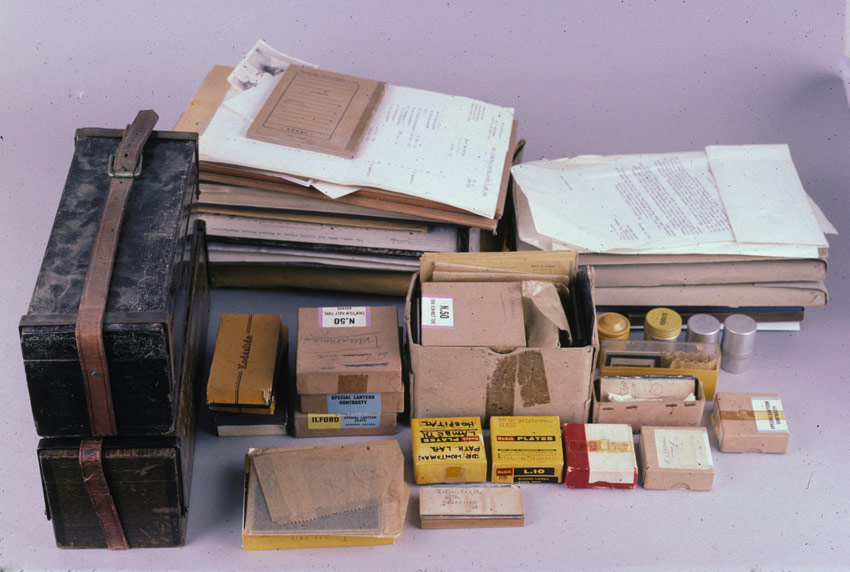
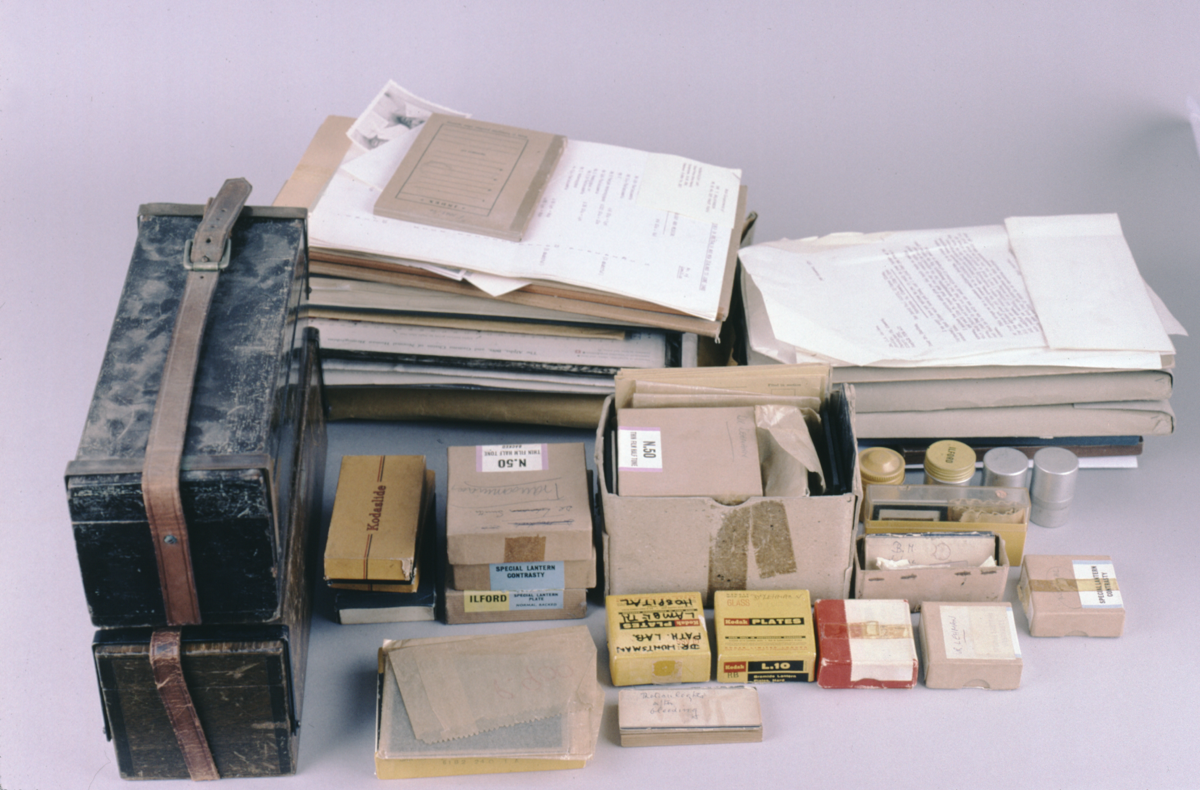
3 boxes of assorted material (slides, notebooks, letters, photographs, models) belonging to the biochemist, chemical pathologist & blood specialist Hermann H. Lehmann.
Box 1 -
o Box of assorted slides — mainly lecture presentations
o Film reel of animal experiments
o Box of large-format slides
o 2 letters to Lehmann
o Small box of slides: ‘blood stains’
o Box of slides: ‘Specimen of Haemoglobin D’
o Box of colour slides of fieldwork
o Small microscope slide box with one slide
o 1 large loose slide
o Numerous large-format slides, some loose, some in boxes
o Various loose photographs, mainly of different races of people
o A wooden frame for holding large format slides, with “H. Lehmann London” written on it
o 2 framed photographs, one of four men in white coats (listed on the back as: “N. Payne; Dr. Lamie; Mr C.A. Smith; Dr. C.G.L. Wolf”) and one of Sir James Chrichton-Browne, “In his house”
Box 2 -
o In envelope entitled “Glass Slides”: Microscope slide case with roughly 80 slides, probably blood samples of named individuals
o Address book
o Photo album, entitled “Abnormal haemoglobin unit”
o Lehmann’s 1930s notebook
o Envelope of photographs of HL at various events, with two associated letters
o Similar pack of photographs, with one letter and one note
o Copy of Haemoglobin Colloquium, with assorted notes and letters inserted
o Thalassaemia slide
o Copy of Lehmann’s Biographical Memoirs of the Royal Society entry (written by Sir John Dacie)
o Sequence of alpha- beta- and gamma-chains (large slide)
o Stapled document: ‘Haemoglobin variants registered in Australia and NZ…’
o Two wooden boxes with brass clasps and leather straps, one empty, the other containing large format slides of lecture presentation material
o Multiple small boxes of slides, both large and small format
o 3 files of letters, notes, and off-prints
o 4 metal 35mm film canisters, all containing rolls of 35mm film negatives
o Box containing large format slides and large format negatives, in holders with “Official Navy Photograph” written on
o A pack of large photographs
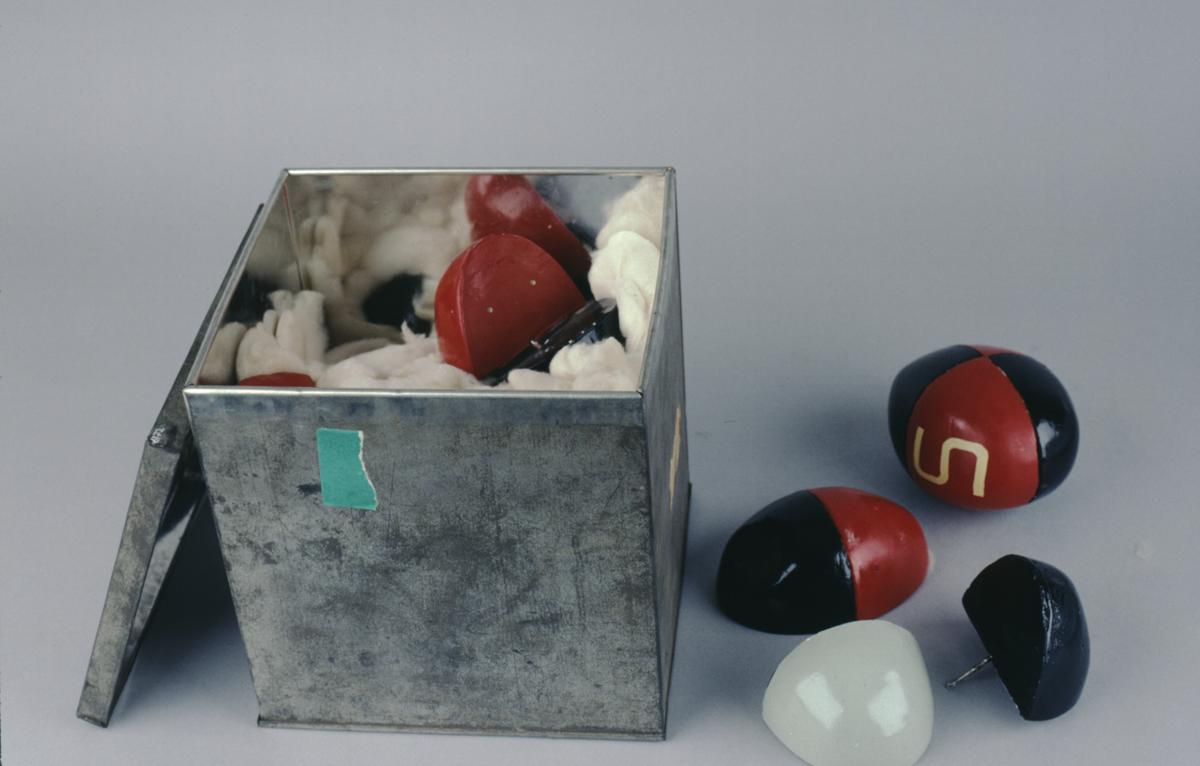
Box 3 -
o Painted (black and red) plaster teaching models, with numbers written on. Models are bean shaped and about the size of a small melon. Perhaps models of haemoglobin?
NOTE: This donation also came with a number of A4 sized, hard-back red and black note books. Their content appears to be medical case notes. They are stored in the Whipple Library.
References
Events
Description
Hermann Lehmann was born in 1910 in Germany as the son in a wealthy German-Jewish family. His family moved to Dresden when his father’s business collapsed due to post-war economic chaos and hyper-inflation. He started medical school in 1928 at the southern German University of Freiburg. He continued his studies in Berlin and completed them at Heidelberg in 1933. Unfortunately, by this time, Hitler had come into power and the persecution of the Jews increased, meaning that Lehmann could not take his final examination at Heidelberg. Nevertheless, he kept working at the Heidelberg laboratory, submitting his thesis to the Swiss University of Basle, where is was accepted in 1934. Lehmann, once qualified, continued working in Germany despite the gathering storm of oppression, but did make a visit to Cambridge, only to return to Germany. When he was accused of attending a communist trade union congress, Lehmann felt it was time to return to Cambridge. During the Second World War, Lehmann obtained a commission in the medical corps, posted to India, and rose to the rank of Lieutenant Colonel. He was demobilised in 1946 and arrived back in England in 1947. He then moved his wife, daughter and himself to Uganda, where he first became interested in abnormal haemoglobin and sickle-celled anaemia, which would become the passion of his life. In 1967, he was awarded a personal Chair in Clinical Biochemistry in the University of Cambridge Department of Biochemistry and in 1972 he was elected a Fellow at the Royal Society. Hermann Lehmann died in Cambridge in 1985.
Created by: David Budd (Work Experience)
FM:46638
Images (Click to view full size):