Accession No
1780
Brief Description
napier’s bones, English, circa 1720
Origin
London; England
Maker
Class
mathematics; calculating
Earliest Date
1720
Latest Date
1720
Inscription Date
Material
wood (boxwood); metal (brass)
Dimensions
length 127mm; breadth 74mm; height 31mm
Special Collection
Holden-White collection
Provenance
On loan from The Fitzwilliam Museum, University of Cambridge. Donated by Charles Holden-White to the Fitzwilliam Museum, 1931. C. Holden-White collection, no. 134.
Inscription
Description Notes
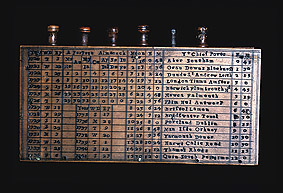
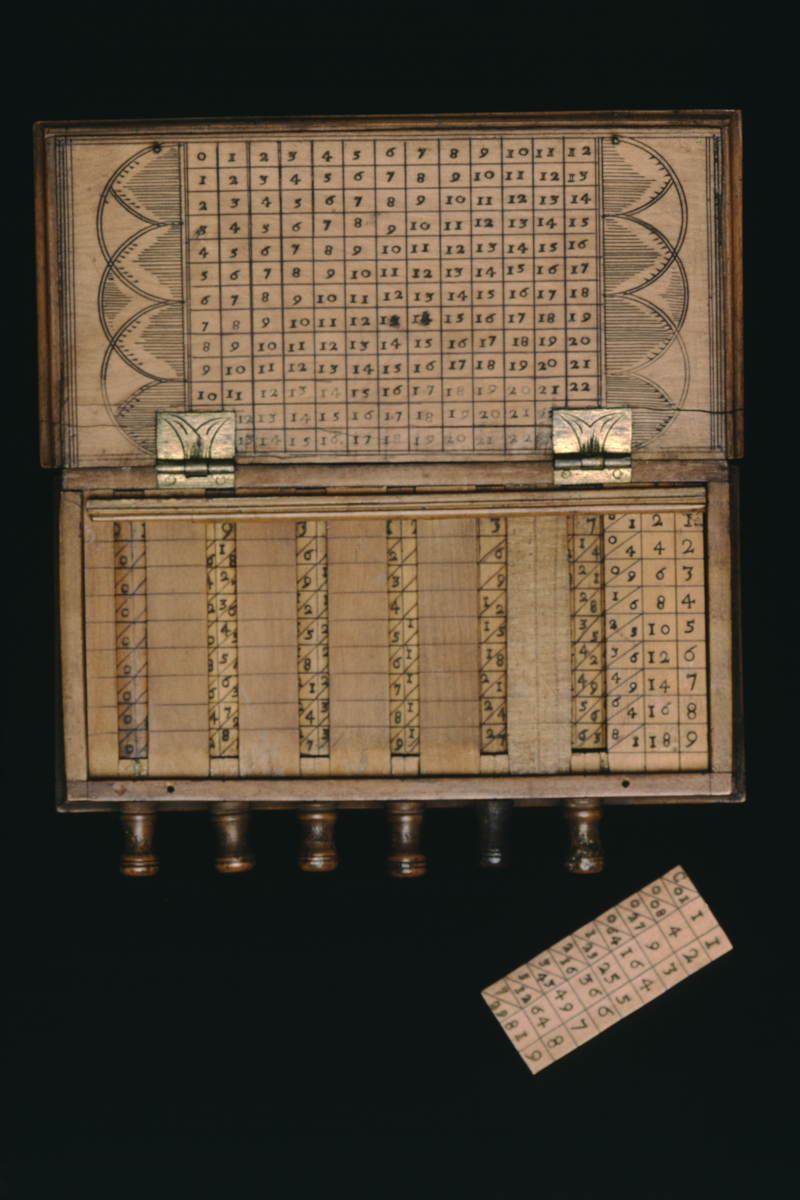
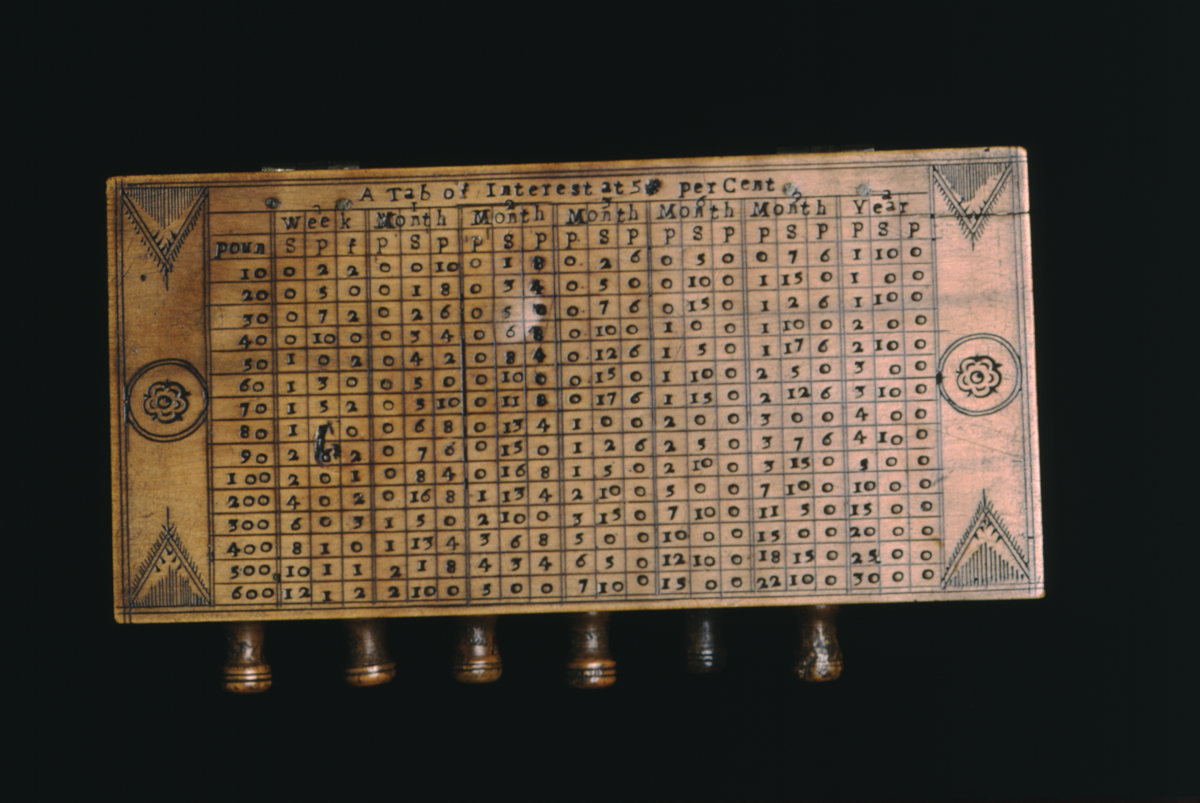
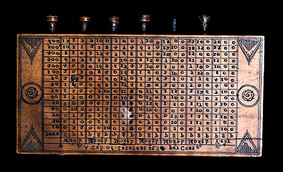
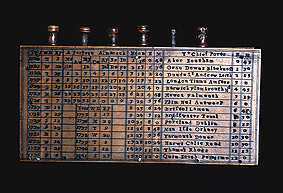
On the outside of the hinged lid is ‘A Tab of Interest at 5 per Cent’ from 10 to 600 pounds for week, month, 2 months, 3 months, 6 months, 9 months and a year. Inside the lid is an addition table for numbers between 0 and 12.. Inside the box are 6 cylinders operated from the front face of the box by 6 turned handles. Each cylinder is calibrated with the multiplication table of 1 - 9 for the multiplicands 0 - 9 and read from top to bottom. Cover strips obscure all but one column of each cylinder. At the right hand side is a fixed strip for calculating squares. Separate loose strip for cubes. Beading strip and one cover plate strip missing. On the base of the box, ‘A Perpetu Almeneck’, a table of Epacts for the years 1720 - 1741 and a tide table for a list of ‘Ye Chief Ports’.
Incomplete (beading strip and one cover plate)
References
Events
Description
Rolling rods are a variation on Napiers bones, they work on exactly the same principle, not loose, and are usually cased.
In 1617 John Napier invented the calculating aid Napiers bones. These were first described in his book Numeration by Little Rods in 1617. Each of the 10 rods or ‘bones’ in a set are engraved with a multiplication table. This simple device made multiplying and dividing large numbers very easy by transforming the calculations into simple addition and subtraction. The rods became extremely popular and spread across Europe lasting well into the 20th century where they were still used in primary schools in the 1960’s.
FM:39540
Images (Click to view full size):