Accession No
1858
Brief Description
engineer’s slide rule, by Stanley, English, 2/4 19th Century
Origin
England; London; Holborn; Great Turnstile
Maker
Stanley
Class
calculating
Earliest Date
1825
Latest Date
1850
Inscription Date
Material
wood (boxwood); metal (brass, steel)
Dimensions
length folded 170mm; breadth 41mm; thickness 8mm
Special Collection
Heywood collection
Provenance
Purchased from the Professor Harold Heywood collection under estate duty exemption benefit with the assistance of a Science Museum PRISM grant-in-aid.
Inscription
‘STANLEY GREAT TURNSTILE HOLBORN LONDON’ (on reverse)
‘IMPROVED & ARRANGED
BY
RT HAWTHORN
CIVIL ENGINEER
NEWCASTLE ON TYNE’ (on reverse)
Description Notes
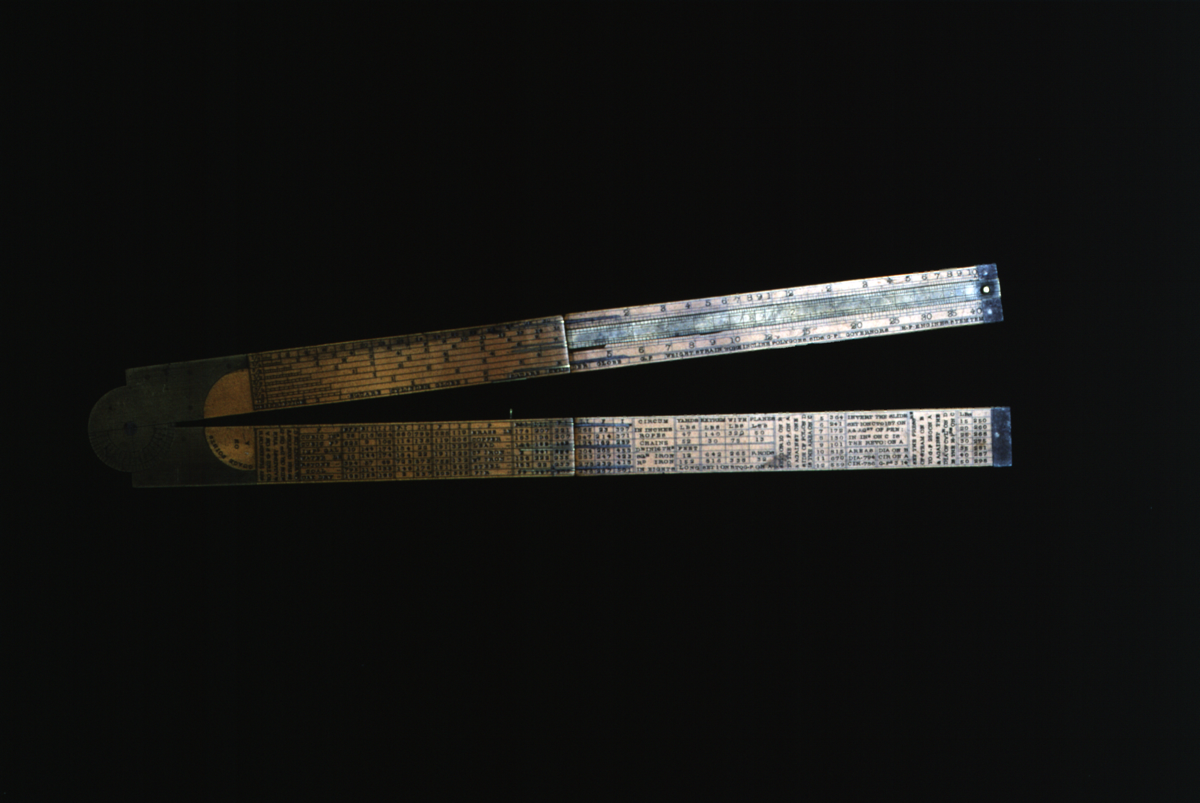
Boxwood folding rule with brass shoulders and sector-type hinge. Steel bound ends. Secondary hinge in brass.
Obverse, upper limb, hinge end:
Scales of part inches for 1/8, 1/4, 3/8, 1/2, 5/8, 3/4, 7/8 and ‘in’
Non-hinge end:
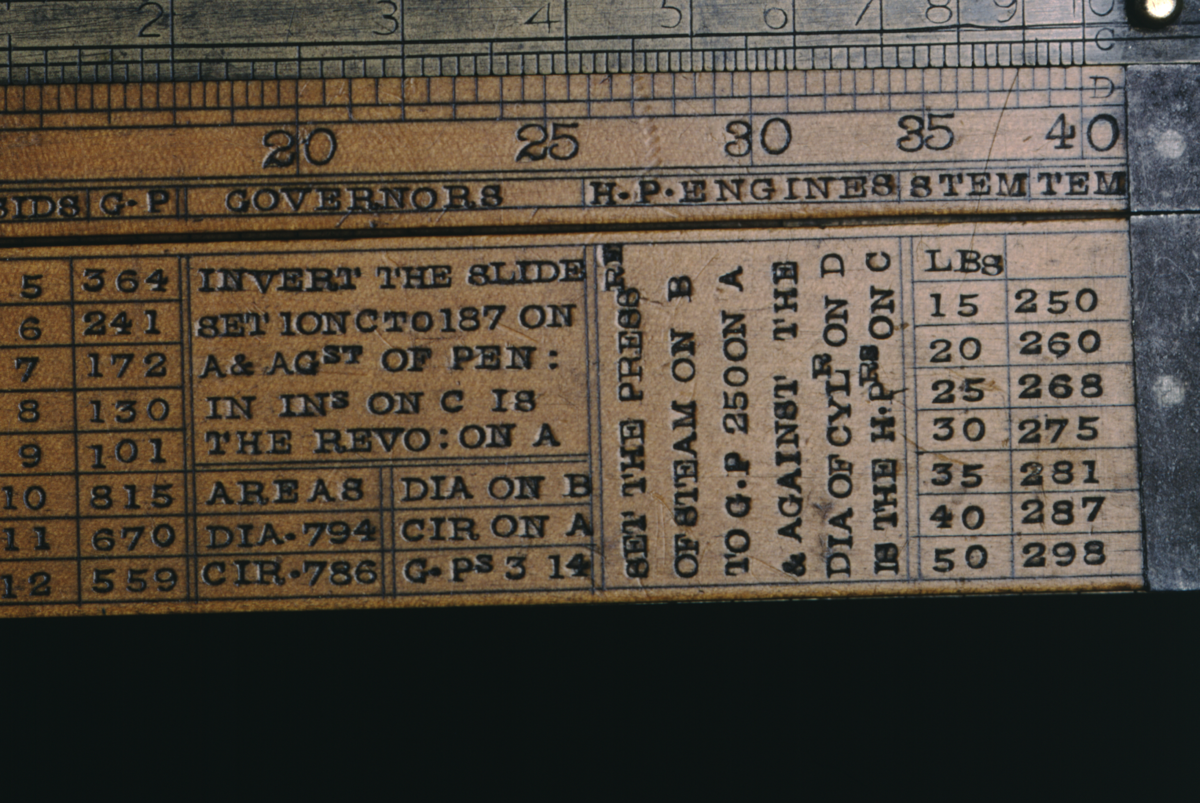
slide rule with brass slide. Three identical scales marked ‘A’ (stock), ‘B’ and ‘C’ (slide) divided [1] - 10[0] numbered 2, 3 ... 1[0], 12, 3[0] ...10[0]; 1 - 2 subdivided to 0.05, 2 - 6 subdivided to 0.1, 6 - 10 subdivided to 0.2, 10 - 20 subdivided to 0.5, 20 - 60 subdivided to 0.1, 60 - 100 subdivided to 0.2. 4th scale marked ‘D’ (on stock) divided [4] - 40 numbered 5, 6 .. 10, 12, 15, 20 .. 40; 4 - 10 subdivided to 0.1, 10 - 20 subdivided to 0.2, 20 - 40 subdivided to 0.5. Back of slide carries inch scale divided [0] - [6] numbered by 1 subdivided to 1/16
Line along whole length of limb forms top section of table occupying lower limb for calculating volumes and densities, measures of work, areas of polygons, steam pressures etc. This table is for use with the slide rule.
Obverse of hinge carries degree scale divided [0] - [180] numbered by 10˚ subdivided to 5˚.
Reverse:
On edge of fully extended limbs scale of inches divided [0] - [24] numbered by 1 (except 6, 12 and 18) subdivided to 1/8
Table for calculating stresses and strains and specific gravities. Also conversion table of linear square and cubic measures.
On outer side of fully extended limbs a scale of decimal feet divided [0] - [200] numbered by 10 (except 50, 100, 150) subdivided to 1.
Brass pins for holding limbs together.
Condition good; complete
References
Events
Description
Developed during the seventeenth century, the modern slide rule is based upon the design by William Oughtred (circa 1630). It is one of many calculation devices that is based on the logarithmic scale, a calculation method invented in 1614 by John Napier.
Before the rise of the pocket electronic calculator in the 1970s, the slide rule was the most common tool for calculation used in science and engineering. It was used for multiplication and division, and in some cases also for ‘scientific’ functions like trigonometry, roots and logs, but not usually for addition and subtraction.
A logarithm transforms the operations of multiplication and division to addition and subtraction according to the rules log(xy) = log(x) + log(y) and log(x/y) = log(x) - log(y). The slide rule places movable logarithmic scales side by side so that the logarithms of two numbers can be easily added or subtracted from one another. This much simplifies the alternative process of looking up logs in a table, thus greatly simplifying otherwise challenging multiplications and divisions. To multiply, for example, you place the start of the second scale at the log of the first number you are multiplying, then find the log of the second number you are multiplying on the second scale, and see what number it is next to on the first scale.
FM:39565
Images (Click to view full size):