Accession No
2123
Brief Description
reflecting circle, Troughton.E, 1805 (c)
Origin
London; England
Maker
Troughton.Edward
Class
navigation
Earliest Date
1805
Latest Date
1805
Inscription Date
Material
metal (brass, silver); glass; wood
Dimensions
box 1 length 345mm; breadth 240mm; height 142mm box 2 length 355mm; breadth 345mm; height 147mm; reflecting circle height 530mm; diameter of circle 317mm
Special Collection
Provenance
Transferred from Institute of Astronomy, University of Cambridge, Cambridge, England.
Inscription
‘Troughton London’
‘163’
‘CAMB OBS Refl:Circ:’ (on limb)
‘Camb Obs. Refl Circ’ (on telescope)
‘Camb. Obs. Refl. Circ’ (on pillar)
‘Camb: Obs: Refl: Circ.’ (on foot)
Description Notes
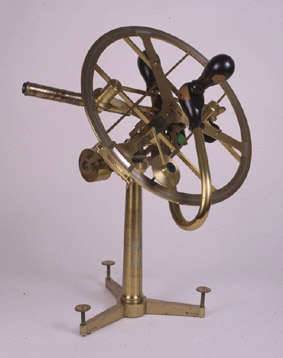
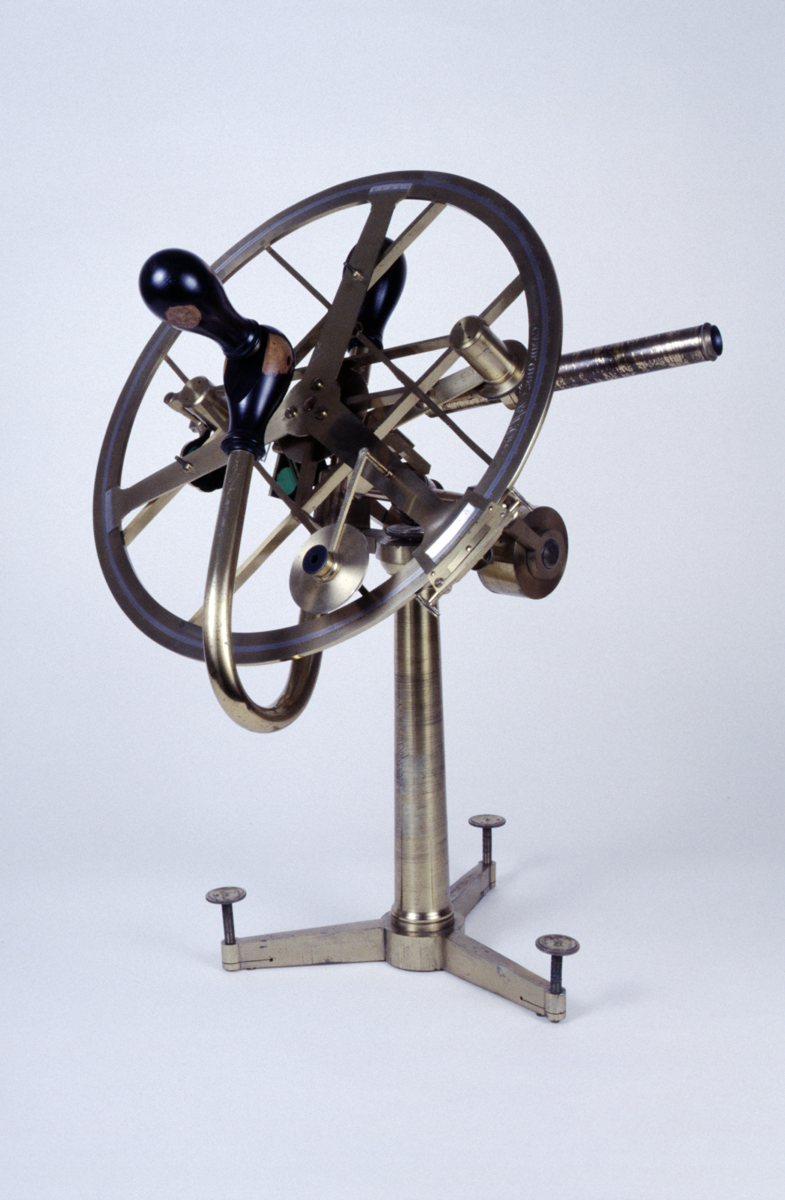
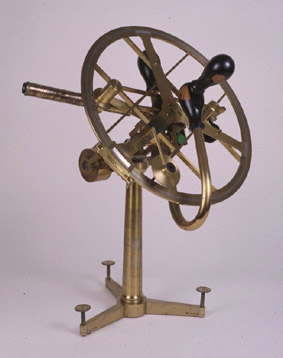
Brass reflecting circle, lattice type frame. Index mirror. Telescope sights. Horizon glass. Two sets of 3 shades. Three index arms, each with mount for reading microscope and type-B vernier on silver, one with clamp and tangent screws. Reading microscope. Silver scale, 720˚ divided by degrees, subdivided to 20’, and part numbered 160-0-160. Wooden handles. Brass pillar stand, with counter-weights, three radial feet with levelling screws. Instrument may be mounted on stand from either side. (Found later:) 2 fitted wooden boxes, 2 additional eyepieces, 1 telescope, 1 dark tube, 1 brass piece.
Condition: good.
References
Events
Description
As made by Edward Troughton from 1796, the reflecting circle is a modification of the repeating circle developed earlier in France. The optical arrangement is similar to that of the sextant, where the image seen directly through the telescope is brought to coincide with the same image seen by reflection in the mirror fixed to the index arm then in the half-silvered horizon mirror. The index is then clamped and the bearing read off to great precision, with the aid of the vernier and the small microscope.
Presented to the Whipple Museum by the Institute of Astronomy, University of Cambridge.
04/08/2008
Created by: Dr Anita McConnell on 04/08/2008
FM:39662
Images (Click to view full size):