Accession No
1289
Brief Description
sextant, by Troughton, English, 1790 (c)
Origin
England; London
Maker
Troughton
Class
navigation
Earliest Date
1790
Latest Date
1790
Inscription Date
Material
metal (brass, silver); glass; wood (mahogany)
Dimensions
box length 320mm; breadth 390mm; height 130mm
Special Collection
Provenance
Originally owned by the Cavendish Laboratory. It is recorded in the Cavendish Laboratory's 1894 alphabetical catalogue of apparatus on p.179; it was stored in the Laboratory in Room XV.
Inscription
‘Troughton LONDON’
‘260’
Description Notes
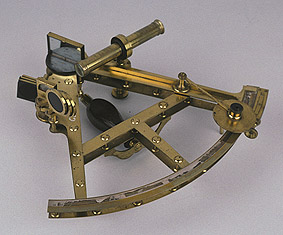
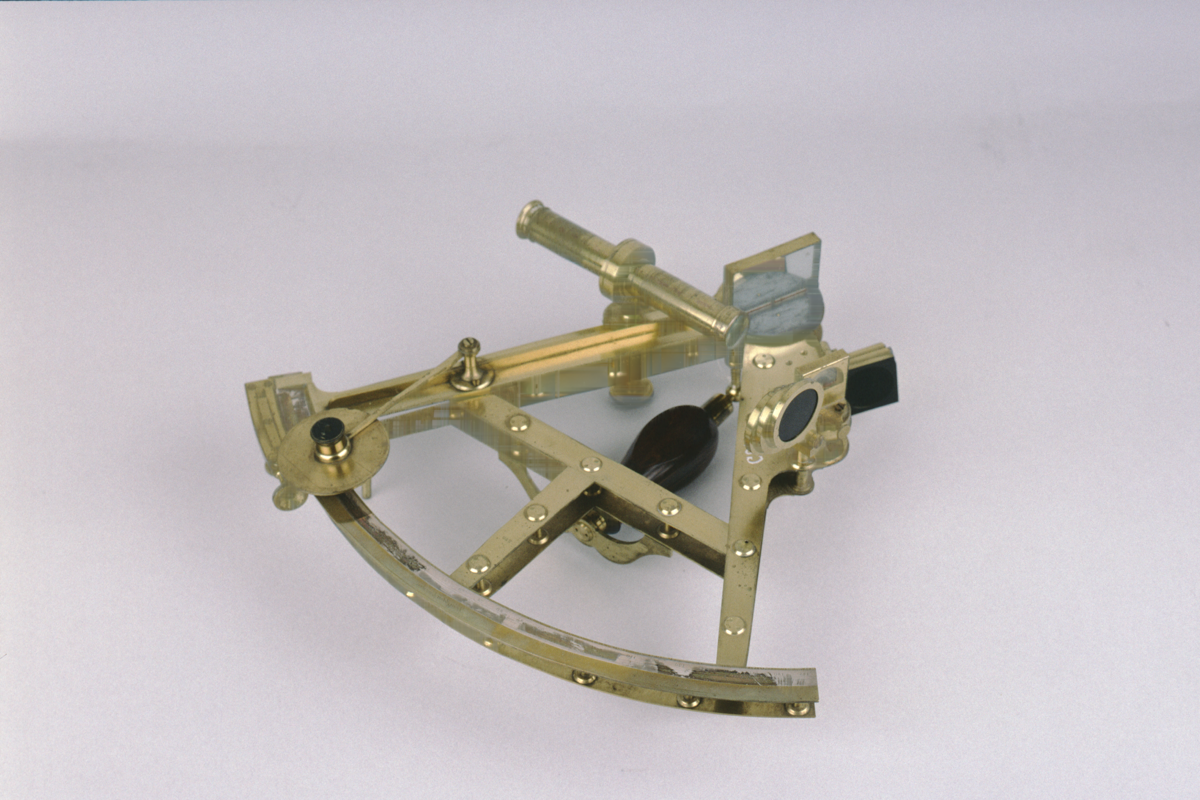
Sextant, by Troughton, English, 1790 (c).
Brass, pillar frame sextant. Index mirror, with three shades. Horizon glass, with three shades. Telescope sights, screwed on, with lateral adjustment by knurled screw. Reinforced brass index arm, with attached reading glass on arm, silvered type-B vernier scale, clamp and tangent screw. Silvered scale divided 0-145 by 1˚, subdivided to 10’. Wooden handle fixed in brass mount. Wooden keystone box.
Condition: fair (plating worn).
References
Events
Description
Today, navigation instruments such as radar, radio and satellites update a ship’s position continuously. During the 17th and 18th centuries, manual calculations had to be made using instruments such as the backstaff, octant or sextant.
The term “sextant” refers to an arc of 60°. The sextant is a portable instrument that measures angles between distant objects. It is an instrument that has been used in the fields of astronomy, surveying and navigation. When navigating, the sextant is used to measure latitude to an accuracy of 0.01 of a degree. To use the sextant the navigator moves the index arm until the index mirror appears to line up the sun within the horizon mirror. By reading the angle off the index arm, the angle of the sun (and therefore the ship's latitude) can be calculated.
Much thought was put into the design for the sextant in an attempt to make them as accurate as possible. The first examples of sextants were made of brass and were mostly large and heavy. Over time the frame was designed to be rigid and light. A successful and popular design in the 18th Century was the “double-frame” or “pillar frame” sextant which was patented by Troughton in 1788. An example of this sextant can be seen in the navigation case.
The Search for Longitude
The sextant was also used in an attempt to determine longitude as well as latitude. In the 1750s, Tobias Mayer’s design of a reflecting circle was given to the British Board of Longitude who gave the instrument to Captain John Campbell to test fully at sea. Campbell liked the idea but found the circle too awkward to use. John Bird was ordered by Campbell to design a 60° arc (the sextant), which he thought to be adequate for the longitude measurements required. (To discover more about the search for longitude have a look at some of the books).
FM:39671
Images (Click to view full size):