Accession No
2580
Brief Description
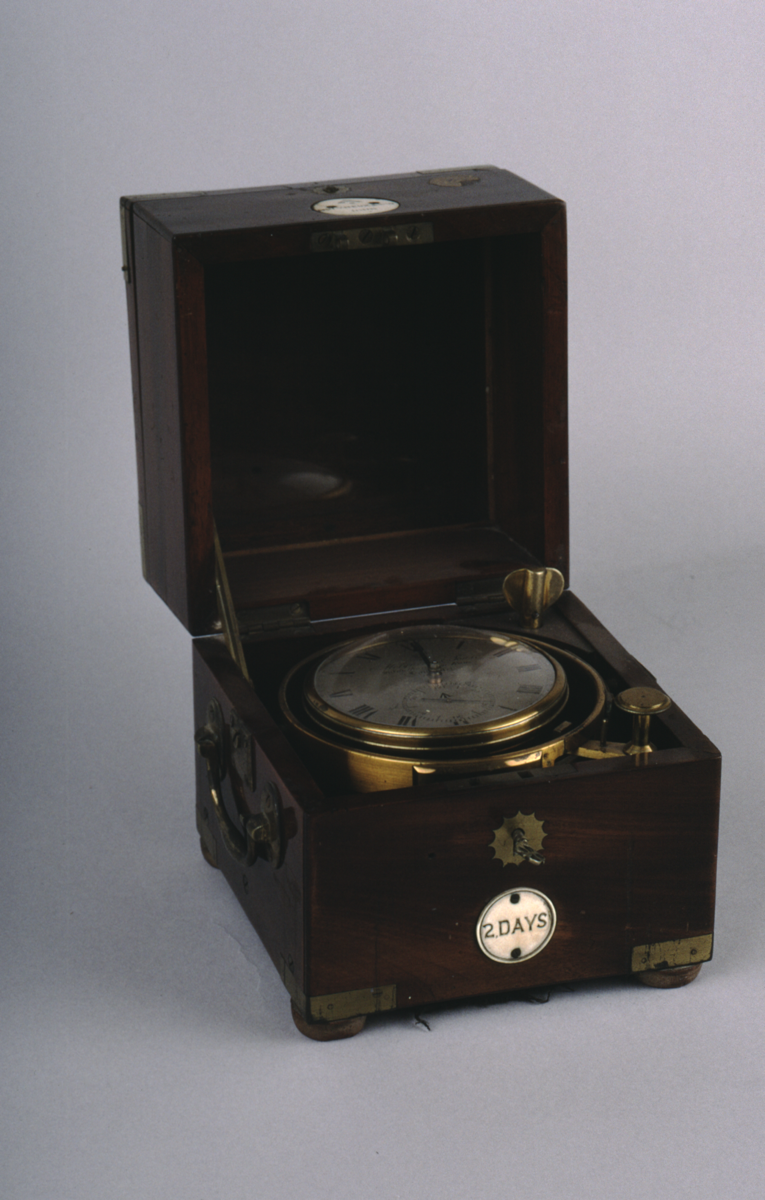
chronometer, in gimbal and fitted box, by Molyneux and Sons, English, 1835 (c)
Origin
England; London; 30 Southampton Row
Maker
Molyneux and Sons
Class
navigation; horology
Earliest Date
1833
Latest Date
1840
Inscription Date
Material
metal (brass, steel, silver); glass; wood (mahogany); ivory
Dimensions
diameter of bezel 100mm; box 159 x 160 x 171mm
Special Collection
Provenance
Transferred from Institute of Astronomy, University of Cambridge, Cambridge, England, 06/1980.
Inscription
‘Molyneux & Sons 30, Southampton Row,
London 1606’ (on dial)
‘MOLYNEUX & SON 1606’ (on ivory plate)
‘2 DAYS’ (on ivory plate)
Description Notes
Chronometer, in gimbal and fitted box, by Molyneux & Sons, English, c. 1835.
2-day marine chronometer. Movement with spotted plates, fusee, Earnshaw spring-detent escapement, compensation balance oversprung with steel (palladium?) balance spring with terminal curves. Slung in gimbals in brass mahogany box with two circular ivory plates. Brass handles, 4 feet. Silvered dial with Roman numerals, subsidiary seconds. Brass winding key. Dome shaped bezel. Observation window with hinged lid. Brass locking key.
Condition: good.
References
Events
Description
Chronometers are very accurate clocks which were taken on board ship as a means to find longitude. A ‘Two Day’ chronometer is one that must be wound every two days.
The chronometer is set to show time at the port of departure, and during the voyage is compared with the ship’s local time as given by the sun. The earth rotates around its axis – 360° in longitude – every 24 hours, or 15° every hour. Thus a difference of four minutes between the time shown by the chronometer and local time by the sun is equal to a change of 1° of longitude.
04/08/2008
Created by: Dr Anita McConnell on 04/08/2008
FM:39680
Images (Click to view full size):