Accession No
2199
Brief Description
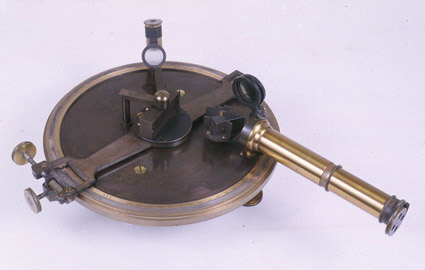
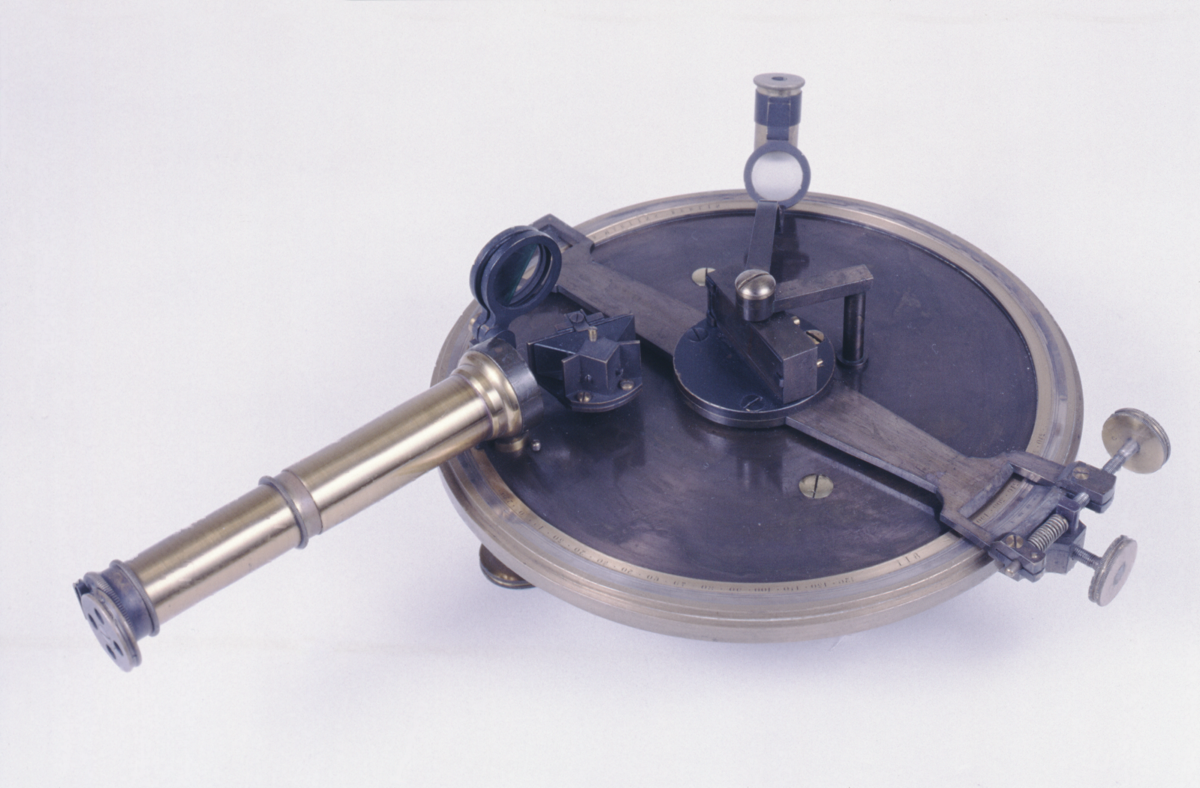
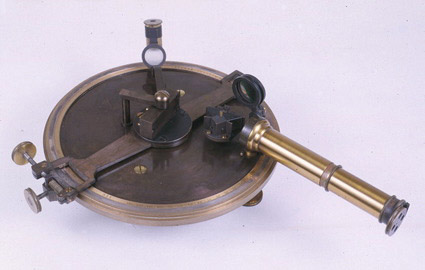
reflecting circle (prismatic), by Pistor and Martins, German, 1880 (c)
Origin
Germany; Berlin
Maker
Pistor and Martins
Class
navigation
Earliest Date
1880
Latest Date
1880
Inscription Date
Material
metal (brass, oxidised brass, silver); glass; wood (ebony)
Dimensions
radius 84mm
Special Collection
Provenance
Transferred from Department of Geography, University of Cambridge, Cambridge, England, 05/1969.
Inscription
‘PISTOR & MARTINS BERLIN’
‘811’
Description Notes
Brass reflecting circle, solid oxidised brass frame. Index mirror. Prism in oxidised brass mount. Telescope sight with lateral adjustment by knurled screw and eyepiece shades. Two 1/2 shades in circular mounts. Index arm with 2 type-B verniers on silver, one end with clamp and tangent screws. Reading glass and reading microscope on single arm, pivoted centrally. Silver 720˚ scale divided by degrees, subdivided to 20’, and part numbered 350, 240-180, 130-0.
Ebony handle.
Condition: good.
References
Events
Description
This circle was used out of doors by surveyors and map-makers to measure the horizontal angle between a reference point and a prominent feature such as a tower, hilltop, or other signal.
The plate carries a graduated scale cut on the inlaid circle, and a rotating index arm with a fixed mirror, verniers at each end and a single clamp. In front of the telescope is a prism, half its height. When the mirror is parallel to the long side of the prism, two images of the same object coincide, one seen directly through the upper part of the telescope, the other reflected by the mirror and prism. The index arm is clamped, and the bearing taken as the mean of the reading on the two verniers.
The index arm is then turned until an object on the right can be reflected into coincidence with the direct view. Again clamping the index, the angular distance between the first and second objects is given by the bearing.
This process can be continued round the horizon, except where the observer’s head gets in the way. When the index is on 0°, the reflected rays are at their most feeble; when the index is at 130° they are at their brightest.
04/08/2008
Created by: Dr Anita McConnell on 04/08/2008
FM:39681
Images (Click to view full size):