Accession No
0192
Brief Description
string gnomon dial, Chinese, 1800 (c)
Origin
China
Maker
Class
dials
Earliest Date
1800
Latest Date
1800
Inscription Date
Material
metal (gilt brass); glass (clear and paste); ceramic (enamel)
Dimensions
Special Collection
Robert Whipple collection
Provenance
Purchased by Robert Stewart Whipple from R. Middegaels, Paris, France, on 10/01/1925.
Inscription
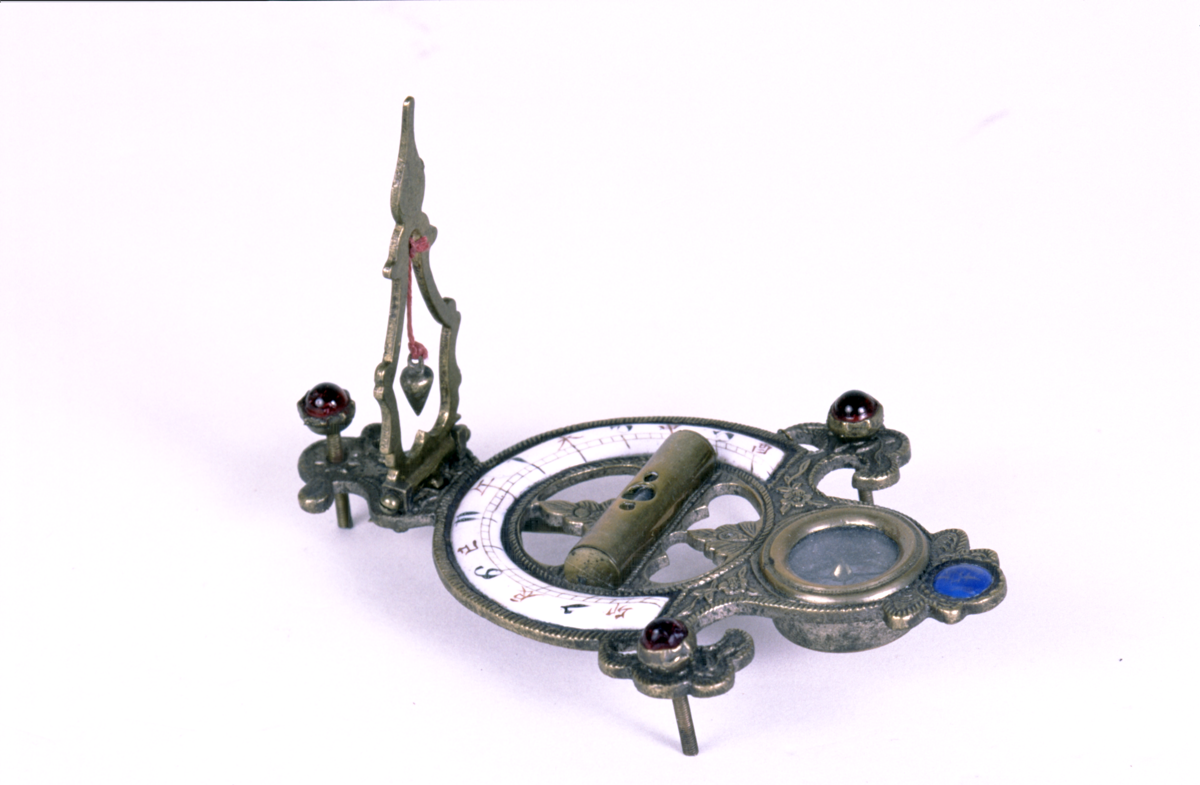
The paste 'jewel' next to South on the compass plate is labelled 'South' in Chinese (南).
Description Notes
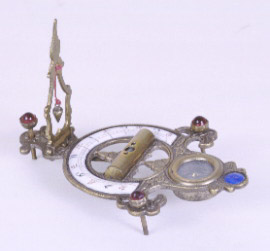
Gilt brass and enamel; decorative pierced base standing on 3 rod feet. Inset compass with enamel rose and 4 cardinal points marked. 4 ‘jewels’ (paste). Central bubble level. The dial plate has a shaped enamel hour ring labelled with alternating Chinese hours (in red) and Roman numerals (in black). Hinged gallows with brass plumb bob. String missing.
good condition
References
Events
Description
Britain holds at least forty sundials made in China during the eighteenth and nineteenth centuries, most of which are direction dials. Unlike horizontal dials that measure the Sun’s altitude above the horizon, direction dials measure the Sun’s azimuth along the celestial equator to determine time. This factor explains why many of these dials incorporate magnetic compasses, which help users align the sundial along the celestial meridian. Among the surviving Chinese sundials in Britain, more than half are diptych dials, followed by inclining, horizontal, and equinoctial dials.
Sundials have been a part of China’s horological tradition for centuries. The earliest surviving Chinese mathematical texts detail the use of calendrical gnomons, which helped imperial astronomers determine solstices and equinoxes. Over time, Chinese timekeeping was influenced by other cultures, particularly during the Song and Yuan dynasties (10th–14th centuries CE), when Islamic astronomers introduced new instruments, and an Islamic calendar was issued alongside the Chinese one every year by the Imperial Astronomical Bureau. The Jesuits further impacted Chinese timekeeping in the seventeenth century, bringing diptych sundials from places like Nuremberg as gifts for the emperor and the scholar-literati.
The portable Chinese sundials in British collections can be classified by their materials, which also indicate their different places of origin. Diptych and inclining dials made from boxwood with Chinese inscriptions were produced in Xin-An, a mountainous region in modern-day Anhui Province. These dials, though reminiscent of the popular diptych dials made in Nuremberg, are adjusted according to jieqi (one of the twenty-four solar terms in the Chinese lunisolar calendar) rather than latitude. Meanwhile, diptych dials made from ivory, and horizontal and equinoctial dials in brass, were crafted in the maritime trading regions of Quanzhou in Fujian and Canton (Guangdong). These regions also produced ‘hybrid’ sundials, with a more explicit aim to appeal to both Western and Chinese tastes. The same sundial might be admired as an exotic object in Beijing for its brass and gemstone decoration, and in Britain for its use of Chinese numerals and craftsmanship.
25/09/2024
Created by: Zhiyu Chen on 25/09/2024
FM:39732
Images (Click to view full size):