Accession No
1850
Brief Description
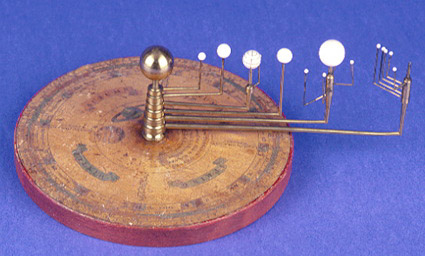
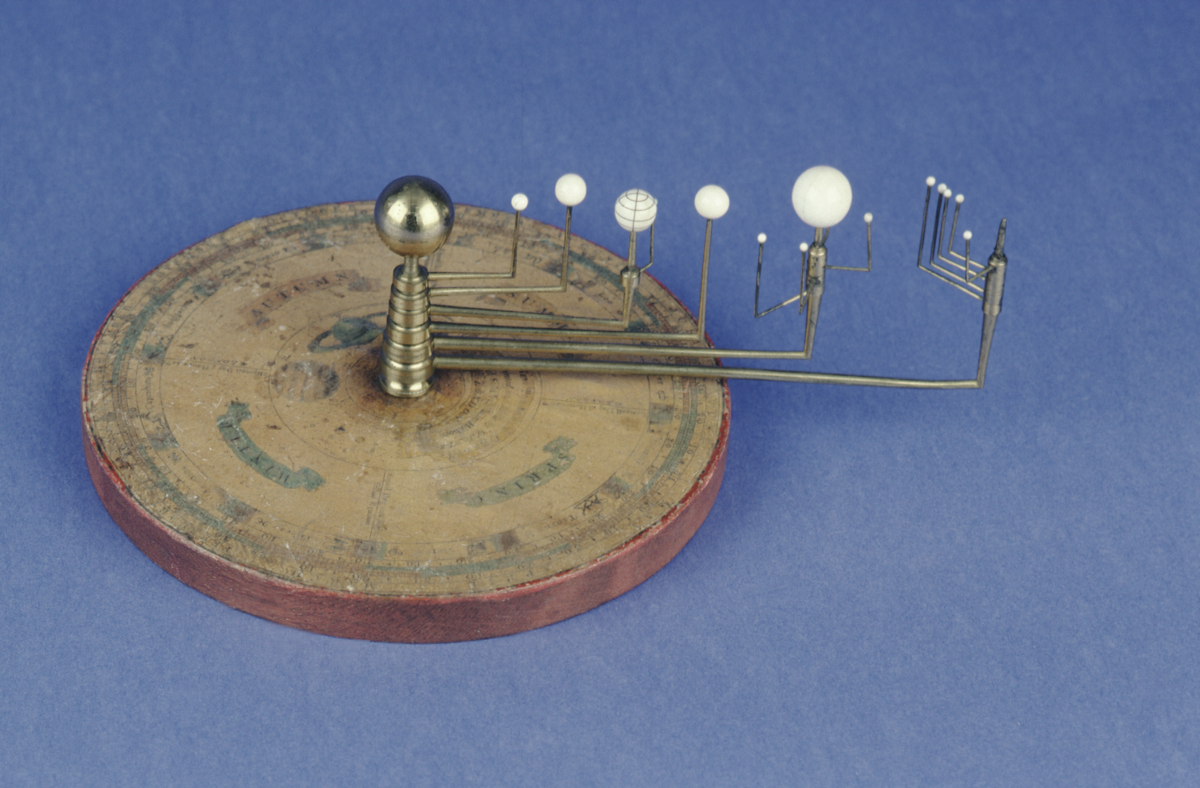
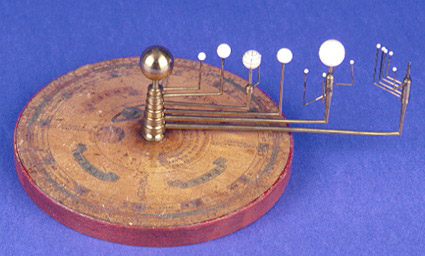
'New Portable Orrery' portable orrery and lunarium, by William Jones, English, 1781
Origin
England; London
Maker
Jones, William
Class
astronomy; demonstration
Earliest Date
1781
Latest Date
1781
Inscription Date
Material
wood (mahogany and one other); paper; metal (brass, white metal); ivory
Dimensions
diameter 193mm; length of Saturn’s arm 180mm; height 100mm lunarium length 221mm; breadth 68mm; height 94mm box length 215mm; breadth 217mm; height 108mm 2nd box length 196mm; breadth 98mm; height 34mm
Special Collection
Heywood Collection
Provenance
Purchased from the Professor Harold Heywood collection under estate duty exemption benefit with the assistance of a Science Museum PRISM grant-in-aid.
Inscription
‘A New Portable Orrery
Invented and Made by W. JONES
and sold by him in Holborn,
London’ (base board)
‘Georgium Sidus’ (base board)
Description Notes
Wooden base; printed and hand coloured paper dial graduated with calendar to 1 day and with zodiac band divided to sign, graduated to 1˚. Divided into quarters with the seasons named and details of the solstices and equinoxes marked; central illustrations of the planets including Uranus. Planetarium screws into central aperture in board. Brass sun with ivory planets to Saturn with 5 satellites (Jupiter with 4 satellites, Earth with one). Each on separate shaft and ring fitting round axis. Operated manually.
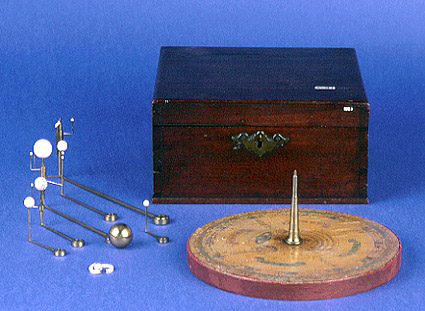
Separate clockwork lunarium screws into same aperture with own brass sun. Ivory earth and moon. Brass pointer. Brass cogs and fitting brass ring for the Moon. Paper discs illustrating signs of the zodiac (detached from brass) and phases of the Moon.
Fitted wooden box (with brass hinges and lock) for planetarium and second for base and lunarium. Oil lamp fits to lunarium (? original)
Complete
References
Events
Description
First made in about 1713, orrerys modelled the motions of the earth, moon and sun and sometimes other planets and satellites too. They illustrate the sun centred Copernican cosmology.
This helio-centric orrery has a clockwork mechanism to move the moon around the Earth and the Earth in relation to the sun, simultaneously demonstrating and explaining lunar phases. A piece of a ‘New Portable Orrery’, it was invented by William Jones, who praised it for its explanatory power through demonstration. This combined with its relative cheapness made it a perfect instrument for improving public education, as pupils would “acquire more knowledge of the most useful and interesting part of Astronomy in one day, than by the study of Books in a considerable time”.
18/10/2002
Created by: Saffron Clackson on 18/10/2002
FM:39741
Images (Click to view full size):