Accession No
0799
Brief Description
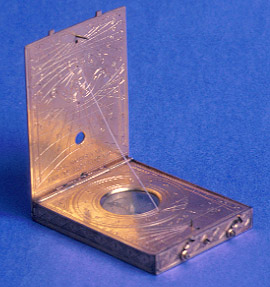
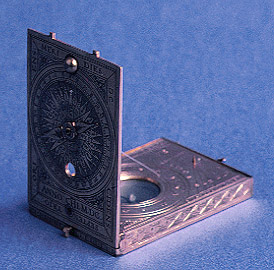
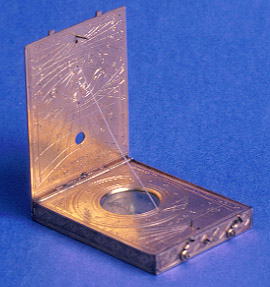
diptych dial, gilt brass, German, 1600
Origin
Germany
Maker
Class
dials
Earliest Date
1600
Latest Date
1600
Inscription Date
1600
Material
metal (gilt-brass, steel); glass; rope (string)
Dimensions
length 84mm; width 62mm; depth 12mm; height when open 89mm
Special Collection
Robert Whipple collection
Provenance
Purchased by Robert Stewart Whipple at Antique Art Galleries, London, England, on 25/03/1936.
Inscription
‘SOL NOBIS VARIA FERTQ3 REFERTQ3 VICES’
Description Notes
Diptych dial, gilt brass, German, 1600, highly decorated.
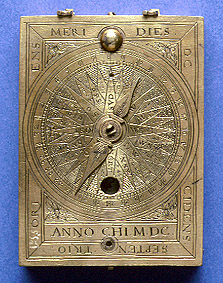
Leaf Ia: 32-point wind rose with 16 points named and numbered (see file); each point subdivided to 1/4. Cardinal points named around the rose in Latin. Date: ‘ANNO CHI. M.D.C.’. Index arm. Pierced to show N point of compass.
Leaf Ib: dial for hours of day and night, marked ‘QUANTITAS DIERVM QUAN NOCTIUM’, divided 8 - 16 and 16 - 8, numbered by 1. Also dial for Italian and Babylonian hours marked 13 - 24 and 1 - 11, numbered by 1. Below this a vertical dial numbered 7 - 12, 1 - 5 by 1; also 8 - 12, 1 - 4 by 1 on the associated parallels of declination; and I - XII by I.
Leaf IIa: Horizontal dial ‘AD LATITUD: GR: 50’ divided 4 - 12, 1 - 8, numbered by 1, subdivided to 15 minutes. Inset silver compass with cardinal points marked; offset 10˚E of N for magnetic variation. String gnomon (replacement). Dial for Italian hours divided 10 - 23, numbered by 1; pin gnomon.
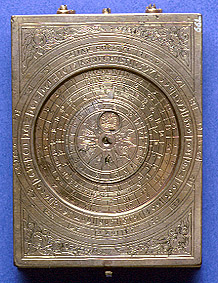
Leaf IIb: table of epacts for ‘ANNI CHRISTI’ 1597-1634. Marked ‘EPACTA IULIA’ and ‘EPACTA GRECO’. Lunar volvelle with brass disc pierced to show lunar phases.
fair condition
string replaced with nylon fishing thread
missing plumbob
[NOTE: On 15/04/2015 XRF analysis was conducted on this instrument. Results and analysis are given in the ‘Notes’ field.]
References
Events
Description
R.S. Whipple spent his life working with scientific instruments. After starting his career at Kew Observatory and then the instrument maker L.P. Casella, Whipple moved in 1898 to join the Cambridge Scientific Instrument Company. Here, he rose through the ranks to become its Managing Director and Chairman. Along the way he began acquiring historic instruments and books as a hobby.
This diptych dial is one of those instruments. It's a common form of portable sundial that can be adjusted to work at a range of latitudes. This fine example is made in gilt brass.
07/10/2025
Created by: Hannah Price on 07/10/2025
Description
The Diptych dial is a common form of portable multi-function sundial. Diptych dials were made popular by the instrument makers in Nuremberg during the sixteenth and seventeenth centuries. They are usually made of ivory with brass fittings, and are often elaborately decorated. The name of the device derives from the Greek diptychos for a pair of folding writing tablets, which the instrument resembles.
Diptych dials consist of two leaves hinged together, with a string ‘gnomon’ stretched between the inner surfaces of the leaves for casting a shadow. To use the device as a sundial the lower leaf must be placed parallel to the horizon and the upper leaf must be at a right angle vertically to it. The gnomon must then be aligned with the meridian of the place where it is being used by using the inbuilt magnetic compass. Time can then be read from the horizontal or vertical dial by the location of the shadow cast by the string gnomon.
In addition to the horizontal and vertical dials, diptych dials normally carry a number of other features, such as equinoctial dials, windroses, tables of latitude for adjusting the string gnomon for different locations, epact tables, lunar volvelles for telling time at night by the moon, and various pin-gnomon dials for telling the time according to Babylonian or Italian hours, or for calculating the position of the Sun in the zodiac.
27/05/2009
Created by: Joshua Nall on 27/05/2009
FM:39771
Images (Click to view full size):