Accession No
1709
Brief Description
horizontal string-style dial, with reversed equinoctial hour-ring, by Augustin Ryther [attributed], English, circa 1585 - 1595
Origin
England
Maker
Ryther, Augustin [attributed]
Class
dials
Earliest Date
1585
Latest Date
1595
Inscription Date
Material
metal (gilt brass, steel); paper; rope (string); organic (wax)
Dimensions
Special Collection
Holden-White collection
Provenance
On loan from The Fitzwilliam Museum, University of Cambridge. Donated by Charles Holden-White to the Fitzwilliam Museum. Holden-White collection no. 1935-63.
Inscription
‘HC’ (inside of lid)
Description Notes
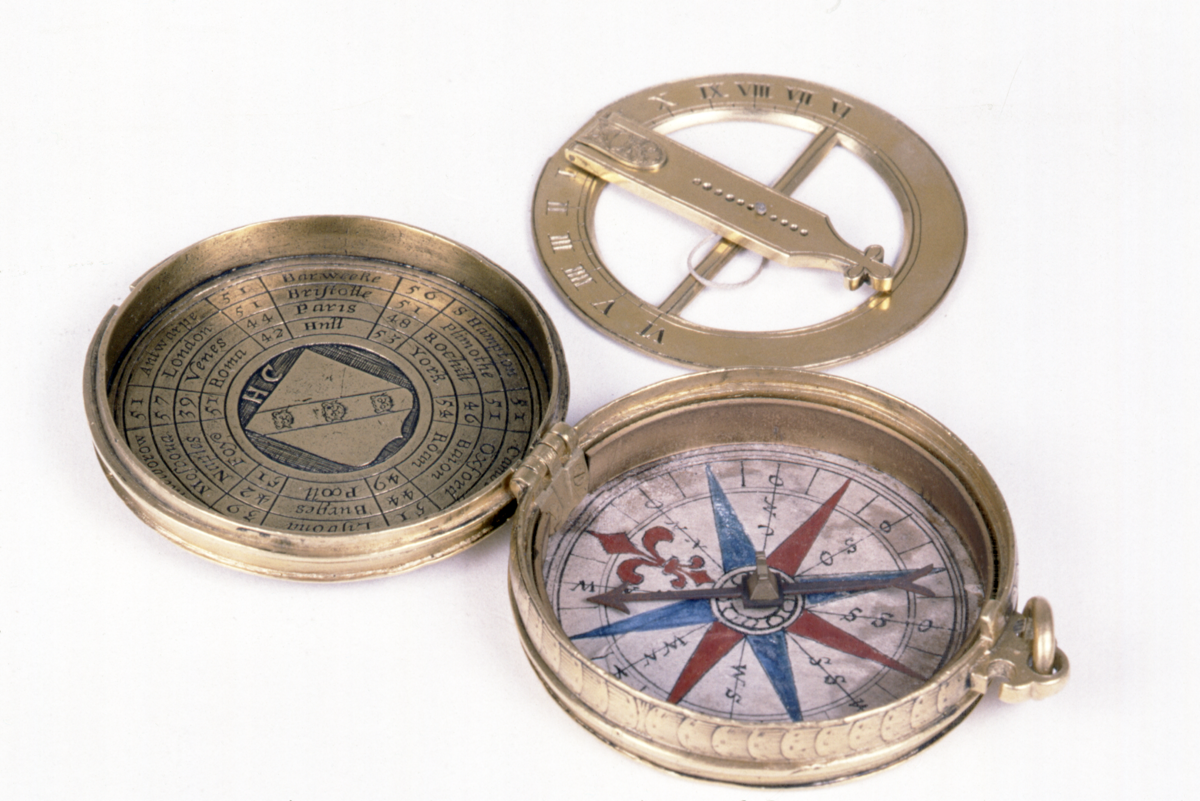
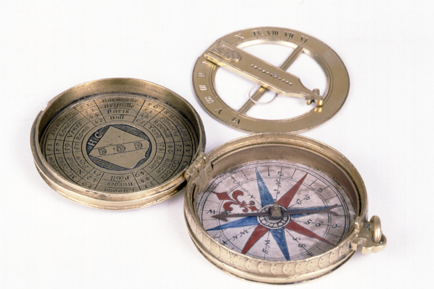
Horizontal string-style dial, with reversed equinoctial hour-ring, by Augustin Ryther [attributed], English, circa 1585 - 1595.
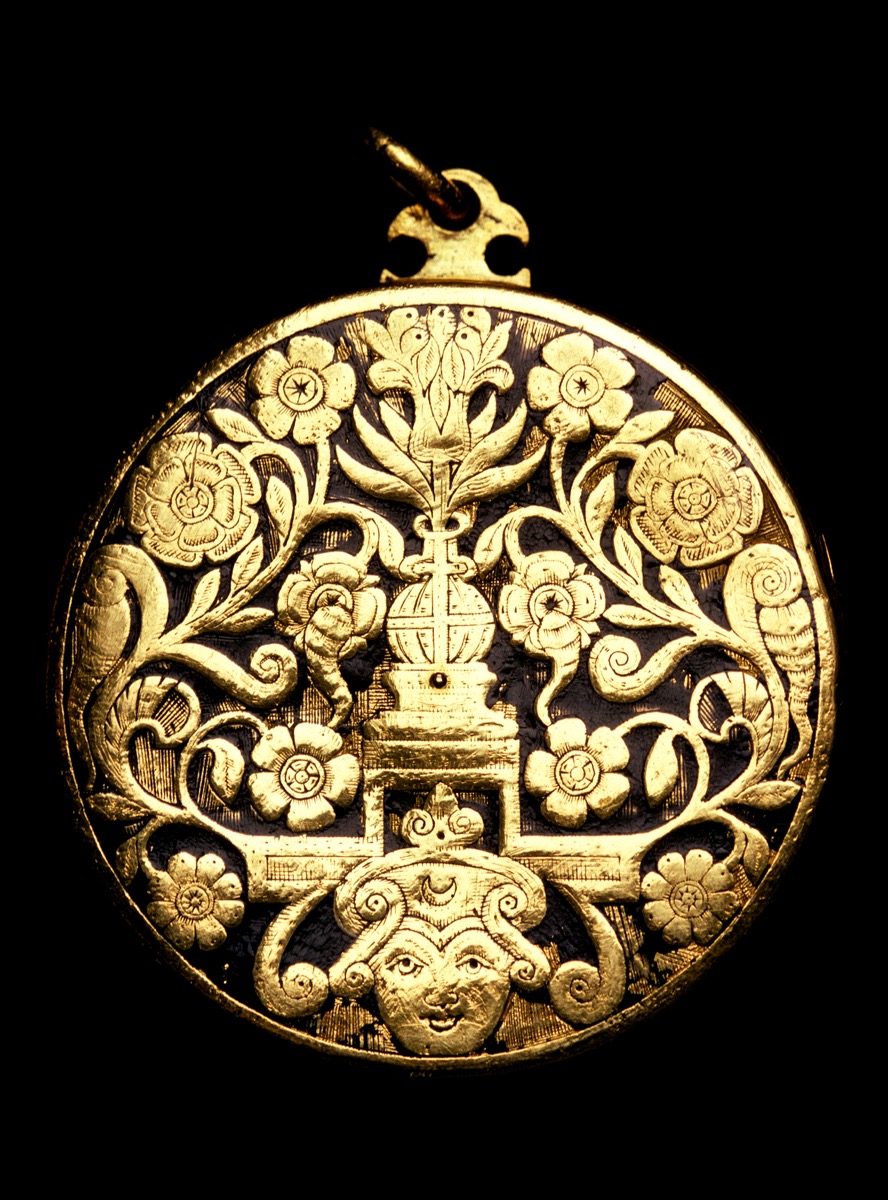
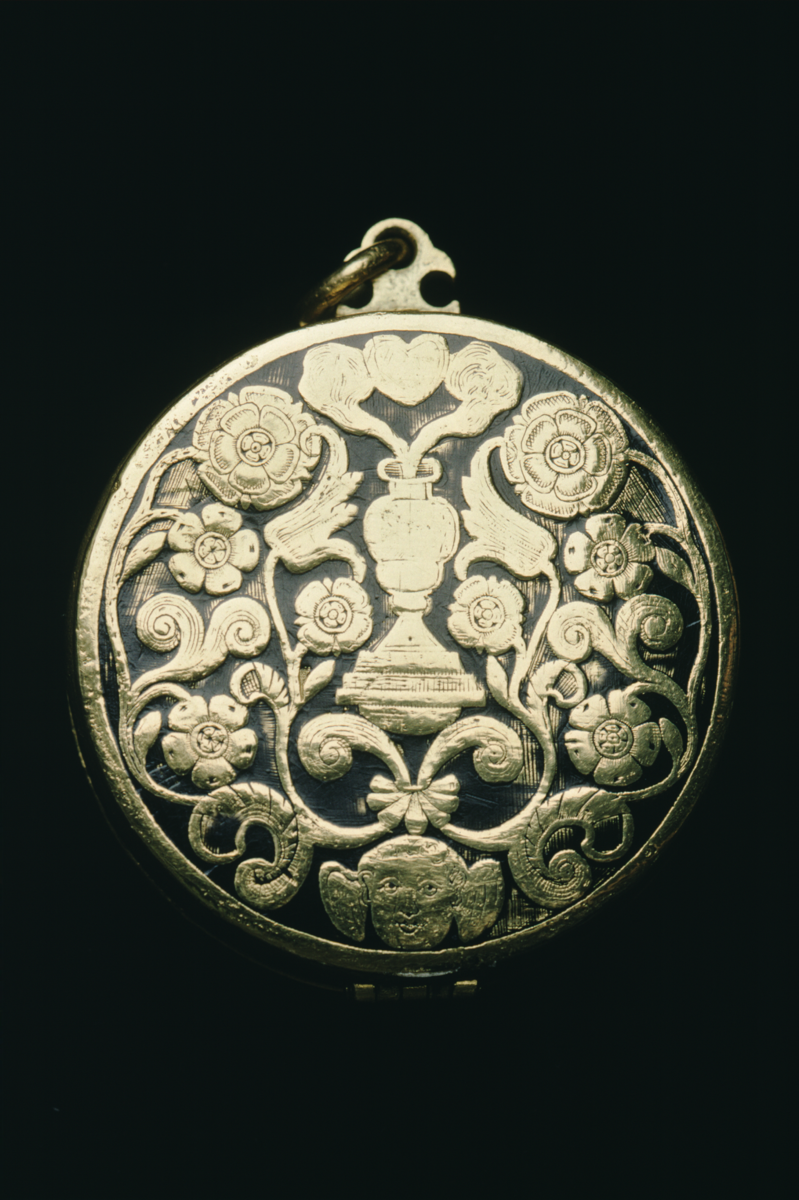
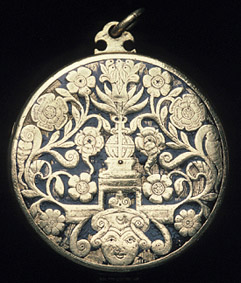
Circular gilt brass case with suspension ring. Both outer faces of case decorated with raised engraving on a black waxed background. Lid decorated with urn and clouds rising from it, over a winged cherubic head with intertwined Tudor rose; base decorated with urn with flowers over face with a crescent moon above and similar Tudor rose.
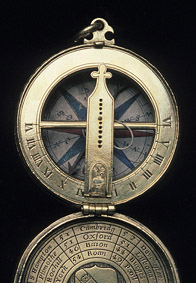
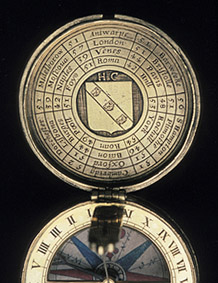
Inside the lid is a list of towns and latitudes in concentric circles; within this is the Coker family coat of arms and "HC", the initials of Henry Coker (c.1528 -1595). In the base is a compass with a hand-coloured paper compass card (German cardinal points NSOW). Above the compass the dial plate is divided (anticlockwise) VI - XII - VI, numbered by I, subdivided to 30 minutes (not the expected projection for a horizontal dial). Folding support for string gnomon, with series of attachment points divided [59˚] - 39˚, numbered by 2˚. Above the hinge of the gnomon support is a decoration of an urn with clouds.
condition: good, exterior engraving worn.
[NOTE: On 14/07/2015 XRF analysis was conducted on this instrument. Results and analysis are given in the ‘Notes’ field.]
References
Events
Description
This sundial was once owned by a Dorset gentleman named Henry Coker, whose initials and family crest can be seen engraved on the lid. Around this, a list of latitudes of towns and cities give an impression of how Coker saw himself: there are places near to his home, as well as more exotic locations like Moscow and Venice.
The elaborately decorated case combines personal and political symbolism: on one hand a heart floats above an urn, perhaps a reference to marriage; on the other a woman's face with a crescent moon likely represents Queen Elizabeth, in the guise of Diana, goddess of the moon, hunting and nature.
Analysis of the engraving shows that this sundial was probably made by Augustin Ryther, a map engraver who turned his hand to making mathematical instruments in the 1580s.
16/09/2025
Created by: Hannah Price on 16/09/2025
Description
This sundial is unusual due to its idiosyncratic construction: it carries the latitude table and adjustable string-gnomon of a horizontal sundial, but the hour-scale of an equinoctial dial. It also has a reverse number plate. A coat of arms engraved on it identified the original owner as Henry Coker (c.1528 -1595) of Mapowder, Dorsetshire. Coker was born circa 1528 and served as Member of Parliament for Shaftesbury. It is likely that this dial is a ‘composite’ instrument, in which its parts were appropriated from other sundial designs, in order to construct an instrument that’s primary purpose was as a showy prestige item of jewellery, rather than as a practical timekeeper.
08/07/2014
Created by: Allison Ksiazkiewicz on 08/07/2014
FM:39805
Images (Click to view full size):