Accession No
0364
Brief Description
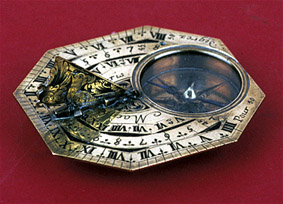
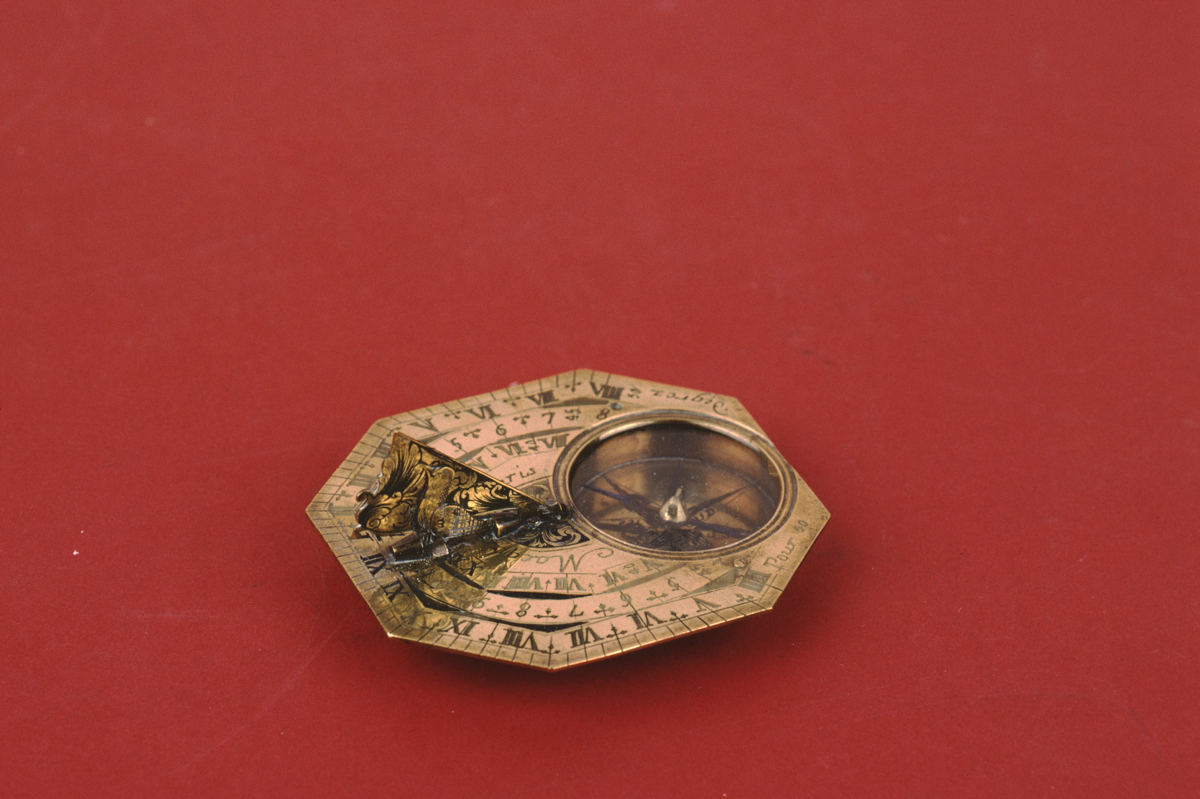
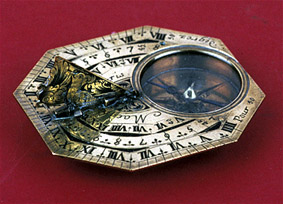
horizontal dial, Butterfield type, by Macquart, second quarter 18th century
Origin
Paris; France
Maker
Macquart
Class
dials; horology
Earliest Date
1725
Latest Date
1750
Inscription Date
Material
metal (brass); glass
Dimensions
breadth 58mm; compass diameter 28mm
Special Collection
Robert Whipple collection
Provenance
Inscription
‘Maquart AParis’ (base)
Description Notes
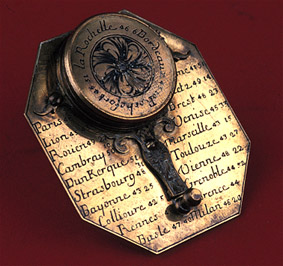
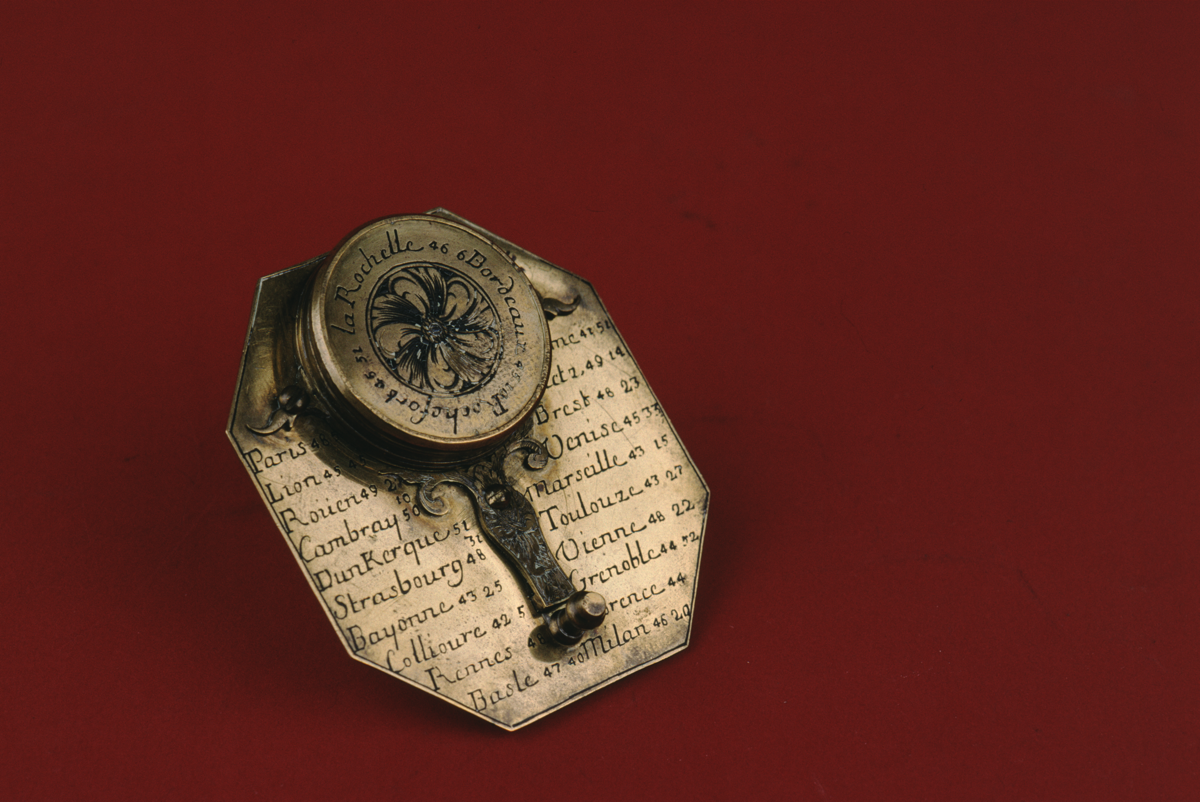
Brass; octagonal base decorated at the base of the gnomon and signed; 3 hour scales ‘Pour 50 degrez’ 45 & 40 deg. of latitude, calibrated IIII-XII-VIII, 4-12-8 and IIII-XII-VIII by 1 to 1/4, 1/2 and 1/2 hour. Inset compass with 8 point rose, 8 cardinal points, fleur de lys north, offset for magnetic variation 15 deg. W. decorated ‘bird’ gnomon 40-55 deg. by 5 to 1 deg. Verso of base a list of towns and latitudes (see file).
Condition: fair.
References
Events
Description
The Butterfield dial was named after the man who popularised this kind of sundial. His name was Michael Butterfield, and he was an instrument maker in Paris, though he originally came from England.
Butterfield dials are a type of horizontal dial, normally octagonal or oval in shape, and are quite small. They have several different hour scales marked out on them, each of which is used at a different latitude. However, the gnomon also needs to be adjusted for the latitude. Butterfield designed an elegant scale for the gnomon adjustment, in the form of a bird. The beak of the bird marked the place on the latitude scale of the gnomon, which was lifted up or down until it was at the correct latitude. A compass in the bottom of the dial was used to make sure that it was pointing in the right direction.
This kind of sundial was not very accurate, but they were made in very large numbers, so they were obviously very popular. Most of the existing ones came from France, where many different makers produced them.
FM:39822
Images (Click to view full size):